The white-throated sparrow has always been special to me


I could listen to the call of the white throated sparrow all day. A while ago one of these tiny songbirds was serenading me and it brought back childhood memories. Most were summer memories as these little guys migrate.

White-throated sparrows generally migrate at night. Usually they forage during the day and travel when the stars are out. Generally, the southward journey takes longer than the northward one.

Here in eastern North Carolina we only can enjoy them in winter. They usually arrive in eastern North Carolina around the first of October and hang around until about the first of May. Take a walk near the edge of woods on a sunny winter day and they will treat you to a song.

Back in eastern Maine they were more common in summer, but some stuck around all year. They sang their familiar “John P. Peabody Peabody Peabody.” Some folks said it sounded like “Pure Sweet Canada Canada Canada.” Either way they’re not bashful at singing their song and I often whistled back at them.

Sparrows generally stay close to the ground and this species is no exception. They nest in thick cover, usually at the edges of forest post-harvest regrowth.

Their diet varies from season to season. In summer they are largely insectivores, while they rely on seeds to carry them through the winter months. They also eat berries, often in that period between summer and winter.

Color can vary quite a lot, but generally these birds are striped with a combination of black, white, tan, brown and gray. Usually individual birds are white or tan striped but not both They also have a distinctive yellow color between the eye and beak. Additionally, as the name indicates they have a bright white throat.

Around here we can lure them to our feeders by providing millet and black oil sunflower seeds. They aren’t shy and will sometimes eat out of your hand. They also back away from aggressive birds like blue jays, evening grosbeaks, cardinals and nuthatches. More birds will find your feeder if they don’t have to travel a great distance from their cover.

White-throated Sparrows are considered to be monogamous. They usually rear one brood per year, but occasionally produce two. Generally females construct the nest on the edge of a thicket. White-throated sparrows conceal their nests well.

Females lay 4-5 greenish-white eggs, usually spotted with brown. Generally only females incubate the eggs, which hatch in a little less than two weeks. Hatchlings are totally helpless for their first several days. Both males and females care for the young chicks. In a few days they begin to venture out and fly. It’s a shame we can’t see that. They don’t breed here.

Nearly every outdoors person has a favorite songbird. Most like bright colored species like cardinals, warblers, fiches or blue jays. I prefer the sweet sounds of the somewhat camouflaged white-throated sparrow. When I hear that sound I almost feel like I’m standing in a brook throwing a fly.

This little sparrow sneaked inside during a harsh winter storm. It’s nasty outside.


Ted Manzer teaches agriculture at Northeastern High School (tmanzer@ecpps.k12.nc.us).

Posted in general nature | Tagged , , , , | 3 Comments

Loons are southern winter visitors few people notice


I like to spend a few weeks in the summer on Big Lake in down east Maine. At night intermingled with the ring of hungry mosquitoes, loons call to each other. I love that eerie sound.

Loons are migratory waterfowl that look somewhat like large ducks. They have pointed bills, bright red eyes and black and white plumage in exquisite speckled patterns. They’re beautiful birds and can be seen in modest numbers near the North Carolina coast in the winter. Winter feathers are not as bright and contrasting. They have more of a gray cast. Eyes turn gray in winter too.

The eerie call is only heard in their summer range. I’ve seen them but never heard them call around here. Young loons usually stay in their southern range for at least another year.

Often they may stay for two or three years, so we do have a few loons around here in summer. They don’t develop that characteristic contrasting plumage until they are mature which may take as much as six years.

Loons are truly unique. Most birds have hollow bones that make it easier for them to fly. Loons have solid bones like we do. This makes them excellent divers. They have been known to reach depths exceeding 200 feet. They also can hold their breath for several minutes.

Because of their solid bones they sometimes take a long time achieving flight. I’ve seen them run on top of the water for 200 yards or more before becoming airborne. Once in the air they are fast flyers. Loons have been clocked at over 80 mph.

Being heavy birds, they are unable to soar or glide. Consequently they must look for bodies of water and they can’t afford to land some place where there is not good water for takeoff. Wind can be critical too.

Feather preening is very important for loons. If only a few feathers are damaged, birds may have trouble staying aloft. Loons usually completely molt in winter, hence the different color. When they reach their summer home they will change colors again and become that characteristic black and white.

They are also spectacular fishermen. I always look for them when I’m bass fishing up in Maine. Where there are loons there will be fish.

Unfortunately, sometimes they will attack lures. I caught a loon several years ago and had quite a time freeing it while still managing to keep all but the hook of my lure. The poor guy beat the daylights out of me with his wings, but I managed to cut the hook as well as tangled line and free him. I thought for a minute that sharp pointed beak might get me, but he bolted as soon as the hook snapped.

Loons usually hatch two chicks and carry their young on their backs. Both parents play active roles raising the chicks. It’s fun to watch them teach their babies how to fish. Both parents make quite a team.

Eagle pairs make great hunting teams too. Two years ago I watched a pair of loons try to defend their family against a pair of bald eagles. Though the adults weren’t hurt, both loon babies were taken. It was sad to watch, but that’s how nature is sometimes.

Loon in Clark Cove stretching his wings

Same loon looking for fish

Ted Manzer teaches agriculture at Northeastern High School (tmanzer@ecpps.k12.nc.us).

Posted in general nature | Tagged , , , , , , , | Leave a comment

Turkey vultures are an important part of our ecosystem


Most people consider them nasty birds. Some call them disgusting buzzards. I love them and think they are one of the most remarkable birds in our world.

They’re large docile birds that clean up roadkill and other carrion littering our roadsides, forests and fields. They slow the spread of disease and generally make the environment smell better.

Turkey vultures (Cathartes aura) have the potential to be fierce predators like other raptors, but they aren’t. They use their formidable claws to tear apart dead animals instead.

Most birds have keen eyesight and these large black raptors are no exception. One thing they possess that most other birds don’t is a fabulous sense of smell. They can detect the odor of rotting flesh in minute concentrations, and they can do it while soaring at high altitudes.

I love to watch them glide. They can fly while barely flapping their wings at all. They merely adjust the angle to make the most of the available convection currents.

Sure, they aren’t much to look at, but beauty is in the eye of the beholder. They have a bald red head. This is actually helpful. Were their head covered with feathers it would collect far more disgusting rotting flesh when these birds dig food from body cavities.

They also have another unique adaptation. To keep cool they do something called urohydrosis. This means they pee on their legs. Since birds don’t sweat, evaporating liquid cools them off. Their urine also is antimicrobial, so it can kill bacteria they might have picked up during feeding.

People call them buzzards, but from a taxonomical point of view they really aren’t. Most birds we commonly called hawks are actually buzzards. The red tailed hawk is really a type of buzzard. I still call them hawks.

Turkey vultures sometimes suffer from pesticide damage. Poisoned animals occasionally become their food and this can be problematic. People sympathized with DDT’s effect on the bald eagle, but the turkey vulture faced the same problem. In general, they encounter fewer problems now than in previous years.

Both parents help with raising young. Males and females work together to build nests, incubate eggs and feed chicks. Nests are crude but both parents contribute.

Usually females only lay two eggs and these take at least 34 days to hatch. Therefore, reproduction is not prolific. Generally the young begin to fly at about two months of age.

Turkey vultures don’t have a distinctive call like most birds. They don’t possess a voice box suitable for making loud noises, so their sounds are limited to hisses and grunts.

Another related species is often seen among turkey vultures. It is the black vulture (Coragyps atratus) and these guys aren’t quite so docile. I’ve been around them and have never been threatened, but I have heard numerous reports of their attacking livestock. Some folks say they even attack people. I’ve never witnessed it.

Years ago, when I lived in West Virginia I did witness an unusual and unfortunate event involving a turkey vulture. It was during fall turkey season, when beards were not required for a legal kill. Back then turkeys had to be taken to a checking station.

To make a long story short, this inept hunter brought in a dead turkey vulture. My father-in-law, who truly had the gift of gab talked to the guy until the warden showed up. I just stood there and smiled. I have no regrets.

Tree full of vultures, mostly immature ones.


Ted Manzer teaches agriculture at Northeastern High School (tmanzer@ecpps.k12.nc.us).

Posted in general nature | Tagged , , , , , , , , , , | 2 Comments

Spanish moss is a natural fixture in southeastern landscapes


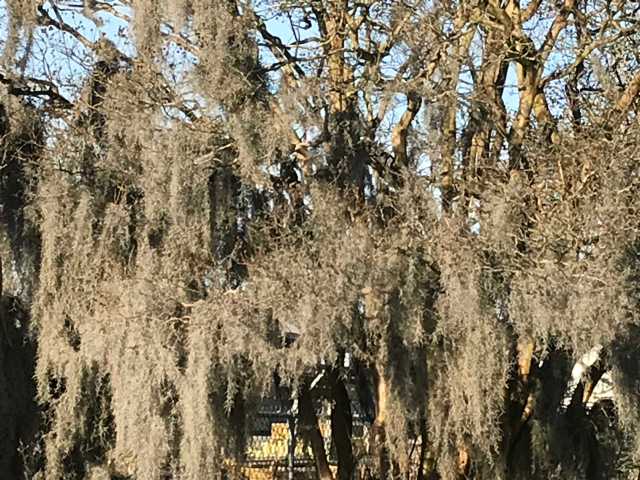
Now that leaves have fallen, Spanish moss has become more noticeable. Long strands of gray hang from trees like tinsel near our abundant swamplands.

Spanish moss (Tillandsia usneoides) isn’t a moss at all. It’s not even from Spain. It’s a member of the pineapple family, just like the colorful bromeliads and other air plants from the tropical rainforests. While this epiphyte may be kin to pineapple it has no nutritive value, so you won’t see it on the menu in any restaurant.

Many people think that Spanish moss harms trees like mistletoe does. This isn’t true. Spanish moss only uses trees for support and doesn’t invade their insides. It gets its nutrients and moisture solely from the atmosphere.

One reason I think people feel that way is that heavy infestations are usually on older trees which are nearing the end of their lives anyway. I’ve heard people make the same accusations about lichens. Fungi are another matter, and they definitely hasten the demise of trees.

Does the Spanish moss detract from the beauty of our landscape? That’s a personal decision. If it’s growing on trees naturalized on the periphery of the property I would leave it. If it’s growing in my fruit trees or on formal landscaping I’d remove it.

Removing one plant growing on another can be tricky. Most herbicides would be harmful to the plant you’re trying to save. Around here normally we are talking about oak trees. My recommendations are to wait until the desired tree is dormant. Now is fine.

First, strip the bulk of Spanish moss trees by hand. Next, treat the remaining moss with a solution of baking soda or Bordeaux mixture. Bordeaux mixture is an old fungicide used on grapes that is made from hydrated lime and copper sulfate. Many garden centers still carry it. These are relatively safe treatments for your trees.

If Spanish moss is not objectionable, it can still be harvested and used to cover the soil in your houseplants. I suggest treating it first to eliminate insects and other critters that might be living in it. Placing your harvest in a sealed plastic bag in the sun for a day or two usually does the trick, especially on hot days.

I remember collecting a bunch of it for decoration purposes years ago on Mill Creek in Perquimans County. I was busily yanking it out of the trees into my boat when a six or seven foot snake wound up on me. I almost leaped from the boat until I realized the serpent was just a black rat snake.

Spanish moss has a history of other uses too. Furniture builders used it for insulation and padding in chairs and mattresses. Birds and other wildlife use it to make nests.

It has even been used medicinally to lower blood sugar. The compound in question is called HMC. Japanese researchers have isolated compounds they say slows skin aging. Herbal medicinal use hasn’t been approved by the FDA yet. Research it more and talk to your medical professional before consuming any.

Crape Myrtle loaded with Spanish moss


Ted Manzer teaches agriculture at Northeastern High School (tmanzer@ecpps.k12.nc.us).
Posted in general nature | Tagged , , , , , , , , , , | 3 Comments

Modern farmers must possess many skills


Occasionally I hear someone refer to an individual as a dumb farmer. It really irks me. Farmers of today must be on the cutting edge of technology, proficient in math and experienced in marketing.

In our area we have farmers with degrees from Duke and NC State. Most folks could never gain entrance to those institutions. These people could have pursued other professional careers but farming was their passion.

Farming large acreages means managing huge sums of money. Calculating fertilizers, pesticides and other chemicals must be efficient. Farmers must know their algebra to apply proper rates. For that matter they must be proficient in geometry to know how big the field is in the first place. Probably most important is that farmers use math to manage their time.

That’s just the beginning. Modern machinery is so technologically advanced that it’s mindboggling. The cab looks like something out of the space program. The average person couldn’t even start a modern combine let alone run it without significant training.

Reading the land is a skill not often appreciated. How wet is too wet? Farmers might not be able to explain it to you but they know.

They also know how to interpret pest damage data and make cost analyses. Sometimes insect or disease damage will cost them less than treatment will. Again, math skills weigh heavy here. They won’t spray if pests will depress yields by about fifty dollars per acre and treatment will cost more than that. However, they know what the breaking point is.

Farmers understand the concept of growing degree days. They keep track of the weather and know when crops should be ready for harvest based upon how much favorable weather we’ve had. That’s why sometimes you see a field of corn harvested in August and in other years in late September.

Precision agriculture is a term foreign to farmers years ago. Now many of them can break down a large field into different management zones to derive the most production possible.

Livestock farmers have special skills too. Knowledge of animal nutrition is critical to healthy herds and flocks. It’s not a one size fits all approach either. Various stages of growth have different nutritional requirements.

Estrus synchronization is also something livestock farmers might discuss. They want all their calves, lambs or kids born at the same time, so they can manage them better. This is especially true in the dairy industry or any time artificial insemination is employed.

Using their brains to solve problems and make money benefits farmers. It also benefits everyone. Every time we take land out of production to build a housing development, shopping center or solar farm we cut down on our ability to feed the world’s people.

Farming is the backbone of our local economy. Our farmers deserve our respect and I think often times they don’t get it. They keep clothes on our backs and food in our bellies.

I’ve seen farmers design modifications to equipment that make it work better and last longer. On the other end of the scale I’ve seen them use wire and duct tape to keep something together and get through the day and back to the shop in one piece. Both cases represent innovation at its finest.

In short, farmers aren’t dumb. To paraphrase a monologue by Paul Harvey, “the world had a need, so God made a farmer.”


Ted Manzer teaches agriculture at Northeastern High School (tmanzer@ecpps.k12.nc.us).

Posted in Uncategorized | Tagged , , , , , , , | 3 Comments

The fur industry is likely one that will never recover


When I was in high school back in the mid-70s trapping and selling furs was a profitable business. I dabbled in it when I was in high school and college, and I made a little spending money. I also set my traps so that the animals drowned quickly and didn’t suffer.

I realize I grew up in the north where harsh winters made for high quality pelts. Here in eastern North Carolina fur from foxes, raccoons and muskrats isn’t quite as valuable. That’s only part of the story.

Once the animal rights movement began to take hold in the 1980s the market began to dry up. A lot of people today think it’s a good thing. My feelings are mixed.

I do admit that many trappers weren’t very concerned about humanely harvesting their furs. Allowing animals to suffer is unacceptable. They also wasted the meat which in some cases is very good. Muskrats are excellent. Raccoons can be greasy but many people find them tasty.

There’s a dirty little secret that many animal rights enthusiasts either don’t know or don’t want people to hear. Ever since the fur industry took a nosedive, human, pet and wildlife interactions have increased and results have not been positive. Rabies is just one example. Don’t take my word for it; look it up.

Wildlife killing pets is a problem that was rarely seen in my youth. Killing cats is no challenge for a mink or a fisher. Raccoons generally don’t bother cats. They’re smart animals that might realize harming a pet cat might make them a target of humans. They have no problem wiping out chickens though.

Recently, reports of coyotes attacking pets have risen. Pets are easy pickings for many wildlife species. As we continue to encroach into areas inhabited by wildlife we can expect more encounters.

I don’t have a problem with harvesting wildlife. I do have a problem with killing wildlife and not using them. Wildlife are renewable resources and if managed properly can help the economy and we can maintain stable healthy populations.

There are instances when thinning the population of certain species can be a good thing. For example, years ago beavers were hunted and trapped nearly to extinction. That was an excess and poor management. Now in some places they are pests and cause flooding that is costly. How can we control their population in good conscience if using their fur is unacceptable?

I trust our wildlife professionals to set reasonable seasons and limits to keep populations healthy and in balance. I hate to see wildlife wasted. Taking the life of an animal for no reason is wrong, but learning to be self-sufficient and conserve resources is a valuable skill.

I’m sure this column will make me some enemies, but it’s a topic many are afraid to defend. Our society has become less rural and many of those skills are now not considered in vogue. Still, I look back to my youth fondly and am glad I grew up when I did. Those days and the fur industry are pretty much gone.


Ted Manzer teaches agriculture at Northeastern High School.

Posted in foraging | Tagged , , , , , , , , , | 1 Comment

Wait a little longer before pruning most plants


We’ve had a few frosts in eastern North Carolina and fall is definitely here, but pruning some plants now could be harmful to them. We haven’t had a hard freeze yet and many plants could yet have a growth spurt.

I know folks are anxious to tidy up their yards, but plant like angel trumpet and lantana should be allowed to die down completely. Pruning them now could encourage a flush of growth and almost certain major winter injury. I’d place butterfly bush in that category too.

There are plenty of other jobs that can be done around the flower garden on these pretty fall days. Weeding is one. Edging is another.

I don’t like fall pruning anyway, but as a general rule it should be avoided especially if plants are marginally hardy. We are in Zone 8, so zone 7 and 8 plants should never be pruned until they are completely dormant and that means winter. Early spring is fine too.

This is also true for fruit trees. Sometimes fall pruning encourages them to bloom. That poses a problem for winter hardiness and spring fruit set. It can encourage disease organisms too. Even if trees are damaged from injury I’d wait until they were dormant before working on them.

Plants in active growth become less winter hardy. Plant sap contains fewer solids and those solutes are essential for what I call plant antifreeze. Pure water freezes at 32 F. However, if sugars, salts, and other molecules are dissolved in it the freezing point is lowered.

Actively growing cells contain lots of water. When they freeze, their cell membranes are perforated by expanding sharp ice. The cells will die. In animals we call that frostbite.

When plants go completely dormant this phenomenon is far less likely to occur. This makes fall the worst time to prune. Fall is also bad if you have spring flowering trees and shrubs. All you will do is cut next spring’s flowers off.

Azaleas, Rhododendrons, dogwoods and redbuds should never be pruned in the fall. Neither should forsythia, lilac, Loropetalum or deciduous magnolias. Encore azaleas, the re-blooming types, need very little pruning. They should be trimmed immediately after they flower in the spring.

Many annual plants are still alive. I have some scented geraniums that are leggy but still hanging on. Since they are annuals and need to be replanted in the spring anyway, go ahead and clean them out if they bother you. This goes for any of your summer annuals.

Most perennials will be better served if they aren’t disturbed until winter. Mum buds might start to swell if plants are pruned now. This is also true for verbena. Candy tuft should also not be pruned until spring.

Usually, by the first or second week in December many plants are totally dormant and winter has set in. This is not one of those years. The main thing is to inspect your plants and pay attention to the weather. Serious cold could hit us in the next two or three weeks. Local forecasts call for frigid weather for mid-week, but it’s short-lived. We need a steady dose of winter for a week or two. Then some of your plants might be in line for some trimming.


Ted Manzer teaches agriculture at Northeastern High School (tmanzer@ecpps.k12.nc.us).

Posted in general nature | Tagged , , , , , , , | 1 Comment

Was it sweet potato or pumpkin pie for Thanksgiving?


People line up on both sides. In this locale more folks probably favor sweet potato over pumpkin, but you can’t go wrong with either.

I laugh when I hear people argue over it. To be honest, if spiced the same it’s challenging to tell the difference. I bake my sweet potatoes before I put them into a pie. Many folks boil them. Other than texture differences boiled sweet potato pie and pumpkin pie are nearly indistinguishable, especially if the pumpkin flesh is strained and puréed. The texture difference is less pronounced by thinning down the sweet potato mix with a little extra evaporated milk.

I have a northern relative who says she doesn’t like sweet potato pie and wouldn’t eat it. I made one once, thinned it down to stretch the filling, said it was pumpkin, and she liked it. I never told her any different.

I made that miscue once. My wife’s Maid of Honor refused to eat venison. At the time that was my major meat source and I made a big batch of spaghetti and meatballs. My sauce had all the trimmings and she attacked it like she hadn’t eaten in days.

When she went back for thirds I asked her if she liked the deer meatballs. That was a mistake. She threw the plate in the sink and it broke into a million pieces. It was one of those Corelle ware plates. They’re pretty durable but when they break they shatter into tiny slivers. I learned my lesson after that.

I think the biggest reason people generally don’t distinguish my pumpkin from sweet potato is that I spice both of them identically and very heavily. I don’t spare the cinnamon, nutmeg, ginger, cloves or brown sugar. The only thing I do is lower the sugar slightly for the sweet potato pie.

Growing up in Maine, we couldn’t grow sweet potatoes, so we seldom ate them. Pumpkins grew like crazy in our garden. Pumpkin pies were always on the table at Thanksgiving. It was the same in West Virginia.

Since I moved here I’ve converted to sweet potato, mostly because they’re more available in fresh form. I’m not a major fan of canned fillings though I’ve used them from time to time.

I think the secret to a great sweet potato pie is baking the sweet potatoes. Baking them to the point of slight caramelization is even better. I know they aren’t quite as bright and pretty, but I’m a big fan of brown sugar or molasses.

From a nutrition standpoint, sweet potatoes have more calories, but they also contain more protein and fiber per pound of flesh. Sweet potatoes are also slightly more vitamin dense too, but not enough to make a major impact on our diet.

So what’s my choice? I don’t have one. They’re far less important than family. Thanksgiving is all about realizing how lucky we are. Spending the holiday with family and good food is something we all should be thankful for.

Why argue about pie? Can you really go wrong with pie anyway? There’s plenty to disagree with, like football games and whose favorite team is better. Pumpkin and sweet potato are both winners. By the way, don’t expect to see a food picture. I’ll leave that to the millions of other people who post stuff. I don’t want to steal anyone’s thunder.


Ted Manzer teaches agriculture at Northeastern High School (tmanzer@ecpps.k12.nc.us).

Posted in Uncategorized | Tagged , , , | Leave a comment

Carob makes a great substitute for chocoholics


Nearly 40 years ago I began experimenting with carob. My reasoning wasn’t that it might be more nutritious. I didn’t even care that it contained no fat or caffeine. It was cheaper and I didn’t waste money.

I’ve always liked to cook. It’s sort of a self-sufficiency thing. As for carob, I don’t even remember who turned me on to it.

Carob and chocolate have slightly different flavors and I don’t consider them entirely interchangeable. For fudge or frosting there’s no comparison as far as I’m concerned. However, when blended in equal amounts I must admit it’s hard to distinguish from straight cocoa in most recipes.

When eaten separately, carob has a milder, sweeter flavor. Recipes require less sugar and do taste a little different than those made with cocoa. Chocolate cake is darker and richer than a carob cake using otherwise the same recipe.

Since carob has naturally sweeter flavor, cakes, cookies and brownies require less sugar. Using the same amount will make them too sweet. If calories are your thing, carob is the better option, but remember that the flavor is not identical. It’s similar to chocolate but not an exact match. Also, foods contain so many other ingredients so neither chocolate nor carob are primary calorie sources.

Both carob and cocoa contain fiber that is important for proper digestion. Carob has much more.

Chocolate has caffeine and a chemical called theobromine. Some people are sensitive to these. Theobromine is a compound that is highly toxic to dogs because it is a strong heart stimulant. Carob doesn’t have any caffeine or theobromine, so it’s safe if your dog gets into the brownies.

In people, theobromine is not always bad. It dilates blood vessels and that can lower blood pressure. I wouldn’t use that tidbit as an excuse to go on a chocolate binge. If you are on any blood pressure medications always check with your medical professional before trying any weird diets.

So where does carob come from? It’s made from ground seeds of a tree in the pea family that grows naturally in parts of Africa and the Mediterranean. Trees are hardy only to zone 9, so we could not grow them here.

In the southwestern US some people have used carob trees (Ceratonia siliqua) for landscaping. They tolerate dry conditions and grow well there. The problem is that male flowers produce a musky bitter smell far stronger than American chestnuts or Bradford pears. Female trees don’t have that problem, but fruits can’t be produced without both types. A small percentage of trees also contain both types of flowers.

These carob trees are also called locust bean or St. John’s bread trees. In fact, many sources claim it is the beans from the tree that provided sustenance for John the Baptist in the wilderness, not grasshoppers. Grasshoppers were a common food source during that time and place however. Who knows, both could be true.

Both chocolate and carob have benefits. Both contain antioxidants. Both contain essential minerals like iron, but that’s not the reason we consume them. We eat them because they taste good. Still, we also shouldn’t overdo it.


Ted Manzer teaches agriculture at Northeastern High School.

Posted in Uncategorized | Tagged , , , , , , | 1 Comment

Clear-cutting is an important strategy for forestry management


It seems most folks are put off by clearcutting. Their emotions tell them that what may look unsightly is also unhealthy. In some cases they might be right, but there are reasons some places are harvested that way.

The species of trees present in the forest are a large reason. Some baby trees cannot grow under the shade of bigger ones. We call these trees shade-intolerant. Most pines as well as valuable hardwoods like black cherry and black walnut belong to this group.

Some trees, like hickories, birches and most oaks tolerate some shade. Maples, beech, persimmon, tupelo and ash will begin to grow under extreme shade. Most understory trees like dogwoods and hornbeams will develop under shaded canopies.

If we only selectively cut down trees we would eventually lose our shade-intolerant trees. Nature keeps that from happening. Forest fires are largely caused by lightning. They create large cleared areas for shade-intolerant trees to develop. However, it’s not a preferred method.

Foresters try to limit the size of these cleared areas for numerous reasons. That’s one reason why prescribed control burning is a critical practice. Limiting the available fuel helps keep fires from starting and makes them easier to control if they do.

I think there is no question clearcutting is essential for healthy forests including healthy wildlife. However, limiting harvest acreages is important especially on steep slopes. Proper forest road construction is important too. Poor forest road design can cause more erosion than anything else.

Many people think that economics is the biggest reason to harvest this way. It’s not. The goal of this strategy is to develop a healthy forest with desired species. Removing weedy exotic trees is an important component. Timber harvesting is important, but not as crucial as maintaining a sustainable forest. Often, loggers don’t want to be bothered by removing unmarketable trees.

Healthy forests have higher photosynthetic rates. Trees grow faster and more useful timber can be harvested. Much of it comes from shade-intolerant trees like our common loblolly pine. Thick stands often result in weak growth. Lower branches become parasitic and overall photosynthetic rate is less.

Newly established forests also provide food and cover for wildlife. Diversity provided by blocks of varying maturities is healthy for most wildlife. This method provides edge areas many wildlife species love.

Not all situations lend themselves to clearcutting. Uneven aged stands provide a diverse environment where numerous wildlife species thrive. This is especially true for many non-game species.

Utilization of all harvest methods is the best answer. People driven totally by their emotions don’t realize we’ll lose biodiversity if we don’t open some areas up to sunlight. Some folks object to clear-cutting because it makes the landscape look ugly. They would prefer clean-cutting, since all residue is shredded and applied to the area once harvesting is complete. This is not always the best technique to slow down erosion or provide cover for wildlife. Either way, opening up an area is necessary to provide a place for shade-intolerant trees to grow.

Squandering resources by losing species is not acceptable. Trees are one of our greatest resources. A healthy forest is the best situation for limiting soil erosion. Learning about the requirements of all our trees will help us manage them.

There’s a ton of misinformation on the internet describing clearcutting as an outdated practice. It’s not true. The practice might be overused out of expediency sometimes, but it’s a sound silvicultural technique.


Ted Manzer teaches agriculture at Northeastern High School (tmanzer@ecpps.k12.nc.us).

Posted in general nature | Tagged , , , , , , , , | 1 Comment