Arborvitae is more than a pretty foundation shrub


I’ve always been a big fan of versatile plants. Arborvitae (Thuja occidentalis) is a common ornamental shrub locally, but that same species is indigenous and grows into a rather large tree in my native Maine. Up there locals call it white cedar. I have a lakeside cabin constructed from it.
When I was a kid my dad cut them down and limbed them. My mom, sister, brother and I stripped off the bark. Dad used the logs for sills, rafters and studs. We constructed our boat dock from them too. I have since rebuilt that dock with them. Ice damage is a yearly recurring problem.
For a long time I looked at those trees as a great construction species. Wood is very light, easily worked and durable. I whittled many a homemade baseball bat out of arborvitae. I could leave them outside seemingly forever and they wouldn’t rot.
Arborvitae is a large evergreen shrub found in numerous landscapes throughout the country. It is extremely hardy and resistant to most insects and diseases. It is also tolerant of poor drainage. Plants require very little pruning. Wood and foliage are aromatic and essential oils are highly effective moth repellants.
Numerous cultivars are available. Some are compact and rarely grow more than a few feet tall. Others have a yellow or golden color. Most have roughly a pyramidal shape, while some types make a great tall hedge or windbreak. Bonsai enthusiasts like them too. They are easily trained and resilient.
These trees are a main source of winter deer browse in northern areas. Foliage also makes a refreshing tea that helps clear your throat and nasal passages. It’s also useful for making Christmas wreaths and other holiday decorations, and it makes great simmering potpourri.
This aromatic evergreen has a long history and wide variety of medicinal uses. The one familiar to most people is using its natural oils to treat skin disorders, most notably skin tags. Numerous products line pharmacy and department store shelves. Effectiveness reports have been mixed.
Native American tribes have used arborvitae preparations to treat fevers, coughs, headaches, swollen hands, arthritis and many other ailments. Plant oils contain a chemical called thujone, which can cause low blood pressure, asthma and seizures. Evidence shows Arborvitae preparations shouldn’t be used by pregnant women as they promote menstruation and could cause miscarriages. Breastfeeding women shouldn’t use it either.
Compounds in arborvitae can stimulate the immune system, but this means it can also trigger negative effects from autoimmune diseases such as rheumatoid arthritis, lupus, or multiple sclerosis. Many skin care products contain natural essential oils from arborvitae. It’s probably best to avoid them until consulting with your medical professional.
Quite often herbs that have many uses particularly based on aromatic oils can also cause side-effects in some people. These chemicals can also interact with prescribed medication. People often have allergies or sensitivities (they’re not quite the same thing) to commercial pharmaceuticals. They also can have those same problems from homeopathic medicines. Herbal doesn’t necessarily mean safe.


Healthy arborvitae foliage

Healthy arborvitae foliage


Young upright ornamental specimen

Young upright ornamental specimen

Good old wild Maine Arborvitae (Northern White Cedar) surrounds big rock  on Big Lake in Princeton, ME.

Good old wild Maine Arborvitae (Northern White Cedar) surrounds big rock on Big Lake in Princeton, ME.

Ted Manzer teaches agriculture at Northeastern High School.
Posted in foraging | Tagged , , , , , , , , | Leave a comment

Has technology has taken some of the charm out of hunting?


When deer hunting season begins I always think back to my youth. Back then I hunted with my dad and grandfather and hunting was a way of saving money. We wandered the woods carrying rifles with old fashioned iron sights and we had no fancy designer clothing.
My dad would never pay money to belong to a club, nor would he spend hard earned cash on scents, fancy soaps, calls, tree stands, feeders, two-way radios or any other accessories other than a compass and some matches. We scouted and did our best with what we had. It was fun.
Many scopes now have range finders that can automatically adjust for elevation. Some even have night vision capability for low light situations. This lets hunters stretch the shooting hours a little. Some guys will go to any limit for an edge. My pocketbook and conscience would never let me.
In my late teens I became interested in bow hunting. A simple recurve was all I could afford, but I got pretty good with it. The arrows had such arc at 40 yards or more that I felt like Carlton Fisk in the 1975 World Series, trying to will my arrows to their target. My success was spotty, but I’m proud to say I never killed anything I didn’t retrieve.
Later I bought an inexpensive compound bow and that was a lot better. It still pales to the new ones which propel arrows at over 330 feet per second with an 80 percent let off. Modern releases make shooting even more accurate. A few years ago I bought my son a Mathews Switchback and when I pulled it back I thought I’d broken it. I could have held it at full draw for an eternity.
Even supposedly primitive muzzle loading rifles have been technologically juiced up. My first experience with a muzzle loader was an old flintlock and if conditions were damp it might not shoot at all.
The percussion types were better, but if the hunter didn’t hold on the target success was variable. Many times there was a delay between the pop of the percussion cap and the lighting of the powder charge.
Many modern inline muzzle loaders when equipped with state of the art scopes could shoot rings around my dad’s old Model 94 Winchester. So much for primitive firearms.
A couple years ago a friend of mine told me he calculated how much his venison cost him. He’s an accomplished hunter and along with his son they have no trouble filling all their tags. He still estimated his deer meat cost over $11 per pound, and he assured me he was being conservative. I believe him.
Hunting club membership, ATVs, fuel, ammunition, arrows, broad heads and numerous gadgets, soaps and fancy clothing really add up. I don’t mean to criticize the modern hunter. The sport has changed. I’m just old school. I think many others would like to be old school too, if it didn’t hamper their success.

Ted Manzer teaches agriculture at Northeastern High School.
Posted in foraging | Tagged , , , , , , | Leave a comment

Gathering wild plants is fun but learn your botany


People approach me and ask if I really collect all those wild plants and how I can identify them. Most think it’s difficult. Some even suggest it’s dangerous. It can be if you don’t learn your botany rules.
Simply trying to discern plants based on general outward appearance using traits such as size, shape and color will generate many wrong answers. Growing conditions can be as responsible for them as genetics. Don’t simply look at leaf size and shape. Notice whether they emerge from stems singly or in groups. That’s a genetic trait and won’t be changed by sun, shade, water, fertility, pH or any other environmental factor.
Also, you need to learn what constitutes a leaf. At the base of every leaf is a bud, so when you observe the base of what you think is a leaf and find no bud, you haven’t looked far enough. Pecans and hickories have what we call compound leaves. Each leaf contains 5 to 17 separate blades. These blades line up opposite each other, but the basal buds emerge singly in what is termed an alternate pattern. Still others can have more than two leaves emerge from a single place on the stem. We call that leaf orientation whorled.
Leaf edges are also important. They can be smooth (entire) or toothed (serrated). Leaves can also be lobed. Vein patterns are important too. Plants in the mint family also have square stems. Some leaves and stems also appear hairy. We call this condition pubescence.
Plants can be woody or herbaceous. Life cycles can be annual, biennial or perennial. I must admit it can be difficult to ascertain that without experience. Some plants keep their leaves throughout winter. Some lose them and we call that condition deciduous.
Flowers are also important. Some have male parts only. Others have female parts and still more have both parts in the same flower. We have to look closely. Using botanical keys can help greatly.
Once we have our botanical clues our experience groups plants based on these characteristics. Images can be helpful to confirm our identification and I sometimes use them. However, internet sources are frequently inaccurate. If I had a dollar for every species of plant or breed of animal I found misrepresented by Google, Bing or some other search engine I’d be a very rich man.
Another problem with looking at pictures is our tendency is to look at the whole plant and not its characteristics. Mums and marigolds can both have yellow flowers but marigold leaves are compound. Mums are lobed.
Maples and sweetgums both have leaves with star-shaped lobes. By the way, the name is sweetgum not sweet gum, despite what the program on your computer might tell you.
If this all sounds complicated maybe it is. I’ve spent a lifetime working with this stuff and there are far more plants I don’t know than ones I do. Foraging is fun but never be hesitant to get confirmation from someone with more experience. Even if you can identify hundreds of species in your locale, stick with the ones you can absolutely never misidentify.

Ted Manzer teaches agriculture at Northeastern High School.

Posted in foraging | Tagged , , , , , , , , , , | Leave a comment

Eastern Red Cedar is an evergreen tree of many uses


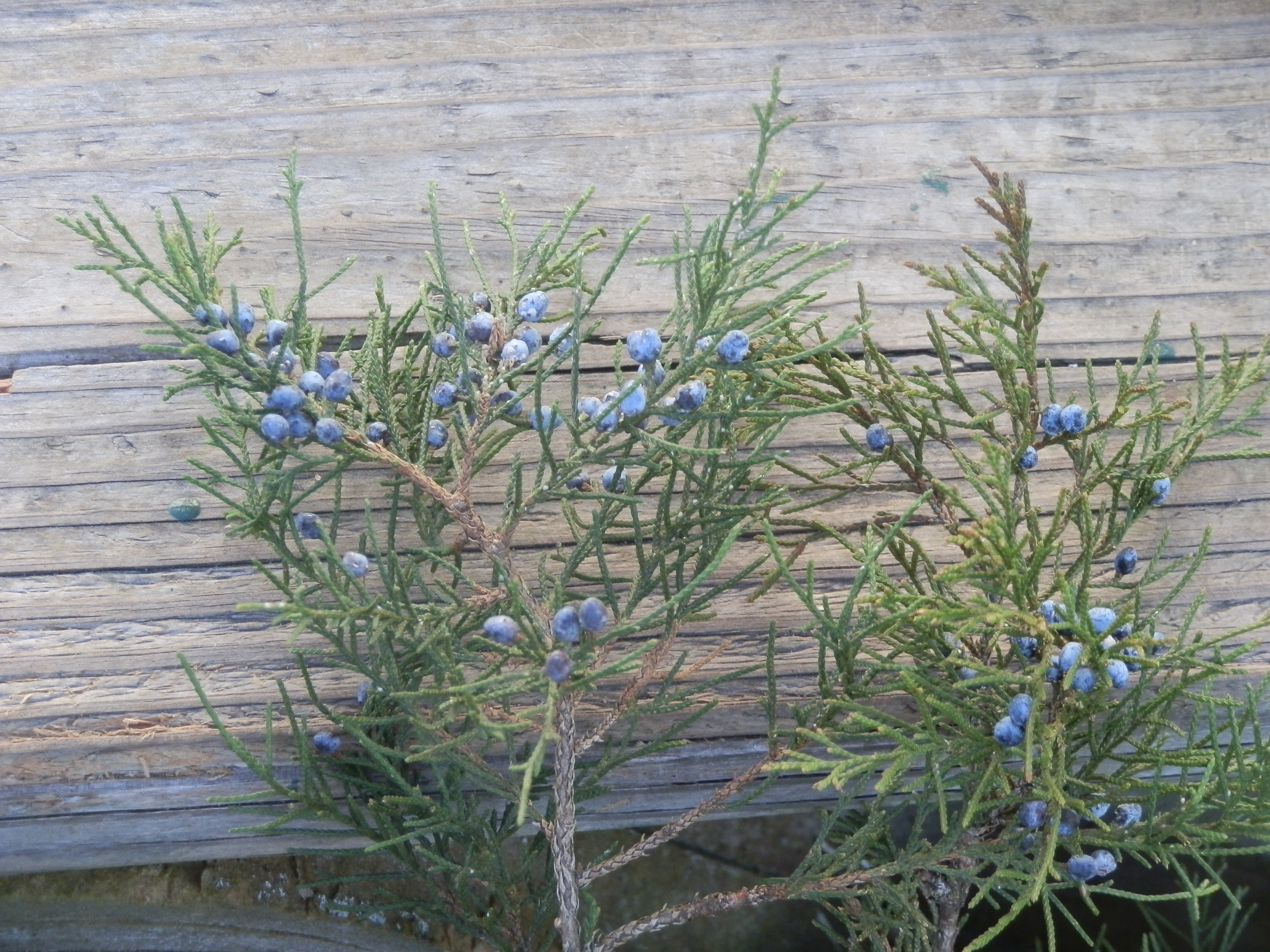
One of our more versatile trees is eastern red cedar (Juniperus virginiana). It’s adaptable, resistant to decay and parts of it are edible and have medicinal uses. Red cedars are evergreens, so they provide protection from winter winds. They’re also important lumber sources and they grow fast.
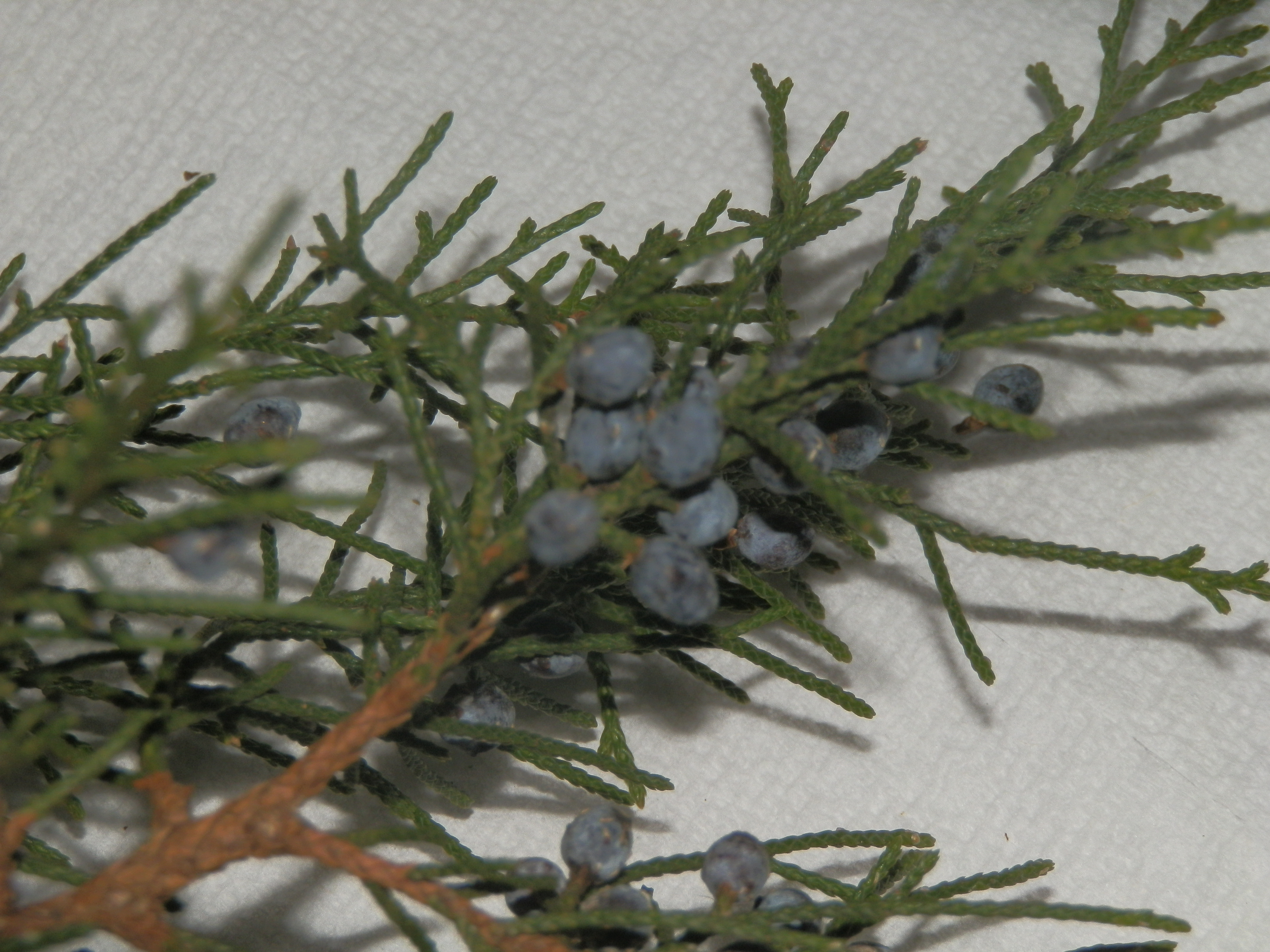
Eastern red cedar actually isn’t a cedar at all. It’s a juniper. Also, some people consume the blue structures they call fruits or berries. The problem is they aren’t fruits at all. They are cones, since junipers belong to a division of plants related to pines called Gymnosperms. Unlike pines, their foliage consists of overlapping scales not needles.
These medium-sized fragrant evergreens grow well on dry sandy or rocky infertile soils with an extremely wide pH range. They also are a pioneer species, meaning they will take over open areas, but will be displaced when taller species shade their canopies. Some call them pencil cedars because of their upright growth habit.
Most trees that require full sun have dense canopies and red cedars are no exception. For this reason and their relatively uniform shape they are a common Christmas tree species. I have never used them for that. I prefer needled trees.
I do think they make gorgeous lumber. The grain is a rich red color and the fragrant smell is unmistakable. Historically the wood has been used to line closets and cabinets to discourage moths. It is also a common fencing material because the wood is so durable in contact with soil. Young trees also make long lasting fence posts.
If you’ve ever been around any mature specimens you might have noticed the pea sized blue cones. They are edible in small quantities and make an acceptable tea or can be used as a flavoring in soups. Make sure they are a dark blue and slightly soft before consuming them and only consume a few at a sitting.
Cones are also used for flavoring gin and a French liqueur called chartreuse. Some use them to flavor sauerkraut. They are mildly antiseptic and have been used to treat worms. Herbalists have prescribed chewing them to soothe mouth ulcers and making tea from them to combat colds and rheumatism.
Foliage is sometimes used medicinally, but in very small quantities. Fresh young twigs are a diuretic. Fragrant essential oils are extracted and added to soaps, perfumes and for aromatherapy. Many people use wood shavings as pet bedding.
Eastern red cedar is no friend to apple growers. Cedar apple rust is a serious apple disease. When the fungus grows on red cedar it looks like a cluster of bright orange worms. As it matures and dries it resembles big wads of chewing gum. Other than that it causes few problems.
On apples, the disease causes leaves to speckle and fall off. Much of the fruit does too. Fruits that persist are blemished and usually unmarketable. Both species must be present for the fungus to complete its life cycle, so a common control is to eliminate nearby red cedar trees.

red cedar branch tips showing cones

red cedar branch tips showing cones

close-up of blue bery-like cones in artificial light

close-up of blue berry-like cones in artificial light

Ted Manzer teaches agriculture at Northeastern High School.

Posted in foraging | Tagged , , , , , , , , | 6 Comments

Reclaiming those old apple trees


Perhaps you’ve let your fruit trees go or maybe bought some old farmland with an overgrown orchard on it. Maybe your hunting land has old trees that aren’t productive anymore. Whatever the case, you might have thought about renovating them. There are several factors to consider.
First, are these trees where you want apple trees anyway and how badly do you want their fruit? How much disease and dead wood are in the trees? Furthermore, is the fruit a desirable cultivar? Unless the trees have sentimental value easier options are out there.
Removing the trees entirely and planting newer disease-free stock might be a better choice. Also, fruit trees can be messy. If you’re not a big apple eater or enjoy spraying, pruning and canning you might be better off to buy your fruit.
If you still want to work with the old trees now is a great time to start. Get ready to generate a big pile of brush, but it’s best to consider a major overhaul is a three year process. Trying to do too much the first year often leads to a large flush of succulent regrowth.
It’s possible to graft new varieties onto an old tree, but that’s a lesson for another time. When renovating by pruning alone consider the overall shape of the tree and the location and arrangement of branches. Limbs with wide angles from the main trunk are the strongest and set the most fruit. Narrow crotch angles break easily.
Where limbs cross one another choose the strongest and prune the other. Remove side branches that grow toward the center of the tree and eliminate droopy ones. Remove anything growing straight up or down. Watch out for branches that might hit you when you’re mowing.
Always remove any dead and diseased wood. Make sure to consider the possibility you might spread diseases, so if you are pruning more than one tree mix some 10% bleach solution to cleanse your tools. Spreading disease from tree to tree is not only possible, it’s very likely.
All limbs have a widened area called a limb collar where they meet the main trunk. Cut where the branch begins to narrow and not flush with the main trunk. Healing time will be less. Limb collars are generally less than half an inch long.
Be prepared for copious amounts of vertical branches to develop the first year. These are called water sprouts. Remove them any time they appear. Many suckers might also spring up from around the tree base. Remove these too. Thinning out entire limbs will result in less of this type of regrowth than shortening branches. Blossoms only form on two-year-old or older wood, so keep that in mind.
Finally, remove competing trees if you want fruit. Apples require full sun. If there are large desirable shade trees it might not be the place to salvage fruit trees. Also, pruning and pest control are chores that must be done every year. Managing fruit trees properly is a lot of work.

Ted Manzer teaches agriculture at Northeastern High School.

Posted in foraging | Tagged , , , , , , , | Leave a comment

Free range chickens are not necessarily free


In the past several years we’ve seen a resurgence of rural people raising small flocks of chickens. There are several reasons for this. Eggs are the most obvious, but chickens clean up grubs and other creeping and flying critters so they won’t attack your lawn, pets or even you.
Some folks are concerned about the amount of antibiotics, hormones and other chemicals fed to poultry and livestock. Unless you raise the birds yourself there is no guarantee you won’t ingest some of these. Simply labeling eggs or chicken meat as free range does not mean they haven’t been fed or injected with unwanted chemicals.
Free range is also a very broad term. Birds can be labeled as free range simply by being allowed a short time outside each day. They don’t even have to have access to grass or bugs to eat. If you raise your own this isn’t an issue.
All is still not rosy. Animals require care and sometimes even with our best efforts some may still perish. Predators, both wild and domestic are a big problem. Foxes, weasels, dogs and feral cats can be tough even on adult birds. Possums, raccoons, snakes and skunks can clean up eggs and young chicks in a hurry. These are just the most common ground predators. Even your own pets can be a problem if you don’t train them well.
Flying raiders like hawks and crows can be major headaches. Sometimes stretching string or wire in a coarse woven fashion from nearby tree branches to the coop can discourage air attacks. These tactics are nice to know since shooting protected birds can get you into trouble.
Training your flock to come inside to a safe place at night is the best way to avoid losing birds. This can be tedious if your chickens range over a large area or are decent flyers and begin roosting in trees. Some breeds, especially hardier ones tend to be wilder. Also, roosters don’t simply crow in the morning. They crow all day.
Another problem you might encounter is difficulty in finding eggs. Hens must be trained where to lay or they will lead you on a daily egg hunt. Eggs also might require cleaning. Another problem is they might find your flower and vegetable gardens excellent table fare. Your steps and walks might also make great bathroom facilities for them too. If their choice is your neighbor’s steps, porch or vehicles then that’s another problem altogether.
Assuming I haven’t turned you off entirely, there are many advantages to having your own flock of chickens. They help clean up leftover food waste. Eggs have higher levels of omega-3 fatty acids, less cholesterol and saturated fat and more vitamins A and E. You can also be certain they haven’t been given any chemicals you might not want in your body.
Perhaps the greatest benefit is the intrinsic satisfaction one gets from self-sufficiency. In these economic times that might be something that could benefit our pocketbooks and our spirit.

Ted Manzer teaches agriculture at Northeastern High School.

Posted in foraging | Tagged , , , , , , | Leave a comment

Creeping raspberry is a heat tolerant edible ground cover


Creeping raspberry is a heat tolerant edible ground cover
I expect to see a lot more of this in the future, but before you get your hopes up it’s not really grown for its fruit. Creeping raspberry (Rubus calcynoides) is sun loving but a shade tolerant low growing ornamental vine. Sometimes you will see creeping raspberry ecotypes called Rubus pentalobus, Rubus rolfei, and Rubus hayata-koidzumii. Many varieties do produce edible fruit, but harvesting very much might injure the plants since stems are tender and you can’t avoid stepping on them.
Leaves are crinkly, evergreen and generally five-lobed. Stems have soft prickles and run horizontally like those of strawberries. Growth is very dense so it forms a great ground cover. It’s especially effective for controlling erosion on steep banks but don’t stop there.
White flowers give way to fruits that vary from yellow to orange to red. Yellow is most common. They are edible and quite good, but plants don’t fruit heavily. Don’t expect more than a handful now and then while you’re admiring the foliage. Fruit is a bonus.
In the establishment stage creeping raspberry requires normal watering. However, once established it is quite drought tolerant. For this reason it is also a great choice for containers. Foliage will spill over the sides of a pot creating an attractive display. It cascades over a wall really well too. I suspect it might even be pleasing in a hanging basket.
This native of Southeast Asia, specifically Taiwan requires little maintenance and is disease and pest-resistant. It thrives on all but the wettest soils. Creeping raspberry also attracts butterflies but usually not herbivores like deer and rabbits. I suspect a winter like our last might cause some damage, but this aggressive vine recovers quickly.
Despite its growth rate creeping raspberry is not invasive, so I don’t expect to see it in uncultivated areas. It also won’t climb trees like English Ivy and many other vines. It will, however, take over the bed where it’s planted even though it is less than four inches tall. Roots are thick and deep. Don’t expect it to play nice with less vigorous perennials.
It does compliment spring bulbs well. Plants are sparser then, so daffodils and hyacinths adapt effectively. Once creeping raspberry starts its growth spurt it’s time for the bulbs to fade away anyway.
As mentioned earlier, foliage is evergreen, but it’s not a boring green. Shades vary greatly from light to dark. Some are even silvery. Don’t expect it to wither when the mercury rises. It thrives in sweltering summer heat. As cold weather approaches rusts, pinks, and burgundies intermingle giving this prostrate ornamental Rubus an attractive blend of color.
The major trouble you’ll encounter now is finding some to put in your landscape. Few nurseries carry it but I expect that will soon change. In general I frown on non-native ground covers because they can get out of hand. This one seems to be different. I think the fact that it doesn’t fruit heavily may have something to do with that. Also the fruits are almost hidden by dense foliage. Birds have a hard time finding them.

Nice stand of creeping raspberry at the North Carolina State University arboretum

Nice stand of creeping raspberry at the North Carolina State University arboretum

Ted Manzer teaches agriculture at Northeastern High School.

Posted in foraging | Tagged , , , , , , , , | 4 Comments

Proper pruning is not one size fits all


Every fall I notice landscaping that has been cleaned up presumably for the winter. Unfortunately, many plants shouldn’t be pruned then. A general rule of thumb is to trim woody plants shortly after they bloom.
Take azaleas, for example. Azaleas bloom in spring and set their flower buds on the previous season’s growth. Pruning too late in the summer or in the fall will eliminate much or all of their flowering. Dogwoods have similar needs. The best time to shape both is when the flowers are no longer attractive.
Crape myrtles and other summer blooming plants can basically be pruned anytime, although cutting them back during the blooming season rarely makes sense. Plants should always be selected to fit their space and this is sometimes a problem with crape myrtles. People tend to trim them severely, which does encourage blooming but leads to other problems.
The imbalance between roots and tops causes a huge flush of growth. This vegetation is often spiky and weak. Additionally, groups of flowers called inflorescences grow much larger and trap rainwater, which weights them down, often breaking branches. A more modest approach is healthier for the plant, so choose cultivars adapted to your desired space. Remember that cutting large diameter branches also increases the potential for disease infection.
Sometimes shrubs become overgrown and must be rejuvenated. Many people prefer to do this task in the fall and while it often causes no health problems to the plant, it irritates the eyes for a long time. I prefer to do my renewal pruning in the spring. I try to shoot for no more than a month before new growth begins. This leaves the landscaping looking butchered for a much shorter time.
Many broadleaf trees and shrubs can be cut right back to stumps, but some plants cannot be pruned this severely. Most narrow-leaf evergreens like pines, yews, spruce, hemlock, juniper and other cone-bearing plants will not survive if no foliage is left. Branches left with no green will die. Sometimes these plants outgrow their space and people try trimming them back severely. The next task usually involves a vehicle and a chain.
Woody plants aren’t the only ones requiring pruning. Pinching off dead flowers will increase the color in our flowerbeds. Sometimes even annual flowers will cease flowering if we don’t deadhead them. Certain ones, such as zinnias even make great cut flowers for vases. Others, like daylily should be left alone until they wilt. Generally speaking, when plants are allowed to produce mature seed they will stop generating additional flowers.
The main thing is to become a student of your garden. Learn the growth requirements of the plants you want in your yard. This is most important when it pertains to flowering, but it can also be critical for general plant health.
We have thousands of ornamental plants to choose from. We also have many wild ones we can semi-domesticate in their natural setting. They all don’t have the same growth or maintenance requirements, and too many people lust for simple solutions. One size does not fit all.

Ted Manzer teaches agriculture at Northeastern High School.

Posted in foraging | Tagged , , , , , , | Leave a comment

Don’t throw away those big orange overripe cucumbers


I was raised by parents who grew up in the depression. Furthermore they are both of Scottish descent, so wasting things always bothered them and I grew up with the same values. I guess I could have rebelled but I chose to be frugal as well.
We always had a garden when I was growing up and on those sandy Maine soils cucumbers were easy to grow and they yielded well. Consequently, we made jars upon jars of pickles. My mother must have tried every recipe she came across, but after a while we settled on our favorites.
One of those required those big old overripe orange ones that we previously threw on the compost pile. Using what we would otherwise throw away was great for us skin flint Mainers. We peeled them and scooped out the seeds. Some we ground into relish, but most we cut into chunks. Then we mixed in onions, sweet peppers for color and poured this yellowish brine on them.
The vinegar brine was seasoned with sugar, mustard and celery seeds and pickling salt. It also contained turmeric, which along with the mustard provided the bright yellow color. The original recipe called for distilled vinegar, but Mom always liked to combine white and cider vinegars.  It deepened the color and added flavor.
These are among my favorite pickles. In fact, I like the recipe so much I use it for cauliflower and wild Florida betony tubers. It’s amazing the number of vegetables, wild and cultivated that pickle well.
My mother is in her eighties now and she still makes these pickles. In fact, she now processes them by the ton and has enlisted several volunteers at the church to help her for one of their annual fundraisers.
Each fall she enlists a bunch of church members and they travel to a cucumber farm several miles away and gather all the overripe cukes. The farmer donates the orange fruits to the church. He has no other market for them anyway. Mom and her friends literally harvest over a ton of them, load them in pickup trucks and everyone helps with processing. They get requests from miles away and all the locals know those pickles will be served at all the church’s baked bean suppers.
The only part that bothers me is that they don’t charge enough. I told Mom that when she considered the cost of traveling to get them and all the materials and labor she should double her price. She told me it didn’t matter because they were donating to the church anyway. When I reminded her that the church needed money she replied that the church is made up of people who help others. I guess mother knows best.
I can’t walk through my garden and spot an overripe cucumber without thinking of my mother and those pickles. The name of the recipe we first started using was Ruth’s Pickles. My mother has modified it a little, and I don’t even know who Ruth is, but her pickle recipe made a big impact on our family and that small Eastern Maine community.
Usually I have enough big orange ones for a batch, but this year our cucumbers were scarce. Bacterial wilt saw to that. Nevertheless, I think I still may have a few jars left. I guess I’ll have to make them last until next year.

Sweet Pickle Brine for those big orange cucumbers

5 qts. peeled and cut-up cucumbers                                 1  1/2 tsp. turmeric

4 medium onions, chopped (optional)                             6 c, sugar

2 sweet red peppers (optional)                                         1  1/2 Tbsp. mustard seed

1 qt. vinegar                                                                          2  Tbsp. celery seed

I usually use an even mix of                                              3 Tbsp. salt (I use pickling salt)    cider vinegar and 1/2 qt. white vinegar.

Peel and cube over-ripe cucumbers and mix in peppers and put into kettle with chopped onions. Add vinegar to only 3/4 depth of vegetable(about 1 quart).  Mix sugar, turmeric, mustard seed, celery seed, and salt; add to contents of the kettle.  Mix well and cook slowly at simmering temperature until pieces are just tender and can be pierced with a fork.  Ladle into hot sterilized jars and seal. Recipe is great for ripe cucumbers or cauliflower.

Ted Manzer teaches agriculture at Northeastern High School.

Posted in foraging | Tagged , , , | 96 Comments

Darn those dirty old sycamore trees


I have a large sycamore tree (Platanus occidentalis) in my yard. It’s healthy and provides needed shade for much of the year. The problem is that it sheds its leaves much like my old tomcat sheds his fur, a little at a time for what seems like forever. I mowed the lawn recently and chewed up all the fallen leaves. The next day there were as many as the ones I mulched into the grass.
These leaves have three large pointed lobes and are often close to a foot across. If they stay on the tree until late fall the foliage develops an attractive deep reddish orange  color. However, the leaf dropping season is among the longest of any tree species.
The leaves aren’t the only part that makes them dirty. Sycamores have fibrous fruits a little smaller than golf balls. They fall on lawns, driveways and sidewalks. Lawnmowers can hurl them through windows or pepper passing cars. Bark also flakes off in large sheets which can make a yard look unsightly.
Sycamores are common landscape trees and native throughout much of the eastern US from southern New England to the Deep South. They adapt well to wet soils, which we have plenty of around here. Despite their dense canopy sycamores also tolerate storms well too. Wood is strong and trees are very well rooted. In short, they’re tough and generally well-shaped.
I planted a wild one in my dad’s yard in Maine and it’s flourishing, so they will tolerate temperatures much lower than those in their native range. Dad isn’t concerned about the leaves or the mess. He figures they fertilize the soil anyway, and he likes his sycamore because nobody else up there has one.
Sycamores can grow to be extremely large trees with straight trunks, but they aren’t used much commercially. While wood is strong it has a twisted grain. This makes it difficult to work and even more difficult to split. They have been used for cutting boards largely for this reason.
Many specimens achieve heights of over 100 feet and more than six feet in diameter. However, trees that large are usually hollow. That’s great for wildlife but not so good for timber use.
Native sycamores are usually found in mixed stands. Young seedlings can thrive under an existing tree canopy. They grow fast and quickly catch up to the taller trees. Due to their fast growth rate they are often mentioned as possible biomass trees for fuel production. They sprout well when cut, which also would be beneficial for that use. Replanting wouldn’t be necessary.
Sycamores are a sap rich tree. In fact, they can provide a great water source for campers. The sap contains sugars and could be boiled down for syrup. However, concentration is so much lower than sugar maple that it wouldn’t be practical.
I guess I’ll continue to deal with all the fallen leaves. Shade is sweet on those 95 degree summer days. Besides, I have nowhere to fell mine safely and it holds up my clothesline.

Ted Manzer teaches agriculture at Northeastern High School.

Posted in foraging | Tagged , , , , , | Leave a comment