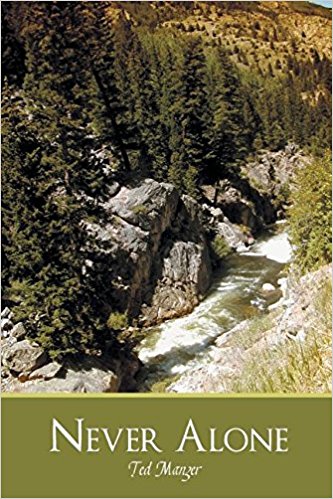
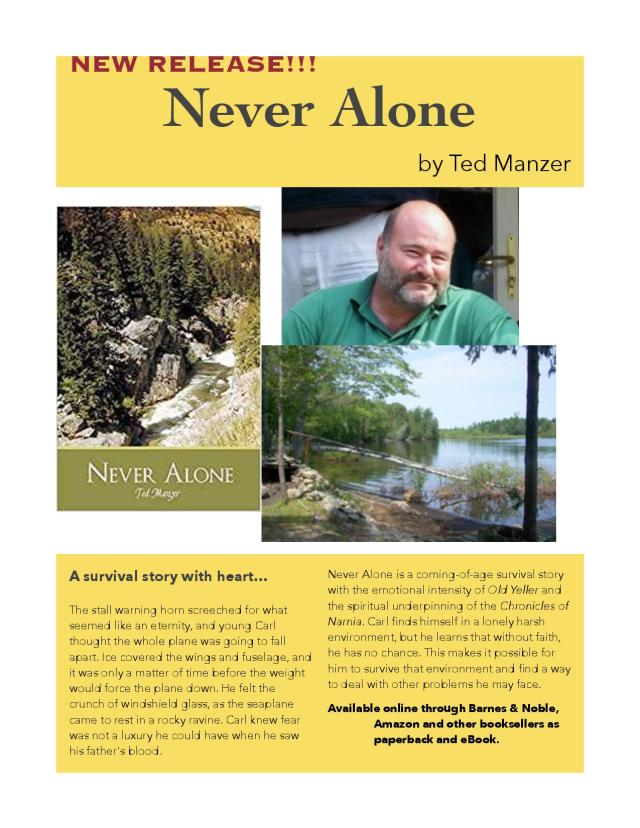
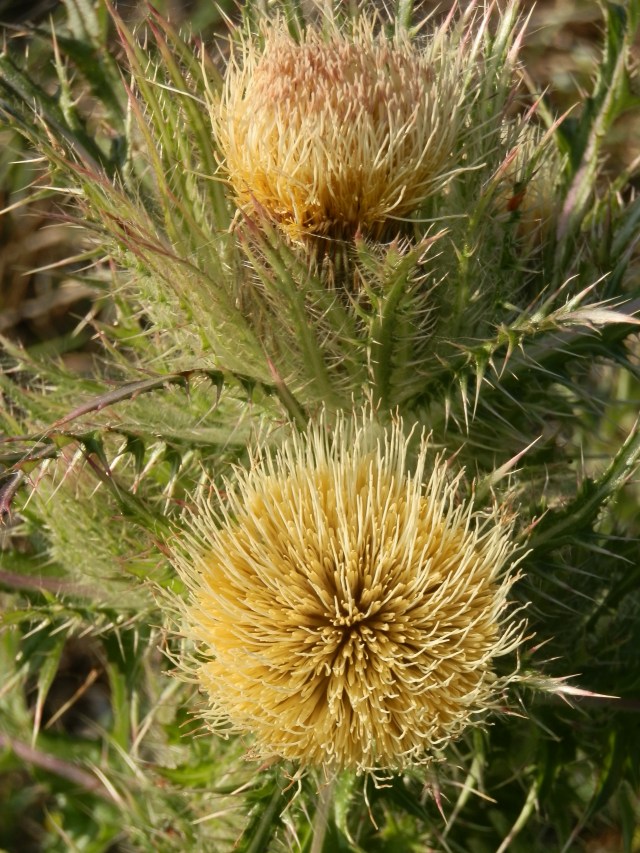
New versions of Never Alone are now available


The eBook version of Never Alone can now be obtained by Kindle and Nook enthusiasts. In the Elizabeth City area it can also be purchased in the gift shop at the Museum of the Albemarle. Please let people know they can get it there if they don’t want to go online. I’m working up a formal book signing at the museum. Tentatively this is scheduled for mid-August. I’ll post details when they are finalized. In the meantime, those wishing to purchase the book can go to amazon.com or barnesandnoble.com and type in my name (Ted Manzer) and the book will come up. Also, there is a trailer up on youtube (search Ted Manzer).

Thanks to all who have supported me. I hope you enjoy the book.


Posted in Uncategorized | Leave a comment

Life experiences become an important component of education


We are nearing the end of another school year. One thing teachers always try to do is reflect back upon what worked and what didn’t work. If something wasn’t successful, we always ask ourselves why it wasn’t. How could we fix it?

As teachers we all plan what we want our students to glean from every lesson. However, sometimes it’s the things that just happen in the middle of it all that take hold. Sometimes problem solving and soft skills can override our planned activities.

For example, the class might be studying plant nutrition or other growth requirements and a plant sale customer comes to the door. I send a student out with this member of our community and the student gets grilled about the growing requirements of different plants.

That was a life lesson. Kids must learn to think on their feet. Nobody wants to sound like he doesn’t know what he’s talking about. I guarantee the next time that kid talks to a customer he’ll be more prepared.

We can plan and teach so students can regurgitate information, but that doesn’t necessarily translate to learning. Sometimes you just have to experience it. I’m a firm believer in applied learning.

I remember one time we were studying the characteristics of water in our Natural Resources class. We were about to move a bunch of tables in the greenhouse and I knew everyone would be tired. It was December and before we went into the greenhouse I put a case of water in the refrigerator and another one in the pond.

The water was about 45 degrees in the pond and 35 degrees in the fridge. I told the kids that and asked them which case of water would be coolest when we came back inside. Nearly everyone said the one in the refrigerator.

Twenty-five minutes later the kids found that the waters in the colder fridge were barely cool. The ones in the pond were cold. They learned a lesson about the high specific heat of water vs air.

I remember another time, again in a fall Natural Resources class. I offered $20 to the first student that could pick up pecan off the ground with an edible seed. They all tried in vain.

Eventually, they realized that we have a huge population of gray squirrels on our campus. These little bushytailed rodents are very adept at plucking the undamaged nuts. Their sense of smell is much better than ours and they rarely miss a good nut. Consequently, nobody got the twenty.

In my 20 years of teaching at Northeastern I could fill up several pages upon pages of similar experiences. Some things you just can’t plan for, but you must take advantage of them when they appear.

As a teacher I think you have to stay positive, no matter how difficult that is sometimes. There are always days that frustrate, but there are good ones too. That holds true for students as well as teachers. They go through the same frustrations that all people do.


Ted Manzer teaches agriculture at Northeastern High School (tmanzer@ecpps.k12.nc.us).

Posted in Uncategorized | Tagged , , , | Leave a comment

Short or tall, Zinnias dazzle in the garden and the vase


I can’t think of an easier flower to grow than zinnia. When I was a kid we always had the old fashioned tall growing types. I think my mom still has some pictures of my sister and I standing next to them and they were taller than either of us.

We never bought plants or seeds. All we did was save seeds from year to year in a paper bag and we had a mixture of every color imaginable. All we needed was an area with plenty of light.

Zinnias thrive in nearly any type of soil. They prefer a well-drained sandy loam with plenty of organic matter, but they tolerate most soil types and moisture regimes. When seeding it is best to wait until soil temperatures get near 60 degrees.

That was a push in Maine, but Mom was never in a hurry. We often didn’t get them in the ground until early July and we still had tons of them. It seldom pays to try to stretch the season.

There’s another thing I always noticed about zinnias. They attract butterflies, lots of them. That’s something that was always cool for a young kid.

It’s nice to have pretty flowerbeds, but zinnias have more attributes than that. Flowers hold in a vase for as much as a week. Proper cutting increases their useful life, sometimes even more than that.

Flowers should be re-cut at an angle under water and placed in tepid water initially. I know people naturally think flowers should be placed in cold water, but when water is cold plants don’t imbibe it as quickly. Therefore they become less hydrated.

Changing the water during the week is helpful also as are floral preservatives. If water gets cloudy it should be changed more often. Cool water is fine for subsequent changings.

Profusion zinnias are the dwarf types, and they emerged on the market in the mid-1990s. They have several advantages over the older types, particularly for flowerbed use. They are profuse bloomers and due to their shorter height they blend better with most other bedding plants. They also are fabulous in mixed pots.

Another advantage at least for garden centers is that they can be established successfully as plants. The taller types have such a short useful shelf life that it’s not worth growing seedlings to transplant. They become too leggy too quickly.

Profusion zinnias make an instant garden. They also are nice for bud vases and other short table arrangements. I know in our house large table arrangements eventually get knocked over.

As if their beauty weren’t enough zinnia flowers are also edible and can be used to garnish a salad. They also make a citrus-like tea. This tea helps with constipation.

Spider mites and aphids are the most common insect pests. Both can be controlled and frequent inspection is the first step. Sometimes all that’s needed to control them is a good bath with dish soap. Imidacloprid is a systemic insecticide that works good too, but don’t eat the flowers if you spray.

Good selection of profusion zinnias

Ted Manzer teaches agriculture at Northeastern High School (tmanzer@ecpps.k12.nc.us).

Posted in Uncategorized | Tagged , , , , , , , , | Leave a comment

Hard copies of Never Alone are now available on Amazon.com.


The book has not been fully released yet. Electronic versions are not yet available and it’s not up on the Barnes and Noble site as of today. I figure within another month all versions will be available.

Well, it’s been a long time coming. I first started this book back in 2004. Since then I’ve broken it  into three books, added stuff, taken things away and generally learned how to write. I’ve also written two more books to the story making it a 5-book family saga. I welcome you to read Never Alone and offer your opinion. If you are so inclined, say a prayer for me.

Posted in Uncategorized | Tagged , , , , , , , | 4 Comments

Bald cypress has far more uses than swampland conservation


Bald cypress (Taxodium distichum) is a great swamp conservation plant. It helps filter sediment so they don’t enter our waterways. Floodwater slows down, causing sediment to settle and not enter the rivers. This majestic tree is one of relatively few species that can even survive such environments.

Cypress trees grow best when soil pH is below neutral. This is rarely a problem in our area. Most swampland soils are well in the acid range which serves these trees well, but extremely acid soils inhibit growth too. Trees grow best at a pH range of 5.5 to 6.5.

Trees can attain impressive size. That makes them a great candidate for forestry use. Harvesting can pose problems, but cypress trees can be profitable.

Bald cypress wood is very durable. It is one of the more decay resistant lumbers found anywhere. Because of this bald cypress is often used for fencing and outdoor furniture. Shredded cypress mulch lasts longer than other mulches since it’s slow to break down, so many landscapers like it.

So are there any other uses for this great filter tree? One would assume it would make a fine landscape shade tree for wet places, since that’s where we find them. It certainly does, but it doesn’t end there.

I maintain this tree’s greatest landscape application is to plant it on upland sites. Bald cypress grows well on well drained soils. When given plenty of light, young trees develop broad attractive canopies. Trees usually require little pruning. They also have relatively few insect and disease problems.

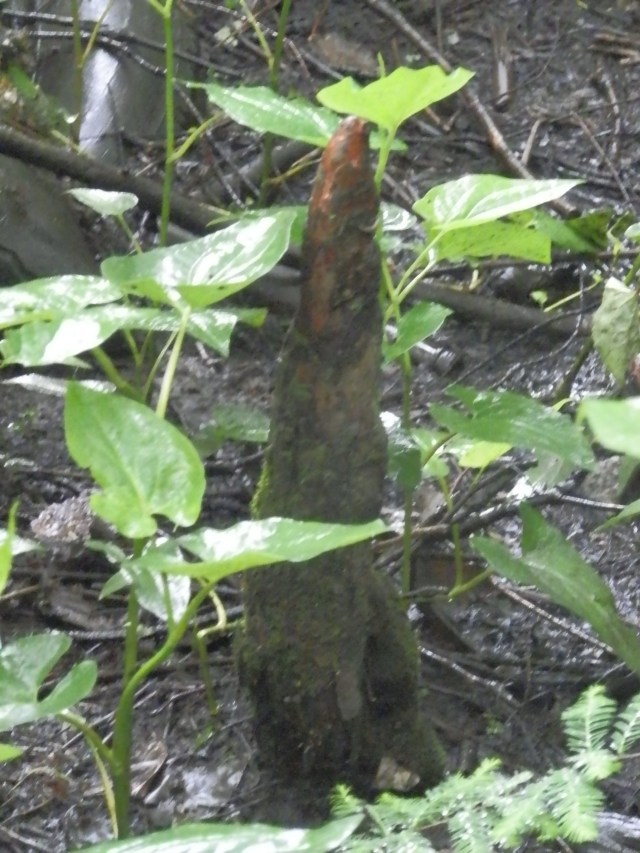
One problem bald cypress has in waterlogged places is that it produces distinctive “knees”, which can cause problems for lawn mowers. These knees can be used in crafts and creative furniture, but most of us don’t want to hit them with the mower every week. On drier soils these trees don’t produce these woody appendage-like growths.

Bald cypress is a conifer and has needles like pine and hemlock trees. However, one factor that makes it a great shade tree is that this foliage is deciduous. That means trees are bare in the winter.

Good shade trees shade us from the sun in summer but let the light enter our houses in winter. In my opinion, evergreen trees should be planted on the north facing side of a building and deciduous trees should be planted on the south facing side. To me that’s common sense.

Another attribute shade trees should have is seasonal color. Bald cypress fall color can be attractive. It’s brownish orange and mixes well with other species. One problem you’ll have though is that people will constantly tell you your pine tree is dying.

When I was in the landscape business I got several calls every fall from people who thought their trees were dead. Those trees were a different species of deciduous conifer called tamaracks.

Bald cypress is also a native tree. Using natives is hot right now and there are many reasons for using them. Usually natives are adaptable and they generally don’t become invasive and threaten other wild plants.

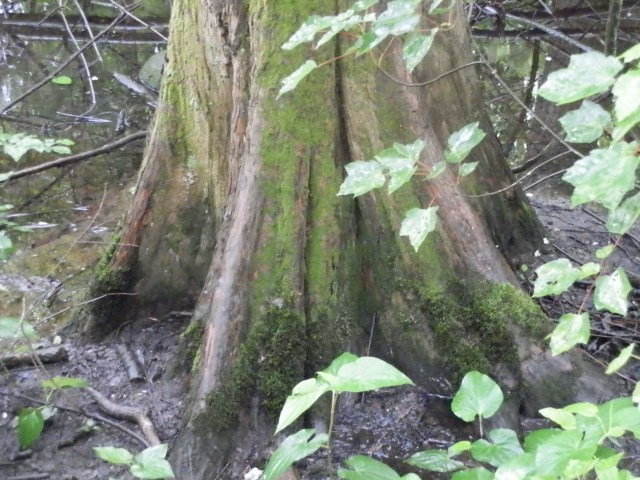
Swamp bald cypress showing enlarged fluted trunk

One of many bald cypress knees


Ted Manzer teaches agriculture at Northeastern High School (tmanzer@ecpps.k12.nc.us).

Posted in general nature | Tagged , , , , , , , , , , | 1 Comment

Spiderwort is a low maintenance native perennial


Some people call them widow’s tears. Others confuse them with daylilies. Still others have never even heard of them. Spiderworts are tough native plants that don’t choke out the rest of your garden residents. Our most common one is the Virginia spiderwort (Tradescantia virginiana).

More and more people are looking for native plants to add to their landscaping. Naturally, they also seek out perennials as these plants don’t need to be planted every year. Usually, water usage is a concern and spiderworts are miserly on water once they become established.

Gardeners desiring to help the environment also want plants that attract butterflies and pollinators. Spiderworts do. Several species of native butterflies and bees love them.

Spiderworts tend to grow in clumps.  They grow best in moist, well-drained and slightly acidic soil, but they tolerate a wide range of soil conditions. They perform best in partial shade but will tolerate full sun as well as shady locations. They won’t bloom much in shade.

Foliage is grass-like and resembles that of daylily or spider plant. Triangular shaped flowers with three petals grow in clusters on the ends of stalks and are usually blue to purple. Some plants have white or pink flowers. I’ve also read where air pollution can influence flower color and make normally blue types light pink. Individual blooms only last for one day.

Walk through any old cemetery or abandoned homestead and you will likely find some. Maybe that’s where the “widow’s tears” comes from. They’re rarer in wilderness places and are considered threatened in much of North Carolina. You should not collect them from the wild.

Spiderworts bloom in mid spring to early summer. Deadheading the old flowers will lengthen the blooming period, so it’s a good practice if bloom is what you’re after. Let flowers mature if you wish to collect seed.

Spiderworts transplant easily as they have a strong fibrous root system. Usually they will benefit from dividing every three years or so and they propagate successfully this way. They also establish readily from seed.

Spiderworts have few insect or disease problems. However, slugs and snails can be a problem to young shoots. While occasionally damaged, they are far from the first choice to be gobbled up by deer, rabbits and the like.

Spiderworts originally got their name because they were used to treat spider bites. When crushed, stems and leaves emit a sticky sap. This sap was applied to the wound. It was also used for general itching caused by mosquito and other insect bites. Plant roots also have laxative properties.

Flowers and leaves are both edible for most people. Leaf sap causes minor skin irritation to some, so try a small quantity first to see if you are affected. Leaves and flowers can be eaten raw in salads or cooked as a pot herb and both are used as herbal teas.

Culinarily speaking, I’m not a big fan so I don’t collect them. They don’t bother me, but they don’t store well in the refrigerator. If you forage some they must be prepared right away or they will turn to black mush.

Blooming widow’s tears covered with dew

Ted Manzer teaches agriculture at Northeastern High School (tmanzer@ecpps.k12.nc.us).

Posted in Uncategorized | Tagged , , , , , , , , , , , | 2 Comments

Bull thistle sure is tough like a bull


You’ve probably seen that tall spiny plant with purple flowers along the roadside. Sometimes the flowers are yellow. It’s called bull thistle and related to the artichoke. Playing ball in a pasture field teaches kids to learn to identify this one in a hurry. Fall or step on it once and you’ll pay more attention the next time.

True bull thistle (Cirsium vulgare) is a biennial. It produces basal rosettes of leaves the first year along with a thick taproot. The second season it sometimes attains heights of six feet. Despite the diminutive stature of the first year foliage, spines at midribs and tips of leaf lobes are still just as aggressive as older specimens. The yellow flowered type (Cirsium horridulum), sometimes called yellow thistle or horrid thistle is an annual. When you look at the spines you can see where the horridulum came from.

These spiny menaces grow best in sunny areas and thrive in most types of soil. Thistles are a problem in overgrazed pastures, because seeds take advantage of any available bare soil. Bull thistle can be problematic on forest clear cuts too. Plants grow fast and can shade out young tree seedlings. Seeds can remain dormant but still viable for several years.

Fortunately, the only reproduction is by seed. There are no tubers, rhizomes or other vegetative structures. However, the seed is prolific and gets spread by wind, much like dandelions. Sometimes huge clouds of thistledown spread seeds great distances.

This plant can be quite invasive and is considered a noxious weed in most states. An exotic species, bull thistle is originally from Eurasia. Flowers emerge in summer and it’s best not to let them mature unless your goal is to attract finches. They love the seed.

Controlling bull thistle by non-chemical means usually involves some type of physical protection. I’ve hand weeded them, but I always use welder’s gloves and wear long pants and long sleeves. Even then it can be a struggle because the roots are often large. Once plants flower they are easier to pull, but you’re playing with fire if the seed is mature.

On larger areas it can be kept under control by mowing it regularly so it can’t set seed. That still won’t solve your problems if you or your children like to walk barefooted. Numerous herbicides will kill it also, but on pastures they also can damage desirable species. In lawns they are rarely a problem. Always read the label thoroughly.

Believe it or not bull thistle can be a valuable survival food. In their first year roots are edible and when cooked they strongly resemble Jerusalem artichoke. If you’re inclined to try them, take a shovel and cut the tops off before digging the roots. Once roots reach their second year they become too woody to eat.

According to many sources, young leaves make a fair cooked green. The spikiness gets tempered by cooking, but collecting them would not be a pleasant experience. Some even recommend using young leaves in salads. That almost seems like joke to me. I’ve never consumed bull thistle foliage raw or cooked, but then again I’ve never been starving to death either.

Yellow bull thistle plant. I’ve been waiting to find some decent pictures before posting this.

Close-up of yellow bull thistle

Ted Manzer teaches agriculture at Northeastern High School.

Posted in foraging | Tagged , , , , , , , , | 1 Comment

Confessions of a potato snob


My father was a plant pathologist specializing with potatoes. He was a private pilot and one of the pioneers at using aerial infrared photography to detect late blight in potatoes. Some cultivars were more susceptible than others.

Since potatoes paid the bills at our house, we ate a lot of them. As a result, I could not help becoming somewhat of a connoisseur. All potatoes are not the same and I learned that at an early age.

I just assumed everyone knew that. There were certain varieties, such as ‘Red Pontiac’ and ‘Katahdin’ that were great for boiling and making potato salad. They weren’t worth a thing for baking, at least in my eyes. I like a dry mealy baked potato that soaks up the butter and sour cream. I don’t like foil on them either. Crunchy skins are my favorite.

On the other hand, other cultivars like ‘Belrus’ and ‘Russet Burbank’ made the fluffiest baked potatoes imaginable. They were totally unacceptable for potato salad. When boiled, they turned to mush. A few were fine in soup because they thickened it. ‘Kennebec’ was fairly versatile and could be used for either. ‘Atlantic’ chips well, but storage is problematic.

The reason for cooking texture differences stems largely from the specific gravity of the tubers. That’s influenced by the amount of starch relative to the amount of water in the potatoes. High specific gravity potatoes are good for baking and chipping. High specific gravity cultivars usually yield lighter colored more brittle potato chips. Nobody wants soggy dark colored chips or fries.

Low specific gravity potatoes are better for canning. They also hold together well when boiled, so they make good potato salad. They also hold together better in soups.

To a large extent specific gravity levels are genetic. That’s why specific varieties are grown. However, certain growing and management conditions can raise or lower starch to water content. Farmers who grow and sell to chip processers are acutely aware of this.

When I moved to West Virginia for graduate school I reunited with an old friend and colleague of my dad’s. The late Dr. Bob Young was also a potato man and he furnished me with experimental potato clones to test. I enjoyed that and it helped with my grocery bill.

Some types didn’t convert sugars completely to starches. That ruined their frying quality as they caramelized too much. Unfortunately, some of my favorites never made it past the experimental number stage.

When developing new cultivars, often cooking qualities take a back seat to yield, skin quality and disease resistance. I guess the general public isn’t as discriminating as this potato snob. Most people blame the cook if the product is subpar. I sit in the restaurant and ask myself why they chose to bake a variety not bred for that purpose.

I still remember questioning my then girlfriend as to why she chose to bake Pontiacs when she fixed supper. She said they were unblemished and pretty. I told her they’d be soggy. They were, but she married me anyway. Life is good.


Visually, sometimes it’s hard to tell – to the left are boilers. Bakers are center and right.

Ted Manzer teaches agriculture at Northeastern High School (tmanzer@ecpps.k12.nc.us).

Posted in foraging | Tagged , , , , , , , , , , , , , | Leave a comment

Pound for pound smallmouth bass are tough fighting fish


I’ve heard people say that four pound smallmouths fight harder than eight pound largemouth bass. I agree. They’ll usually leap and shake first. If that doesn’t work they dive to the bottom and try to get under something.

They don’t leap or run like a salmon, but they never quit. If you don’t have a net you’re in trouble. Get them to the boat and they still have enough in the tank to get away.

I remember once catching three on one cast. A little one hit the bait first. Before I could crank the reel three turns another one attacked him. A few feet from the boat a huge smallmouth nailed that one. I had a boat full of witnesses too.

I wish we had smallies around here. Growing up in Maine they were the most common

gamefish. Nearly every lake had some. In eastern North Carolina we don’t have the proper conditions for them to spawn.

Smallmouths (Micropterus dolomieu) need to have a gravelly bottom to lay their eggs. Preferably this is adjacent to a rocky drop-off. Rivers in the coastal plain don’t have these conditions. We might have accumulation of sand, but gravel is not part of the geologic makeup.

Smallmouth bass sweep nesting areas free of debris before the females lay their eggs. Usually these spots are a couple feet across. Often times they lay next to a sunken log. I remember paddling a canoe in the spring searching for nesting sites when I was a kid. Once eggs were laid the males would defend the area aggressively. They might even ram a boat.

Surprisingly, it is the male that builds the nest. Males guard them too. Usually these areas are a few feet deep, but sometimes they can be more than ten or less than a foot deep. A male will lure a larger female to his carefully prepared nest and hopefully she will lay eggs for him to fertilize. Then she leaves. Protecting the nest is his job.

Once the fry hatch and begin to grow his job is over. It is now that the male smallmouth bass has developed an insatiable appetite and will attack food voraciously. Fishermen love this post spawn period.

Smallmouth bass are generally active in cooler water than their largemouth cousins. During the summer they tend to hang near the bottom during the day. In the last hour or so of daylight they often hit the surface and this is when they are fun to catch.

Don’t get me wrong. I’ve had plenty of deep water success with bronzebacks. Sinking a large live baitfish on the bottom along a drop-off can often lure huge specimens. I’ve caught smallmouths in excess of six pounds with this technique. My son caught a thirty-one inch chain pickerel the same way.

I know largemouth bass are bigger and plentiful around here, but you fishermen will never regret heading out to smallmouth territory. Mountain rivers as well as northern lakes offer tremendous smallmouth fishing. Don’t knock it if you haven’t tried it.

Some pretty nice fish spread across the two by eights. There were close to 20 pounds of bass and a 28 inch pickerel

Ted Manzer teaches agriculture at Northeastern High School.

Posted in foraging | Tagged , , , , , , | Leave a comment

Cherries need not be ornamental varieties to have landscape value


We’ve all seen the breathtaking pink blooms of the Kwanzan, Yoshino and other cultivars of ornamental cherries. They make great small shade trees and specimen plants. Blooming season is a bit brief, but they’re pretty dramatic for a couple weeks.

Edible cherry cultivars can fit well in your landscape too. They have an attractive mass of flowers and also yield tasty fruit. Two major types are common and both have desirable qualities.

Sweet cherries (Prunus avium) are usually eaten fresh, are often larger and often require a different cultivar for cross-pollination. Some cultivars don’t. Bing is a common type often found in stores. It needs a pollinator, but Stella, Black Gold and North Star do not. Many people think sweet cherries are more versatile, but this is not true.

Some people cook with sweet cherries. Pies and other creations are darker and usually mushier. Make sure to check the recipe or you might concoct something much sweeter than you had in mind.

Sour cherry cultivars (Prunus cerasus) are self-fruitful and are definitely the choice for pies, juice and jellies. Color will be bright red. They are a little tart for fresh eating, but they’re good in a salad where a little tartness is acceptable. They can also pollinate sweet cherry cultivars if they flower at the same time, but they usually bloom later. Using another sweet cherry cultivar will yield better results.

Wild black cherries are very common around here. Some folks say that wild black cherries will pollinate cultivated varieties too, but I’ve read conflicting information which makes me skeptical. These wild cousins are tasty in their own right, but they’re small and birds usually beat you to them.

Cherries grow best in well drained slightly acid soils. When drainage is less than ideal they are more susceptible to root and stem diseases. Sweet and sour cherries both have similar growth requirements, but sour cherries are more winter hardy.

When it comes to insects, Japanese beetles love cherries, the foliage that is. They don’t bother fruit, but defoliation greatly affects fruit yields. Eastern tent caterpillars ravage black cherry, but they don’t seem to attack cultivated cherries as much. If you just have a few trees you can usually control them by physically removing the webbing when you see it.

As with apples, cherries are available in dwarf, semi-dwarf and standard sizes. Make sure you pay attention to this when you pick out your trees or they might not fit your landscaping. In general, sweet cherry trees are usually taller.

One might think that birds would cause more damage to sweet cherry trees. Unfortunately, this is not true. Birds like both of them. Robins and cedar waxwings appear to like the sweet ones best. Chickadees and sparrows usually eat more sour ones. Most other birds don’t seem to care.

As far as nutrition goes, sour cherries are much higher in anti-inflammatories than sweet types are. Research indicates they might have several uses medicinally. As a result, a plethora of supplements are available on the internet and in health food stores.
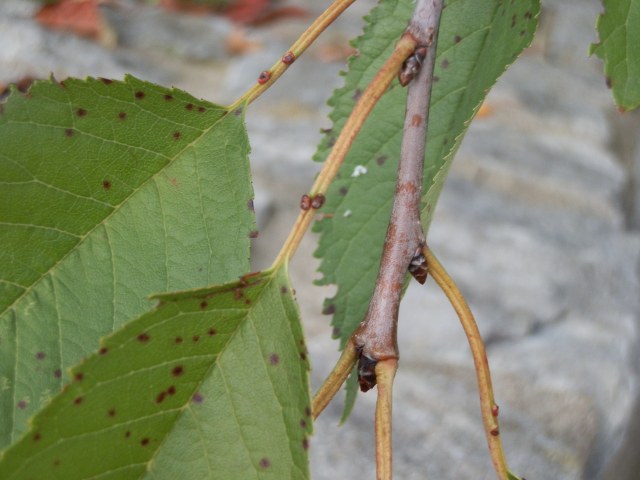
close-up of cherry leaves showing distinctive nectar glands on petioles


Ted Manzer teaches agriculture at Northeastern High School.

Posted in Uncategorized | Tagged , , , , , , , , | Leave a comment