Prime farmland is a precious irreplaceable resource


Don’t get me wrong. I’m not against renewable energy, but it pains me to see prime farmland being taken out of production permanently. Food shortage could be a real problem if this trend continues.

With rising worldwide population, we need to take advantage of our most productive land. Converting agricultural land into roads, shopping centers, housing developments and even solar farms is irreversible.

There are plenty of places we can generate power. There are many fewer ones where we can produce high-value agricultural products. I’d love to see more solar powered roofs, for one thing. I’d also like to see more in places where large amounts of vegetation aren’t removed from the environment.

Another problem nobody talks about is the reduction in photosynthesis and therefore the greater potential increase in temperature caused by removing plants from the landscape. Photosynthesis is an endothermic reaction. That means energy must be added for the process to proceed.

Plants capture energy from the sun and sequester carbon dioxide in the form of sugars. In the process, plants take in liquid water from their roots and give off water vapor through transpiration. This happens both by photosynthesis and plant respiration.

When water changes from a liquid to a gas, about 540 calories of energy are required to convert one gram of liquid water to water vapor. This is called the latent heat of vaporization and the process cools the environment.

Therefore, when we have less photosynthesis, we have less potential cooling. We also have less uptake of carbon dioxide. These thermodynamic facts are quantitative and undeniable.

When I was in college in the late 70s, we deliberately burned unvented heaters in our greenhouses to increase carbon dioxide levels and promote plant growth. The theory works, but it assumes that we maintain proper nutrient levels. Lack of nitrogen could mean less chlorophyll production, and that would lower photosynthesis.

It’s no accident that tropical rainforests are much cooler than their desert counterparts in similar latitudes. High levels of photosynthesis have a dramatic effect on climate.

Any time we remove plants and create roads, buildings, solar farms or whatever, we create heat islands. We also lessen our ability to produce food and fiber.

We obviously need roads, homes and businesses, but anything we can do to increase plant growth is beneficial. Renewable energy is also a good thing, for many reasons. Even if they had no ill effects, fossil fuels won’t last forever anyway.

So, what does it all mean? It’s complicated since there is a loss of energy created by longer distances between solar energy production and subsequent use. If we used only barren areas to produce solar electricity, efficiency would suffer. So would profit.

In Europe, many solar farms are elevated so that crops can still grow underneath them. From what I’ve read, the system works. Most pictures I’ve viewed show panels much further apart, which would be necessary for crops to receive enough light.

I’m not sure how practical that is in hurricane-prone places like eastern North Carolina. I also don’t know how much it would cost, but we can’t lose sight of the fact that land, especially prime farmland is a precious irreplaceable resource.


Ted Manzer teaches agriculture at Northeastern High School (tmanzer@ecpps.k12.nc.us).
Posted in Uncategorized | Tagged , , , , , , , , , , , | 3 Comments

Ground cherries are underappreciated wild fruits


The internet is a great place to gain knowledge. It’s also a bastion for false or misleading information. Sometimes I read something and laugh. Then I wonder how many other people read that same thing and were scared by it. It’s all how the author wants to spin the facts.

I was researching poisonous plants recently and found one that I know is not only edible, but it is also quite good. Ground cherry (Physalis sp.is a member of the potato family, just like tomatoes, peppers, eggplant and tomatillo. Ground cherry is a wild tomatillo. The fruits are excellent, provided they haven’t been sprayed by pesticides.

So why do so many sources consider them deadly poisonous? Leaves and stems contain alkaloids that are highly toxic, as is potato foliage. Immature ground cherry berries can cause upset stomach, vomiting and diarrhea, but so can many immature fruits.

Eating the proper plant parts at their correct growth stage is a no-brainer for cultivated foods. The fact that something is considered a weed seems to scare some people, and maybe in some cases that’s good. Inadequate education is sometimes worse than none at all.

So where do we find these ground cherries and what do they look like? There are close to 30 different species in the United States and about a third of them grow in Carolina. However, few are present in our area.

Often plants can be found in our gardens or adjacent disturbed places. They tolerate moderate amounts of shade. Wild turkey and other game birds consume the fruits but won’t graze the plants at all.

Ground cherries grow best in well-drained soils with adequate moisture. During drought periods they often drop their fruit. When fully ripe they also do this, hence the name ‘ground cherry.’ Fruits generally ripen in the summer and fall.

Plants have dark green leaves and flowers that are distinctly potato-like. Most species have pentagon shaped yellowish flowers with five fused petals. Usually, there is purplish blush toward the flower centers.

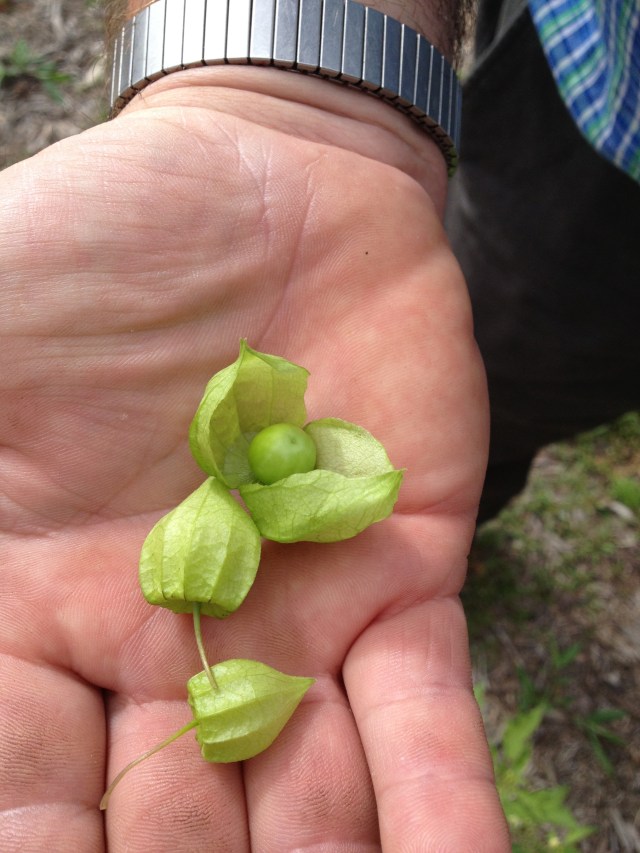
Distinctive fruits are encased in a papery husk, just like tomatillos. Husks are not edible. Though much smaller, berry flavor is mildly sweet like a tomato or tomatillo. Fruits can be harvested before they are completely ripe, but must not be eaten until they soften. Husk color ranges from a light yellowish to orange. Once berries are mature there will be no bitter flavor.

Fruits can be eaten raw or cooked. They can be sweetened and make a great pie filling. They also make a great salsa verde, although the color is more orange and not green. They even can be dried like raisins and used accordingly. Mincemeat lovers can experiment by adding some to their favorite recipe, especially if no currants are available. They also make great jellies and jams or use them fresh in salads.

The biggest challenge in this locale is availability. I rarely see populations of ground cherries like I did in West Virginia. It’s a shame because ripe fruits are not poisonous. We must read deeper than the headlines.

Immature ground cherries

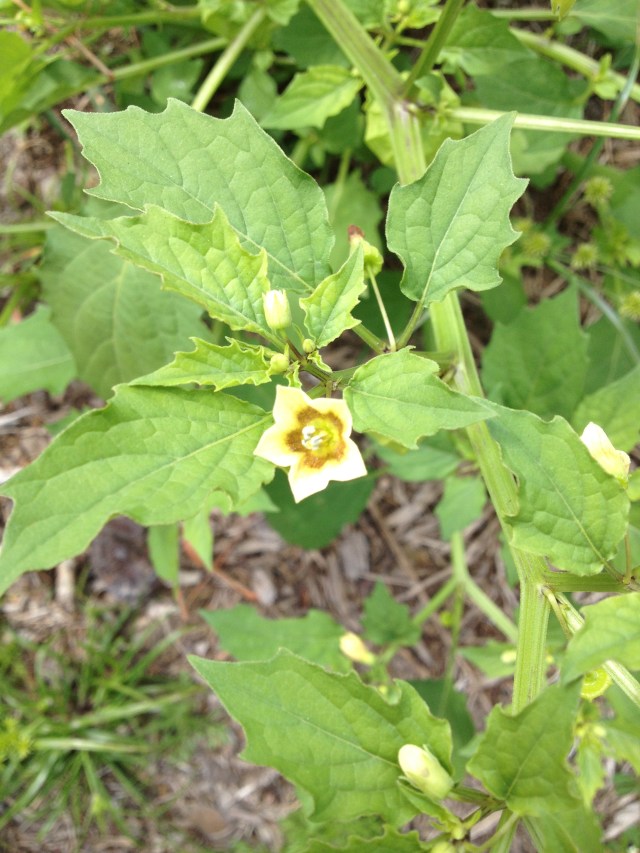
Ground cherry plant with flower


Ted Manzer teaches agriculture at Northeastern High School.

Posted in foraging | Tagged , , , , , , , | 3 Comments

Mexican petunia is almost as beautiful as it is invasive


I have a thick stand of Mexican petunia (Ruellia brittoniana or Ruellia simplex) next to a couple of the greenhouses at school. The plants have been established for close to 20 years. This past week we replaced the plastic covering on one of the houses, and I didn’t realize the job it would be.

I’ve replaced plastic dozens of times, but never had I been forced to deal with this invasive perennial to get the job done. Roots and rhizomes had really built up over the years.  There was such an overgrowth of plant material that the easiest fix was to put new baseboards above the existing ones and install new locking rails.

Mexican petunia is not really a petunia at all. It’s an upright perennial plant highly adaptable to the southeastern US. It gets covered with purple, pink or white petunia-like flowers in summer, and they hang on well into the fall.

Each flower lasts only a day, but you would never know it. When plants are in bloom they’re loaded. A thunderstorm can strip plants of every flower and the next day these guys are a sea of color again.

Mexican petunia tolerates wet soils. It will even grow in ponds. Plants can be maintained at less than waist height but left unpruned they can grow six feet tall in rich wet soil. For best flowering, plants should be in full sun. They make a great screen and they’re easy to grow.

Propagation is easy. Stem cuttings root well without the need for rooting hormone. Division is another productive method. They also naturally spread from seed. Butterflies and hummingbirds are attracted to the tubular flowers.

The problem is that Mexican petunias don’t play nice. If used in the landscape, they must be planted alone and a place where they can’t spread.

Purple types are the most aggressive. White and pink flowered types are usually somewhat shorter and don’t spread as quickly.

Recently, plant breeders have developed shorter less aggressive cultivars in all three colors. The drawback is that most of them are also less winter hardy. Last winter killed all my dwarfs but none of the full-size types.

This exotic perennial has few insect or disease problems. Mine get covered with mealybugs, but they don’t seem to be bothered by them. Deer generally save their foliage for last.

Chemical control is usually successful. Most broadleaf herbicide mixtures will control Mexican petunia as will glyphosate. The problem is that they will also kill or injure most other ornamental plants in your perennial garden.

Fortunately, we are near the edge of the hardiness zone for Mexican petunia. When planted in open areas, winter will spank them every few years. Those planted in sheltered places are rarely killed or even injured.

We don’t propagate very much Mexican petunia for our school plant sales anymore. We used to sell a lot and some people still ask for it. Its bloom can be spectacular. However, its invasiveness is a turnoff, and I can’t bring myself to promote it.

Plants beginning to emerge in mid-March.


Purple Ruellia making its way under the greenhouse walls

Mexican petunia covered with mealybugs

Ted Manzer teaches agriculture at Northeastern High School.

Posted in Uncategorized | Tagged , , , , , , , , | 7 Comments

Pineapples can be nutritious, delicious, medicinal, and ornamental


I remember the first time I ate fresh pineapple. Before that, I’d only eaten canned. It was wonderful and I had a whole new appreciation for it. I gained a similar experience after eating fresh grilled tuna for the first time. It was spectacular.

When I was a kid, fresh pineapple was expensive. It was not unusual to see them for five dollars each in Maine grocery stores. Consequently, we never bought any. I recently found some for well under a dollar each, and they were of good quality.

Pineapple is a very nutritious fruit. It’s loaded with large amounts of vitamin C and a ton of fiber. Yes, it is sweet and contains large amounts of sugar, but this bromeliad can help you lose weight. A cup of pineapple contains only about 80 calories.

The secret to success is a chemical called bromelain. It’s an enzyme used as a meat tenderizer among other things. Bromelain partially breaks down proteins before cooking, making the meat easier to chew. It also has strong anti-inflammatory properties. Anti-inflammatory substances are critical for good health.

Bromelain is found in pineapple stems in greater quantities than the edible parts. Supplements are usually extracted from the stems. Some researchers claim that when bromelain helps break down proteins in the stomach, it aids in reducing unwanted fat. I think this may be embellishing the chemical a little bit, but numerous claims are out there.

However, while bromelain probably doesn’t directly cause weight loss, it does reduce inflammation. Reducing inflammation means less pain. This helps people become more active and lose weight. It’s difficult to exercise when you’re in pain.

Bromelain has also been shown to improve intestinal health. Eating pineapple provides fiber, and that’s helpful. Moreover, bromelain limits cytokine production. This may promote less inflammation of the intestinal tract and less bloating and diarrhea.

Another bromelain benefit is that the chemical helps keep platelets from sticking together. This could be a good thing for reducing heart attacks. Too much could possibly prolong bleeding from wounds or excessive menstrual bleeding.

Eating too much pineapple at a time can cause mouth soreness in some people. That’s likely because the bromelain is breaking down some of the protein in the cells inside your mouth. Your stomach has an environment where this won’t happen. I suggest rinsing your mouth with a few swallows of water after a large intake of pineapple. Hot coffee would likely work, too. Heat inactivates bromelain.

Pineapples also make cool houseplants, provided you have a well-lit place for them. Pineapple tops are easy to root. Let the top callus over for a day or two. Then set them on moist but not wet soil. Don’t plant them too deep. Sometimes propping them up with a couple toothpicks can help.

Within a few weeks they will begin to root, and in about a year and a half, you might be rewarded with a ripe fruit. Setting them outside for the warm summer months will increase the likelihood for success. Fruit or no fruit, they make an interesting and attractive houseplant.

Rewards of nearly two years of waiting. The plant looks a little sick, but it doesn’t matter.

Ted Manzer teaches agriculture at Northeastern High School.

Posted in Uncategorized | Tagged , , , , , , , , , | 1 Comment

Wet weather can have an impact any time of year


This has been a mild winter. We haven’t had any snow or at least none that has stuck to the ground. We also haven’t had a night below 20 that I recall. That’s a far cry from last winter.

Trees and shrubs are flowering almost a month before they normally do. Peaches are blooming. Ornamental pears have already started. Many red maples have already finished blooming and daffodils are in full bloom. Mosquitoes have made their appearance in significant numbers.

There is one similarity to last winter though. The last several months have been very wet. Last winter was one of the wettest I have ever experienced here. It was so wet I lost a 20-year-old white pine tree.

Northeastern North Carolina escaped the hurricanes of last fall, so our soils weren’t saturated for long periods like those from Little Washington southward. Recently we have been making up for it. Ditches are full. My yard looks like an impoundment.

A week ago, folks were discussing the spring planting season. Their reasoning that it was near was based on the mild winter. Water plays a big role in any type of agriculture at any time of the year.

Water is a unique substance. It has a high heat capacity. That means it takes a lot of energy to change its temperature. We can have warm days, but soil temperatures will remain cold for a long time if they’re wet.

Furthermore, soils can’t be worked if they are wet. Our flat terrain causes our soils to collect water even if they are sandy. Naturally, clay soils have greater water problems.

Long-term forecasts continue to predict a wet spring. Regardless of air temperatures, this will signal later planting times. We shouldn’t rush things. If soils are too wet and soil temperatures are too cold, we shouldn’t plant flowers, vegetable gardens or anything else.

Planting in wet soils compacts the ground and destroys soil structure. This will hamper drainage and if weather becomes dry it will hinder water uptake as well. Roots won’t develop properly if they can’t obtain oxygen either. The bottom line is that plants will suffer whenever people try to stretch the season on the front end.

Soil is a collection of different sized particles. Clay soils have tiny particles. Therefore, spaces between particles are small. Small spaces hold water. Larger spaces, like those on sandy soils, will hold air. The sandier the soil the less likely its structure will be destroyed by tilling it when it is wet.

That said, plants still will not thrive when roots can’t obtain oxygen. Roots won’t get any if the soil is saturated with water. Furthermore, wet soil is cold soil. Phosphorus uptake is important for seedling growth, and it is limited in cold soils.

There is an old saying that patience is a virtue. It certainly is. I’m as sick of all this rain as anyone. However, it’s only the end of February. I might be a little nervous if we were facing this situation in mid to late May. It’s too early to panic.


Ted Manzer teaches agriculture at Northeastern High School (tmanzer@ecpps.k12.nc.us).
Posted in Uncategorized | Tagged , , , , , , , | 3 Comments

Corkscrew willow and Corkscrew hazelnut have striking winter interest


Many plants have unique features that are displayed during the growing season. Some have unusual foliage. Some have unique flowers. Incorporating plants with attractive winter features can be a challenge.

Two common plants are corkscrew willow (Salix matsudana) and corkscrew hazelnut (Corylus avellana ‘Contorta), the latter often referred to as Harry Lauder’s walking stick. Both have gnarly branches that are far more showy in winter than in summer, but they still have plenty of summer interest.

Corkscrew willow, sometimes called curly willow is a large shrub to small tree. It has typical willow-like foliage and it is a fast grower. It is also one of the first trees to leaf out in the spring. Like most willows, it tolerates wet soils very well. It also can be a problem when planted too close to foundations and septic systems. Willows are also relatively short-lived.

Willows like sunny locations and this one is no exception. When taller trees begin to shade them, they lose vigor quickly. In a few years, they begin to die out. To keep this from happening they should not be planted directly north of taller shade trees. They also benefit from frequent pruning. Occasional severe pruning will usually prolong their lifespans.

Harry Lauder walking sticks have similar growth habits but are slower growing and better suited to drier soils. They also are shrubs and not trees. Plants rarely grow taller than 10-15 feet. Foliage appears later in spring, but prior to that, the attractive male catkins make their appearance.

Female flowers are present as well, but the male ones are far showier. Flowers are present throughout winter, but when they open in spring their yellow color can be breathtaking. These corkscrew hazelnuts have edible nuts, but often plants don’t fruit heavily.

Pruning corkscrew hazelnuts can be more complicated than pruning willows. Plants tend to become thick and they often accumulate dead wood. This must be removed to preserve plant health and attractive form. Usually, these shrubs sucker at the base and this detracts from the overall beauty and vigor.

Both these species are commonly used in floral arrangements. They add texture and character to make ordinary floral pieces stand out.

When it comes to propagation these two plants show a stark contrast. The hazelnuts are relatively difficult to root from cuttings and the willows are a cinch. Curly willow cuttings will root in any wet spot. I’ve had the most luck with dormant cuttings in late winter.

Neither curly willow nor Harry Lauder’s walking stick has many problems with insects or diseases. All willows are prone to foliar feeders like aphids, lace bugs, caterpillars and beetles. They are relatively easy to control with systemic insecticides.

Hazelnuts have few insect disease problems, but there is a fungal disease that can be a problem. I have no experience with it, but it attacks walking sticks and is called Eastern Filbert Blight. This is a systemic ascomycete fungus disease that enters the plant during wet weather and cankers begin to form the following year. Once they appear plants usually never recover.

Curly willow branches

Harry Lauder’s walking stick

Harry Lauder’s walking stick showing a close-up of the gnarly branches

Harry Lauder’s walking stick showing a close-up of male catkins


Ted Manzer teaches agriculture at Northeastern High School.

Posted in general nature | Tagged , , , , , , , , , , , , , , | 10 Comments

Cockleburs can cause more than just an inconvenience


I was walking around in the brush recently and noticed thick stands of cockleburs (Xanthium sp.). I tried to avoid them, but before I realized it my pants collected dozens.

People with hunting dogs know all about cockleburs. Long-haired dogs have even more problems. Sometimes prickly burs get so entangled that cutting them out is the only option.

I remember putting up hay and coming home with my fingers full of pieces of these nasty briers. I also recall spending hours removing them from an old collie mutt.

Unfortunately, the discomfort of sandwiching one of these burs in between the skin and another object is not the worst of the problem. The cocklebur plant is poisonous. They are a major problem in crop and pastureland.

Toxicity to animals can occur at different times of the year, but newly emerged seedlings are the biggest concern. Early spring is a problem time in pastures. Sometimes animals can get poisoned later in the year when mature seeds drop and start to grow.

Seeds are toxic too. I don’t know of anyone who would try to eat these spiny things, but pets and livestock might ingest some while trying to groom themselves.

Toxicity is caused by Carboxyactractyloside or CAT for short. CAT interferes with cellular energy exchange. It’s a little complicated, but the bottom line is that even low levels of the compound can cause death. This chemical is not a problem in mature plant tissue.

When I lived in West Virginia I don’t recall many toxicity problems with cockleburs. My in-laws never had any poisonings from cocklebur and their neighbors didn’t either. These weeds were more of a nuisance than anything.

I think there were three primary reasons for this. First, their cattle were never lacking for hay in winter. This meant that the animals had the luxury to eat around the spiny burs and not ingest the seeds.

Another reason was probably because most farmers tried to wait until pasture growth was well established in spring before stocking animals. Placing livestock on them before adequate forage accumulated meant short thin pastures during the summer heat.

Finally, cattle were never allowed on meadows until it was time to feed hay. This meant any cocklebur seeds that germinated were already too mature to cause problems.

Cocklebur is an annual weed and spreads only by seed. Clipping pastures before seeds mature can help eliminate the spread of this weed. Many herbicides can control it, but they might leave residues that could accumulate in livestock.

This is a lesser problem in corn and soybeans as there is normally a longer time period between chemical application and harvest. It is impractical to keep animals from grazing an area for much of the growing season.

Cockleburs are problematic for pets. I doubt dogs would deliberately eat them, but they could ingest seeds by trying to remove the burs with their teeth, That’s the only way they know how. They also can get burs stuck in their tongues. Therefore, I suggest grooming your dog if they bring home a coat full of cockleburs.

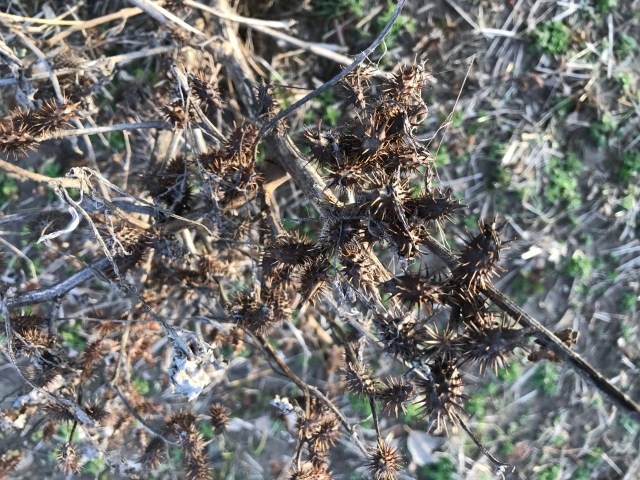
Cocklebur plant in late winter

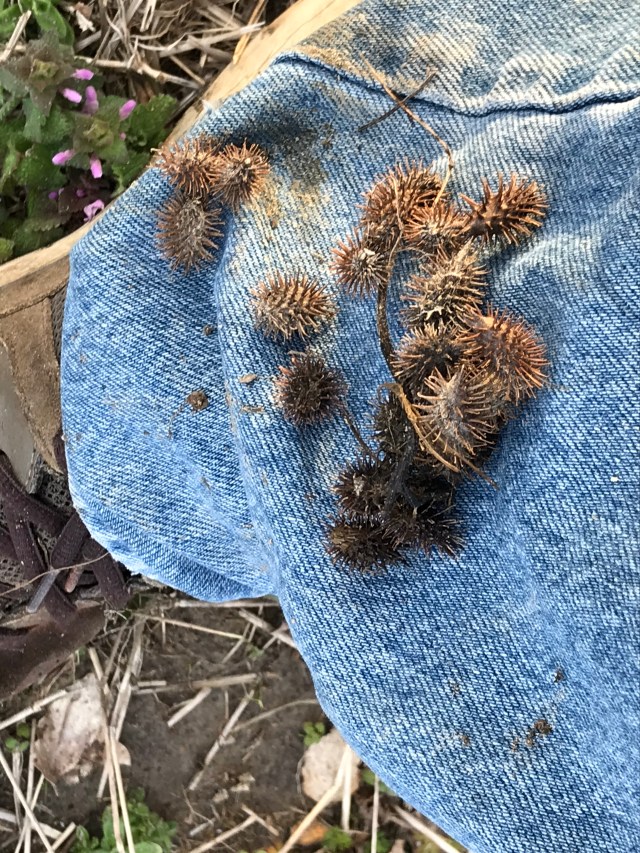
Cockleburs on my jeans

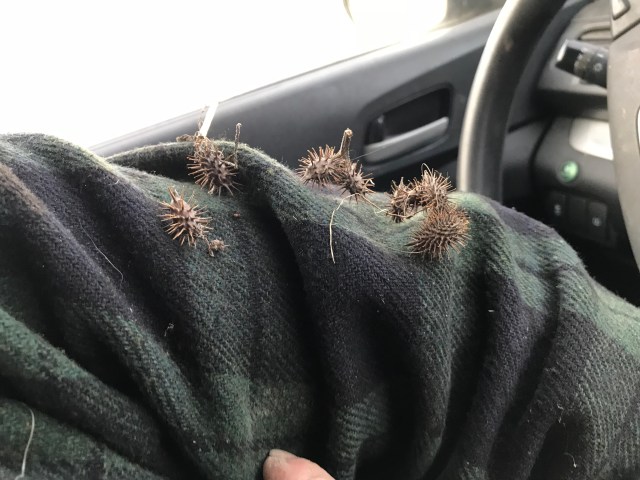
Cockleburs on my coat

Close-up of the burs

Ted Manzer teaches agriculture at Northeastern High School (tmanzer@ecpps.k12.nc.us).

Posted in general nature | Tagged , , , , , , , | 5 Comments

Is manuka honey a wonder cure or another overrated holistic drug?


I was talking to a friend recently about an expensive honey from New Zealand. It’s called manuka honey and it comes from the flowers of the manuka tree. Manuka trees are commonly called New Zealand tea trees and are in the myrtle family.

Raw honey is naturally antimicrobial and has long been used in human and veterinary medicine. My father-in-law used it to treat freshly dehorned cattle. I was shocked when I first saw it.

He removed the horns, which many would consider a brutal process. It really isn’t, because horn removal lessens injury when animals are kept in close quarters.

After removing the horns, he tied off bleeding blood vessels and cleaned the area. Finally, he coated the wound with a thick layer of honey. I can’t recall any surgical sites becoming infected.

I don’t know how much he knew about microbiology. I think he was more concerned about keeping flies from laying eggs. They would die in the sticky honey.

He used local raw honey because it was available and cheap. Raw honey is important since a large percentage of honey in stores has been processed and blended to such a degree that most antimicrobial properties have been lost.

Manuka honey is not cheap. Some medical grade stuff can sell for well over a hundred dollars for an eight-ounce jar. This honey has a high MGO content. MGO stands for methylglyoxal, which is much higher in manuka honey than any other types. This chemical has strong antimicrobial properties.

Pollen from the manuka plant is high in methylglyoxal. However, there is considerable variability. In addition, much honey is mixed from other pollen sources.

Manuka honey that is marketed as medicinal quality is graded on its antibacterial strength called its Unique Manuka Factor (UMF). Values of 15 or greater are much more valuable for medicinal use. Price is much greater, too.

Manuka honey is used to treat acid reflux disease and other digestive system problems like stomach ulcers and irritable bowel syndrome. It also is used to treat tooth decay and gingivitis and it also has been used to combat strep throat.

Not all use is internal. Manuka honey is employed topically to treat skin infections like eczema and acne. Research even shows its effectiveness in controlling MRSA and other serious staph infections.

Burn and wound treatment are other topical uses. Numerous sources also indicate it helps with skin ulcers caused by diabetes. Even ear infections have been treated with Manuka honey. Honeys with higher UMF levels are most often used topically.

Like all honey, manuka is high in sugar and could be a problem for diabetics when consumed internally. In addition, it could pose problems for folks allergic to honey, even with topical treatment.

There are hundreds of articles about manuka honey on the internet. Some promise such superlative results that they are too much for my inner skepticism. Still, due to the sheer volume of research, the product must have some merit. I still suggest contacting your medical professional before jumping headlong into the manuka phenomenon.


Ted Manzer teaches agriculture at Northeastern High School (tmanzer@ecpps.k12.nc.us).

Posted in general nature | Tagged , , , , , , , , | 3 Comments

Bald eagles, ospreys have contrasting styles as predators


Not long after I wrote a column on ospreys, I spotted a pair of mature bald eagles on Northeastern’s campus. I’ve never seen any at school before, but I see them occasionally around Elizabeth city and in surrounding counties.

Bald eagles are a bit larger than ospreys. They eat a greater array of food, too. These powerful raptors catch fish, their favorite food, but they also can take down larger prey. They usually don’t, because that’s too much work.

Eagles don’t like to expend more energy than necessary. Like most predators, they don’t usually take unnecessary chances either. Taking on larger prey like dogs and cats could get them injured. Permanent injury to a predator ultimately means death. Fish are safer.

Ospreys usually make a steep dive for their prey. Sometimes they travel as deep as four or five feet into the water, while eagles catch fish near the surface. These two efficient predators have contrasting styles, and I enjoy watching both.

Eagles fly at a shallow angle when approaching the water. They don’t decelerate much. An adult bald eagle can snatch a three-pound smallmouth and keep right on flying. I’ve seen it.

Large mature bald eagle perched in a white pine in downeast Maine

Eagles also like to view their hunting spots from high perches, rather than fly or glide around scoping out food like turkey vultures do. Eagles also don’t limit themselves to living prey. They are opportunistic and will steal food from other predators.

I saw one eating from a deer carcass once. They will also attempt to pilfer food from other eagles in midair. Bald eagles also like to follow ospreys around and steal from them. Since they are about three times the size of ospreys, the ospreys rarely challenge them.

They also hunt in pairs sometimes. A few years ago, I observed a pair of eagles harvest the offspring from a pair of loons. The communication and coordination were incredible. The loons tried desperately to save their young, but they were no match for the eagles.

We ware all familiar with the appearance of adult bald eagles, but many people don’t recognize what younger ones look like. Eagles don’t develop the classic white head and tail feathers until they reach sexual maturity at four-years-old. Sometimes they don’t mature until they are five.

Immature eagles start out mostly dark colored with dark beaks. Their body colored becomes flecked with white until their fourth year. The beak changes to a bright yellow color by year four. During this time eyes also change from dark colored to bright yellow.

Female bald eagles are slightly larger than males. Both work to build nests, which are often over ten feet deep and eight feet across. Eagles, like ospreys usually fortify their nests every year, so after several seasons they are spectacular. No other bird in North America builds nests as large as bald eagles do.

Alaska is the state with by far the highest population of bald eagles. Cold weather is not the reason, as there is a significant population in Florida. Every state except Hawaii now has growing populations of bald eagles.


Ted Manzer teaches agriculture at Northeastern High School.

Posted in general nature | Tagged , , , , , , , | 1 Comment

Ospreys might be the greatest of all fishermen


I wish I had more time to spend on and around the water. I love to watch the ospreys patrol the skies in search of fish. Some people call them sea-eagles or sea-hawks. In many places, ospreys can only be observed during certain parts of the year, but here in eastern North Carolina they live here year-round.

Forty years ago, sighting an osprey was rare. They faced the same decline as the bald eagle and many other predatory birds. Certain pesticides didn’t break down in the environment very fast. DDT is the one everyone talks about, but there were others.

These chemicals accumulated in the bodies of animals. Those at the top of the food chain became the most contaminated because of a phenomenon called biomagnification. Plants and insects were sprayed and whatever ate them also absorbed the poison. Animals couldn’t rid themselves of these toxins, which became more concentrated. The same thing happened with mercury levels of swordfish and other apex predators in the ocean.

Since about 1970 we have done a much better job reducing chemical contamination of our environment. Eliminating lead in gasoline means there is now far less lead in our air and waterways.

Pesticides and other chemicals never really killed many ospreys. They caused females to lay eggs with thinner eggshells, and the birds were unable to roll and incubate the eggs without breaking them. Therefore, reproduction suffered greatly.

I’m glad their populations have recovered. It’s fun to watch them. These raptors can fly at speeds as fast as 80 miles per hour. They wait until all odds are in their favor. Then they do their thing.

Ospreys are efficient fishermen. Ask any aquaculture farmer and they will tell you that ospreys can steal profits in a hurry. Killing them isn’t an option as they are protected. Harassing them or interfering with their nests isn’t allowed either.

When ospreys catch fish, they position their prey facing forward for better aerodynamics. This is important as these birds carry large payloads for their size. Ospreys look larger, but adults only weigh about three pounds.

Ospreys nest in large elevated open places near water. They build structures bird watchers can monitor with ease. Both males and females help build nests from sticks. They line them with finer materials.

Parents use the same nests year after year and fortify them with more material. After several years these structures become massive. Sometimes nests are constructed at the tops of large dead trees, but utility poles and other man-made structures become the basic framework for many osprey nests.

Females usually lay three eggs which hatch in five to six weeks. Sometimes males help incubate them. Once the eggs hatch, males bring fish back to the nest. Young birds stay in the nest with their mother for about two months.

Older hatchlings usually bully the younger ones when food is scarce. Often, only the first hatched egg survives. Ospreys only hatch one brood per year, so a productive nesting site is critical for survival of the young. Ospreys are long-lived birds and usually breed for about ten years.

Osprey on a nest made on top of a utility pole in Down East Maine


Ted Manzer teaches agriculture at Northeastern High School (tmanzer@ecpps.k12.nc.us).
Posted in general nature | Tagged , , , , , , , | 2 Comments