For me it’s hard to top a mutt


I don’t mean this as a slap toward people with purebred dogs. I’ve just never had a reason to possess one. I have great admiration for the skills these pedigreed canines can acquire and demonstrate. Overall expense for me was never justified.

Watching a good lab retrieve waterfowl in cold windy conditions is captivating. I also enjoy seeing a beagle get the scent of a rabbit or a Brittany do its thing with quail, grouse or pheasants. Border collies and other herding breeds make moving livestock much easier too.

My father-in-law loved his coonhounds. Some cost him a month’s salary and he worked them night after night to earn that money back. He loved his hunting dogs the way western cowboys loved their horses.

There’s no question that if I was a serious hunter I’d probably have a proper dog for the job at hand. The problem is that all I really want is a dog who will be my friend. I don’t need a fancy dog. I’m happy with a mutt.

Now it’s true that mutts can be taught to hunt, retrieve, herd and guide. Some are very intelligent and trainable. We just don’t always know what we’re getting. Champion hunting or herding dogs usually are offspring of the same. Pedigree is highly regarded and experienced people will invest in those animals. Why argue with success?

Your average person doesn’t really need that type of pedigree. Most people want a companion animal and there are a lot of mutts around needing a home.

I must admit there are some advantages of a purebred. The owner knows roughly the size, shape and temperament of the breed. However, temperament and general manners can be trained into a canine. I’m no expert and I’ve done it.

There will forever be arguments as to whether purebreds or mixed breeds are healthier. I’ve heard all the arguments on both sides. You probably have too. We know that whenever we inbreed we narrow the gene pool and concentrate harmful traits.

However, mutts get all the same diseases like hip dysplasia, heart disease, kidney diseases and various cancers. Certain breeds might be more prone to some but all dogs can get them. That goes the same for parasites.

Some purebred connoisseurs might claim that mutts are more likely to have parasites, since they probably did not receive as much medical care early in life. Overall statistics might even show that, but that problem has more to do with treatment than it does breeding.

Nobody is going to herd cattle with a Chihuahua mix. I doubt that little toy dog would make a great rescue animal either, nor would it be proficient at retrieving ducks in cold rough water.

It all comes down to procuring the dog you want and taking care of it. All dogs deserve regular veterinary care and proper nutrition. I’ve owned what some might call worthless old mutts, but these dogs would lay down their life for me in a heartbeat. You can’t buy that at any price.

One of my favorite mutts and a fixture in our family for 11 years

One of my favorite mutts and a fixture in our family for 11 years

Trevor and Blazer

Perhaps my most loyal mutt with his best friend


Ted Manzer teaches agriculture at Northeastern High School (tmanzer@ecpps.k12.nc.us).
Posted in Uncategorized | Tagged , , , , , , , , | Leave a comment

It pays to condition your houseplants before bringing them inside


Cooler weather is approaching and it’s time to think about preparing your houseplants for their return to the inside. Tropical plants thrive outdoors during summer. Sometimes they get too accustomed to those conditions. When that happens they struggle when brought back indoors.

We need to prepare them for an environment with less light and less humidity. These two factors will stress plants. Stress affects their ability to produce sugars for growth and maintenance. It also makes them more susceptible to pests and diseases.

Therefore, we must gradually get plants accustomed to conditions that more closely resemble an interior environment. Ficus trees, for example will drop leaves like crazy if we take them directly from a sunny place to an indoor spot. Even if we place them in a south facing window they’ll still drop at least half of their leaves. If we don’t adjust their water to account for less photosynthesis they might lose even more. With proper conditioning you can still expect to lose about 25 percent of them.

It usually takes five or six weeks to completely acclimatize these trees to handle drastically lower light levels of the interior environment. We’re probably a little past that as I plan to move mine indoors in mid-November, weather permitting. Some more tender plants I’ll move sooner.

Before moving houseplants indoors we must also make sure they are free of pest and disease infestations. Insects are much easier to control outdoors. They become a much greater problem when plants become stressed from reduced light.

Mealybugs, scale, aphids and spider mites are common houseplant pests. They rob plants of energy and make them more prone to diseases. These little parasites also interact with the plants to produce a sticky substance called honeydew. This honeydew gets on carpet, walls, furniture and just about anything else in your house.

Pruning is something else to consider. I like to do it gradually and not too much immediately before moving plants indoors. Pruning encourages growth and we don’t want to do that with winter approaching. We want healthy plants, but we want their growth to slow down. For this reason fertilization going into winter is generally not desirable.

We also need to monitor soil moisture levels. When plants get less light they don’t use as much water. Excessive water means less oxygen to plant roots, which leads to root rot. Some plants, like jade plants, are especially susceptible. They can tolerate being slightly overwatered if they are outside. Indoors they aren’t as forgiving.

I admit I’m generalizing a little. Some plants don’t require as much light and must be kept in dense shade outdoors anyway. Their only adjustment is to the change in humidity. Philodendrons, pothos, African violets and peace lilies don’t require much conditioning.

Keeping houseplants on the porch or patio during the summer is something many folks enjoy. However, due to some of the necessary conditioning involved with moving them out in the spring and inside in fall some people don’t bother. I don’t know how many times I’ve heard people say that every time they move a plant it dies.

Bringing houseplants outside in spring isn’t necessary. Improved growing conditions do rejuvenate them though. Often by the time spring arrives some are pretty spindly. That’s usually an easy fix.

When we bring plants indoors we are generally slowing their growth rate down. There’s no harm in that. All we need to do is not give them mixed signals. Pruning and fertilizing encourage growth. Insufficient light means less energy will be produced to accommodate that. It’s a balance.

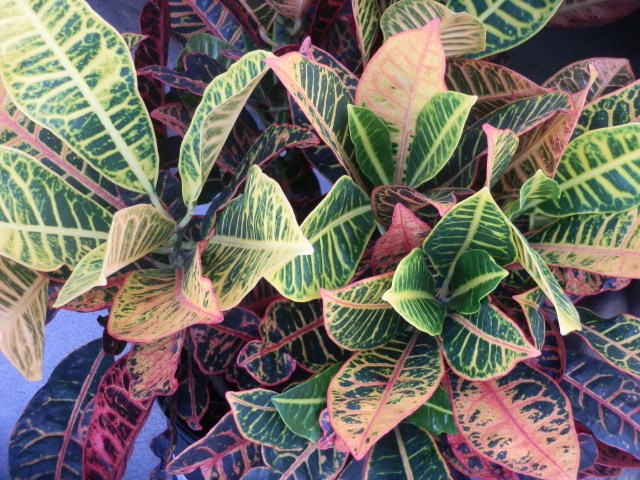
This croton has been conditioned and is ready to go inside.

This croton has been conditioned and is ready to go inside.


Ted Manzer teaches agriculture at Northeastern High School (tmanzer@ecpps.k12.nc.us).

Posted in general nature | Tagged , , , , , , , , , , , , | Leave a comment

Mums are a great fall addition and they come in many colors


It’s October and it seems everyone wants mums. Some want them for parties. Others like them on their porches. Still others add them to flowerbeds.

Mums add profuse color to any setting. Common colors are: white, yellow (the most common color), bronze, burgundy, pink and purple. Dozens of varieties are available in various shades and foliage textures.

If kept pinched most cultivars will bloom for several weeks. Pinching means removing flowers that have gone by. This usually encourages more buds to for and extends the blooming season.

I’m often asked if they’ll come back next year. I guess that depends upon what type of mums they are and how they are treated before they are planted. Like anything else, there is no simple answer.

Some mums are what we call florist mums and they aren’t very winter hardy. Most of the chrysanthemums used around here are hardy mums. That means with proper treatment they will endure the winter and begin growth again in spring.

Many people struggle when trying to over-winter mums. Usually the plants aren’t put in the ground until they are already on their way out. Plants need to establish strong root growth before cold soil temperatures set in. After planting, they also should be mulched. Mulching helps moderate soil temperatures.

Assuming your mum has had time to develop a strong root system it should come through winter in fine shape. Most varieties are hardy well north of us, so outright cold temperature kill shouldn’t be a problem. Other factors could be.

Mums need full sun or nearly full sun to thrive. They also need to be planted where they have well drained soil. Well drained in summer does not always translate into well drained in winter. Just because they are dormant doesn’t mean they can tolerate prolonged periods of wet feet.

Assuming the mums have survived winter they should be pruned back severely several times until about the middle of July. I suggest not letting them get taller than about a foot and trimming off about a third to half for each pruning session. Never let them get taller than a foot high. Depending upon the rainfall or amount of watering they will need to be clipped back about every three to four weeks.

Mums should be planted where the pH is near neutral. Therefore, they are not a good companion plant for azaleas. Mums definitely benefit from regular fertilization. Most soluble fertilizers work well.

Garden mums are what we call short-day plants. This means they form flower buds in response to an interaction of day length, temperature and plant age. All mums aren’t the same. Different varieties flower at different times in fall, based primarily on their responses to day length. That’s why you can go to the garden center and find some varieties showing virtually no color while others are in full bloom.

This light requirement phenomenon can be problematic. Planting your mums in places where there are bright lights could mean less impressive blooming next fall.

Sometimes adding foil and a bow for a single use is sufficient

Sometimes adding foil and a bow for a single use is sufficient and perennial use isn’t important.


Ted Manzer teaches agriculture at Northeastern High School (tmanzer@ecpps.k12.nc.us).

Posted in Uncategorized | Tagged , , , , , , | Leave a comment

Even mean old roosters have a good use.


I know what you’re thinking. They can go in the stew pot. That’s true, but most of those bony old devils don’t even make good fricassee.  They’re great on a fishhook though.

When I was a teenager I was a serious fly-tyer. My grandfather got me started when I was seven and by the time I was in my mid-teens I was pretty good. I even kept a local sporting goods store stocked with a few of my favorite patterns for a while.

I always had my eye out for pretty roosters. I remember one time I was with my grandfather at his fishing buddy’s house. This guy had a mean old bright colored mixed breed rooster, and he was complaining about him. Normy asked me if I wanted him, and I told him that I very much would like the fowl.

Normy laughed at me but my grandfather didn’t. He knew exactly what my intensions were. I wanted those gorgeous neck and saddle hackles. I figured the best use for the meat for crabbing or maybe to catch a coon or two.

The long brown saddle hackles were perfect for tying ‘Queen Bees’, one of my favorite streamer flies. That’s a dandy pattern for landlocked salmon. Those back hackles were also great for a few of my favorite trout wet flies. This old bird also had exquisite long mature neck hackles, great for many of my favorite dry flies.

There’s a big difference between rooster and hen feathers. Hen hackle feathers have a degree of webbing to them and they are rounder and not as long. They’re fine for some wet fly patterns but are totally unacceptable for dry flies or tandem streamers.

Fly tying supplies are expensive. I was a cheapskate and scrounged for all the bargains I could find. A few years later I worked for a college professor who had a woodworking shop on the side. He also got his hands on about twenty big meat chickens. I helped feed them as well as work in the shop. They were major feed burners and grew like weeds.

One evening a fox or a dog slipped through a hole in the coop and killed every one. I carried them two by two to a big hole I dug next to his garden and buried them. However, before I interned their carcasses I skinned out several satisfactory white rooster necks and backs. That evening I toted home a sack full of white feathers.

My mother helped me dye them different colors. We mixed dyes together to achieve the proper hues and I tied flies with these feathers for several years. They weren’t of the same quality of a good old bright colored rooster, but they caught fish.

Since my youth, those hackles are the first thing I notice when I see a rooster. I don’t have time to tie flies like I once did, but I always see value in an old rooster. When they decide to spur me I just admire their feathers a little more. I need to get back into fly tying.

He's young but he has potential

He’s young but he has potential


Ted Manzer teaches agriculture at Northeastern High School.

Posted in foraging | Tagged , , , , , , , , , | Leave a comment

We must be careful when fertilizing lawns and shrubbery


It seems I constantly get asked these two questions. “When should I fertilize my yard and how much do I need to use?” There’s no cookie cutter response to that one.

In general, fertilizer should only be applied during or right before plants are in active growth. This is especially true for nitrogen as it is easily lost by the soil. When plants don’t absorb nitrogen right away, part of what remains in the soil is broken down. The rest winds up in groundwater or our waterways.

This dormancy rule does not apply to adding lime to soil. Lime takes time to react, so applying in fall is often a good idea. I try to refrain from liming and adding nitrogen fertilizer at the same time anyway. Ground limestone and hydrated lime can cause denitrification, releasing nitrogen gas into the air, wasting money.

So why do we need lime anyway? Lime raises soil pH and makes plant nutrients more available. In short, fertilizers are utilized more efficiently and plant growth is better. However, if some is good, too much is not better.

This is especially true around most evergreen shrubbery, which should be maintained in moderately acidic conditions. Some plants such as azaleas, rhododendrons or blueberries should grow in strongly acidic soils, so they rarely if ever require additional lime.

Nitrogen is the most discussed nutrient when fertilizing lawns. Nitrogen deficiency results in stunted yellowish growth. Turf rarely requires additional phosphate except during establishment where it is important for young roots. Potassium is another story.

Potassium (potash) contributes to drought tolerance, cold hardiness, and disease resistance. It’s held tighter and not lost by soils as much as is nitrogen. That’s good. Fall is a great time to add potassium, while fall nitrogen fertilization is only effective if turf is in active growth.

Fertilizing lawns in summer can be risky. If rainfall is limiting, fertilizer can do more harm than good. Most of our fertilizers are applied as a mixture of salts. These can cause plants to lose moisture. We call that fertilizer burn.

Shrubbery generally should not be fertilized with nitrogen in the fall. Fertilizing after plants go dormant simply means it will be lost. A worse problem results when plants are still growing. Winterkill is a major possibility with fall nitrogen fertilization.

All of these problems are magnified if we use high analysis fertilizers. In theory, there’s no difference in applying 50 pounds of 10-20-20 compared to 100 pounds of 5-10-10. We can calculate the proper amount to use, but applying it uniformly is another story. Overlapping too much could be problematic using concentrated fertilizers.

Some folks think they should always add nitrogen to plants with yellowish color. This is not always true. The best thing to do is perform a soil test. It won’t reveal the level of nitrogen in the soil but nitrogen might not be the problem.

Sometimes yellow color is the result of low iron availability, a phenomenon called iron chlorosis. Wet soils, excessively dry soils and low light intensity can exacerbate this. It can be prevalent in lawns, shrubbery, flowers and vegetables. Adding iron or lowering pH slightly can change foliage color in as little as a couple days.


Ted Manzer teaches agriculture at Northeastern High School (tmanzer@ecpps.k12.nc.us).
Posted in general nature | Tagged , , , , , , , , , , , | Leave a comment

Fall Clematis is a vigorous white vine that’s easy to grow


I drove to the beach two weekends ago and saw huge expanses of white flowers along the roadside through Tyrrell and Dare Counties. I recognized the vine immediately, but it has been a long time since I traveled that stretch of road in the fall. The flowers in question are Fall Clematis (Clematis paniculata), sometimes called Sweet Autumn Clematis.

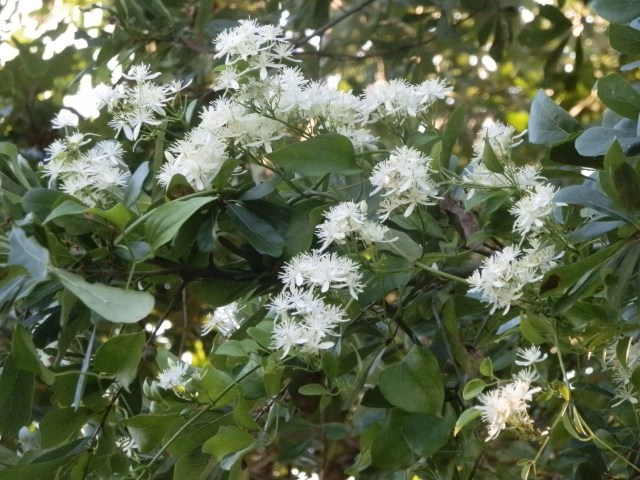
Fall Clematis vine climbing a water oak tree on the edge of my property

Fall Clematis vine climbing a water oak tree on the edge of my property

A few weeks back I wrote about clematis. Most types are difficult to establish. This one isn’t. In fact it can be quite invasive. It’s great for covering buildings and the transformation is quick.

I have several of these vines along the edge of my property and they make a breathtaking fragrant natural screen. However, since they’re a vine they will grow on adjacent shrubbery and up nearby trees. I love these plants, but they can get out of hand.

This type of clematis flowers on the current season’s growth, so aggressive pruning is usually advantageous. Plants also tolerate partial shade and still flower heavily. Containing the vine is simple, since it can be pruned to the ground in spring with no ill effects. For that reason I don’t worry that it’s so aggressive.

Individual flowers are small and not dramatic like some clematis types. The impact of these vines is the true volume of bloom. Entire expanses can be white and the sweet smell is truly another plus. Plants also bloom late into the fall, often until frost. This year they aren’t hanging on as long.

Fall Clematis also doesn’t require cool roots like most types do. I’ve also found it’s more tolerant of high soil moisture too. Furthermore, this hardy vine is highly deer resistant.

That shouldn’t be very surprising. Clematis are in the buttercup family. That group of plants is notorious for being poisonous. Delphinium, wolf’s bane and hellebore are just a few examples of highly toxic ornamentals from that family.

We’re not planning to eat any of them, so I don’t consider toxicity a problem. One exception might be if this vine covered a pasture fence. Normally livestock would avoid it, because its palatability would be very low. However, if the pasture became severely depleted, the animals might resort to eating it. That could be disastrous.

Another potential problem might result for people highly allergic to bees. Bees and butterflies love these flowers. I always notice a constant hum when I walk out to admire my Fall Clematis. That said, bees are usually docile and don’t attack unless strongly provoked.

I think people can get paranoid if a plant is listed as poisonous. In most cases fears are overstated. Many flowers in our gardens are not safe to eat. Rarely is there ever a problem, but some folks freak out if they read a plant has toxic properties.

So don’t worry about Fall Clematis. Enjoy its aroma and explosion of white blooms. If it starts to get out of hand, simply prune it back to within a few inches of the ground in late fall to early spring. As for now, keep your eyes open along the eastern North Carolina roadsides. It’s out there.


Ted Manzer teaches agriculture at Northeastern High School(tmanzer@ecpps.k12.nc.us).

Posted in general nature | Tagged , , , , , , , , , , | 2 Comments

Keeping game from spoiling is an important hunting skill


Hunting season is fast approaching. In fact, dove and Canada goose seasons are already in, and I hope hunters can thin those resident geese out a little. Whitetail deer archery season opens this weekend.

I never seem to find the opportunity to get out like I once did, but when I was younger this was a very important time for me. I remember my father had two rules. The first was to never take bad shots and risk wounding game. The second was to make sure no meat was wasted.

When I was in high school I recall many of my fellow students pontificating about hunting and processing game. I remember guys talking about their grandfather always waiting at least three days before skinning and cutting up a deer. That’s fine if daytime temperatures are 40 but not if they are 70 or higher.

Bacteria cause meat spoilage and they multiply in a warm moist environment much faster than a cool dry one. Basically, we need to cool meat out fast. That means field dressing as soon as possible. Removing the hide in timely fashion is important too.

I’ve viewed countless photographs of bucks hanging by the horns with the hide on. I’ve even queried a few hunters and most told me it helps them bleed out completely. Take my word for it; it isn’t a good practice.

Game needs the body heat removed as quickly as possible. If a cooler isn’t available, try quartering the animal and icing it down in a cooler. When I have to do this I also add enough water to make the mixture slushy. This ensures uniform contact and even cooling.

I also add about a pint of vinegar to help marinate and tenderize the carcass. Leave the lid open to allow airflow. I never pack meat in the freezer until all body heat is removed. Ventilation during the cooling process helps remove volatile compounds that can lead to off-flavor.

Cooling the meat from body temperature to freezing too quickly can make it tough. Conversely, overloading a freezer with warm meat isn’t good either. It’s best to chill freshly killed meat as quickly as possible but not freeze it immediately.

Some folks prefer to age their meat in a refrigerator and if you have space that’s fine. I’m usually short on refrigerator space. Aging meat properly yields a superior product, but it takes experience and skill. When aging, one should trim off excess fat as it may become rancid and ruin flavor. This is true for most wild game but from what I have heard is not as critical for beef.

Probably the most important part of handling meat comes before you even get your prize home. In the case of deer and other large mammals the dressing process is critical. Deer have scent glands on their hind legs. They should be removed as soon as possible, preferably with a different knife than is used for the rest of the job. I always carry two knives.

I’ve always enjoyed caring for the meat even more than making the kill. Maybe I’m just weird that way, but it’s how I was raised.

Vacuum packaging is a great innovation to lengthen storage  time and maintain quality

Vacuum packaging is a great innovation to lengthen storage time and maintain quality


Ted Manzer teaches agriculture at Northeastern High School (tmanzer@ecpps.k12.nc.us).

Posted in foraging | Tagged , , , , , , , , | Leave a comment

North Carolina is home to many carnivorous plants


Last week I profiled the Venus flytrap (Dionaea muscipula). Most folks are familiar with that one, but there are several more insect consuming plants in our locale. We don’t often encounter them since they usually live in wet boggy areas. Some live submerged in water.

The most common insect lover is my favorite, the pitcher plant (Sarracenia sp.). Several species abound locally. They are called pitcher plants because modified leaves form structures that hold water and look like pitchers.

These pitchers possess downward facing hair-like structures that keep insects from escaping. The hollow receptacles contain nectar that lures their prey down into the enzyme containing liquid. Before long the insects are digested. Sometimes even frogs fall prey to these plants.

Not all trespassers are trapped though. A species of parasitic wasp builds its nest inside the pitchers and is not harmed by the environment. Many spiders are also able to enter and exit without consequence. They can even steal some of the goodies.

I enjoy hitting the Maine blueberry bogs every summer. My main goal is obvious, but I also love admiring the pitcher plants. These bug catchers are usually chartreuse trimmed with red, but color can vary greatly. Some types have long narrow pitchers, while others are short and broader.

Another carnivorous plant I see in the blueberry bogs is also a Tar Heel State resident. Sundews (Drosera sp.) have hair-like structures that produce a sticky material. It works like the old-fashioned fly strips. Leaves usually contribute to the capture by enveloping the victim.

Sundews are easily overlooked because of their small size. Often they are confused with Venus flytraps from a distance. Both are reddish and possess leaves with spiny edges. Upon closer scrutiny the difference is obvious.

North Carolina is also host to an aquatic insectivore called a bladderwort (Utricularia sp). They are usually overlooked. Most of the time plants are entirely underwater. However, in late spring and early summer they bloom. Clusters of white yellow or purple flowers resembling pea flowers emerge above the surface.

Many people have seen bladderworts in fish tanks. Plants have no roots. They have hollow structures a little like those of pitcher plants. These hairy edged bladders are touched by aquatic insects and that triggers them to suck in their prey.

All carnivorous plants have two things in common other than trapping insects. First, they all live in relatively infertile environments where most plant life struggles. The terrestrial species all favor acidic soils. Bladderworts are most common in slow moving acidic waters.

Secondly, they all live in areas with subfreezing temperatures. Some dwell as far north as central Alaska and northern Canada. Pollution is a far greater threat than cold temperatures.

Many of these unique plants are also protected from harvest or any other type of molestation. If you would like to use one in your landscape or keep as a houseplant you should research thoroughly. Choosing the wrong species even without ill intent could get you in trouble. It’s best to buy these guys only from reputable nurseries.


Ted Manzer teaches agriculture at Northeastern High School.

Posted in general nature | Tagged , , , , , , , , , , , , , , | Leave a comment

Venus fly traps are native plants and really cool


One group of plants that seems to fascinate people, particularly children is carnivorous plants. The one we think of first is the Venus fly trap, which is actually native to North Carolina. Its range is small and encompasses a small area near the coast along the border of North and South Carolina.

Venus fly traps are difficult to grow. They are also protected, so don’t try to find them and dig one up when you’re in the Wilmington area. There’s a thriving black market business, and getting caught in the middle could be costly.

People have a misconception that because these plants are only seen growing in pots they must be tropical. This obviously isn’t true. Winter temperatures in that locale can dip below 20 degrees.

Venus fly traps must endure a cool period during the year. The key here is that they must be allowed to go dormant during this time. They shouldn’t be fertilized or fed with insects. It’s winter to them.

Plants also require fairly high light levels to thrive. Native specimens live in a naturally humid environment but they adapt well when humidity levels are lower. Many people try to grow them in terrariums with other plants and don’t allow them the dormant period they require. The fly traps inevitably perish.

These curious insectivores should reside in a place with good light for a long duration. Plants respond well to an outside environment, at least for most of the year. Around here there may be times they should be moved inside. However, one should choose an area that would not encourage growth.

One problem many people have is that when Venus fly traps are first bought they already are on a downward spiral. Likely they have been subjected to insufficient light and improper watering. These plants like lots of light, but if you place them directly from a dim to a sunny location without conditioning them they will sunburn and die. Increase sun exposure gradually.

Proper watering with rainwater or distilled water is best. Most tap water around here is too hard and plants struggle. In their natural habitat fly traps grow in boggy areas. That might make you think they require lots of water. They don’t.

Soil should be well drained but kept moist. Plants should never be wet. This is especially true in winter when they’re dormant. Watering into a tray like many do for African violets is probably the best method. Never allow water to remain in the tray very long during winter.

Above all, don’t over fertilize them. Venus fly traps require infertile soil to thrive. Don’t use commercial potting mixes with fertilizer in them. A mixture of peat moss and very coarse sand or perlite is good. I like sand because it is heavier so pots are less likely knocked over. Sand also won’t float to the top of the pot after a rain.

Venus fly traps can be difficult mostly because their requirements are different than most of our plants. They’re really cool though.

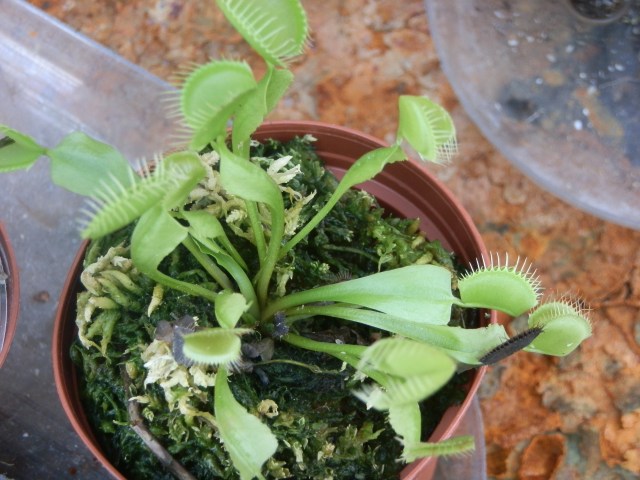
Venus flytraps are fun to grow but easy to kill

Venus flytraps are fun to grow but easy to kill

Ted Manzer teaches agriculture at Northeastern High School (tmanzer@ecpps,k12.nc.us).

Posted in Uncategorized | Tagged , , , , , , | Leave a comment

Clematis fills a niche but is often difficult to establish


Well established clematis vines are breathtaking when in bloom. Large showy flowers can adorn a mailbox, fence or lamp post and bring it alive. Hundreds of cultivars are available in a cornucopia of colors, sizes and blooming seasons. The problem is that too often gardeners can’t get those fussy vines to live past their second season.

Clematis has interesting and rather unique growth requirements. Plants require bright sunlight to flower, but they must have cool shaded roots to grow. Usually this is accomplished by some type of companion crop in combination with mulching.

Even with proper planning it’s often difficult to nurse these vines to maturity. Once there, clematis often outlives the gardener. Fertilization is helpful but never during the blooming season.

Since we’re talking about a vine, we must consider some type of support. Otherwise a sprawling unkempt eyesore will develop. That is unless the plant dies, which is likely. Clematis needs string, fishing line or wire to begin its climb to a permanent support.

Soil should be well drained. High organic matter is helpful as clematis dry out easily. Well drained and moist sounds like a contradiction in terms, but that condition is necessary for healthy growrh. Acid soils must be amended to near neutral pH.

Once plants become established, pruning is necessary. Usually vines are pruned in late winter to early spring. Waiting too long will delay flowering. Some types can be cut to the ground in early spring, while others must be pruned more sparingly. Experience with various cultivars is the best teacher.

Slugs are a common pest of clematis. This is often exacerbated by planting hosta to shade clematis roots. Earwigs attack flower buds and disfigure the blooms. Grazers like deer and rabbits like clematis foliage and can be a major problem in some locales.

Their primary disease is Clematis wilt caused by several different fungi. Spotting leaf margins, browning leaf blades, wilting and leaf drop are dominant symptoms. Older lower foliage usually is most affected.

Proper pruning, fertilization and general environmental conditions like moisture and light help reduce the problem. If wilt occurs on your plant, cut it to the node below where the infection or wound appears. If no leaves are evident a couple inches should be sufficient.

Healthy flowering clematis vines are alluring. Many folks like to use various flowers as decoration on cakes and salads. Clematis should not be used since its flowers are poisonous. Skin irritation, vomiting and diarrhea are probably the worst problems for humans. Toxicity isn’t severe. I have read problems might be greater in dogs, cats and horses.

Clematis isn’t edible, but I view some literature with a grain of salt. A University of California toxic plant site lists choke cherry as highly toxic. I grew up eating them both fresh and in homemade jelly with never an adverse effect. I never consumed the poisonous seeds. I never plan to eat clematis.

Still, individual experience must be the teacher. Consume any new foods, especially nontraditional ones, in small quantities initially.

clematis vine in bloom

clematis vine in bloom

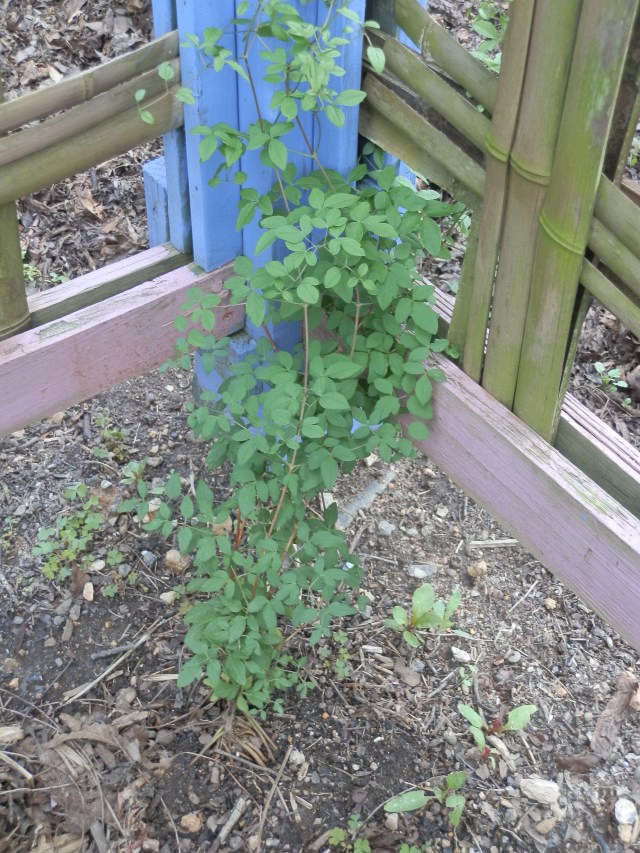
Clematis foliage early in the season

Clematis foliage early in the season

Ted Manzer teaches agriculture at Northeastern High School.

Posted in Uncategorized | Tagged , , , , , , , , , | Leave a comment