Nasturtiums are colorful flowers with many uses


Nasturtium is an annual plant with attractive flowers and unique looking lily pad-like leaves. It’s easy to grow and totally safe around children. Leaves and flowers are both edible.

Nasturtiums thrive in sunny locations on infertile soil. Strangely enough, high fertility yields fewer blooms. These flowers range in color from yellow, through orange and peach hues all the way to bright red.

Five petaled flowers are about two inches across and have a prominent structure called a nectar spur. This structure looks something like the similar structure on columbine and also resembles the bracts on impatiens. Leaves are either solid green or variegated.

These brightly colored flowering plants can be started indoors or simply planted from seed. I prefer to do that. The seeds are relatively large for annual flower seeds. They are about the size of chickpeas and look like little brains.

Plant them about an inch deep when soil temperatures are above 50 F. In less than two weeks little nasturtium plants will pop up and quickly fill the area. Thin them if necessary.

Plants grow well in sandy infertile soils, but they must be kept from drying out. A little added organic matter can improve their health. Some watering is usually necessary but don’t over water them.

When your stand of nasturtiums thickens you may begin to harvest flowers and foliage for salads. A little extra water at this time can be helpful. Nasturtium flowers and foliage have a slight peppery taste which is made stronger by water stress. Removing flowers will also keep plants flowering longer.

Nasturtium flowers add flavor as well as make a colorful garnish. Leaves are often used cooked as well as in salads. Both, especially the flowers, make a spicy herbal tea.

Numerous sources claim nasturtiums repel whiteflies, squash bugs, cucumber beetles and striped pumpkin beetles. I remember my grandfather always planted them in his vegetable garden. He always grew bountiful crops of cucumber and squash on that sandy Maine glacial till.

Another thing I do remember is that aphids and slugs often attacked them. For that reason some people plant nasturtiums as companion plants to lure pests from other crops. I’m not entirely sold on that.

Therefore, when growing nasturtiums to eat, they should be washed thoroughly. Eating aphids won’t hurt you but I have no desire to consume them. I worked with a graduate student who put aphids on peanut butter sandwiches and it nearly made me sick. He thought it was funny, but I managed to convince him not to do it in my presence again.

Herbalists have long touted this plant for its medicinal uses. It has strong antimicrobial properties and has been used for urinary tract infections. It also has been used to treat cuts and abrasions for bacterial infections. Nutritionally, leaves and flowers are good sources for vitamins A, C and D.

Whether you want to eat them, use them medicinally, employ them as pest repellants for your garden or simply enjoy their uniqueness and beauty, Nasturtiums have something for everyone.

Nasturtium showing lilypad-like foliage and flowers with nectar spurs

Nasturtium showing lily pad-like foliage and flowers with nectar spurs growing among the herbs


Ted Manzer teaches agriculture at Northeastern High School (tmanzer@ecpps.k12.nc.us).

Posted in foraging | Tagged , , , , , , , , , | Leave a comment

Horse nettle is a toxic tomato imposter


Anyone with a vegetable or flower garden has probably encountered a prickly weed with white to pale purple flowers with yellow centers. If plants are not removed from their location these flowers develop into yellow fruits resembling cherry tomatoes. This isn’t surprising as they are in the same family.

The plant is horse nettle (Solanum carolinense) and I’m convinced that this common weed could be part of the reason many North Carolinians once thought tomatoes were poisonous. All parts of the horse nettle plant are toxic. The yellow fruits, borne in clusters and strongly resembling tomatoes are very toxic. They are poisonous to livestock too, but animals are smart enough to leave them alone.

When I lived in West Virginia the people there called this spiny demon sand brier. It was probably more prevalent than it is in this locale. I cursed this weed every time we put up hay. My fingers, hands and arms were constantly inflamed from prickles embedded in my skin. Feeding it in winter wasn’t much better.

Surprisingly, nobody that I knew ever had any problems with livestock getting sick. I suppose the animals must not have ingested enough to hurt them. I certainly can’t blame them from picking around the spiny stuff.

Children are especially vulnerable to horse nettle toxicity. The pernicious culprit is an alkaloid called solanine. Fruits are bitter tasting and would not be palatable anyway, but children are smaller. Therefore, they need a smaller dose to be affected.

Common toxicity symptoms are: headache, nausea, vomiting, abdominal pain, and circulatory or respiratory problems. Ingestion of too many berries, particularly late in the season can even cause death. We need to be able to identify it and teach youngsters to avoid eating it even though it looks intriguing. Obviously we eliminate it from around our homes, but it’s common in many places children might play.

Horse nettle leaves remind me of eggplant foliage, another potato family relative. Plants are usually less than two feet tall and somewhat erect. Flowers favor those of potatoes more than tomatoes. This shouldn’t surprise as horse nettle is more closely related to potatoes.

Many gardeners and environmentalists rail on the problems caused by exotic species invading the landscape. I’ve read articles stating that if we just kept our plant selections limited to native species our environment would be better. Well, horse nettle is a native plant. It’s a perennial weed common throughout most of the country.

Many common broadleaf herbicides will control horse nettle. A combination of 2,4-D and dicamba works fairly well. The problem is that horse nettle has an extensive underground system of roots and rhizomes. Often chemicals will kill the above ground portions of the plant but those parts underground are less affected.

Additionally, failing to remove plants from the area means they will likely spread from copious amounts of seed. My recommendation is to learn to recognize this plant when it is young and physically or chemically remove it as soon as possible. Spines are less objectionable when plants are young.

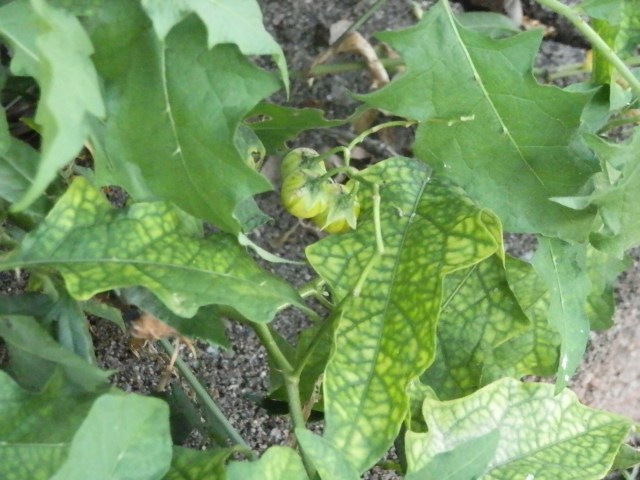
Horse nettle plant growing among the rose bushes

Horse nettle plant growing among the rose bushes

Cluster of horse nettle fruits

Cluster of horse nettle fruits


Ted Manzer teaches agriculture at Northeastern High School (tmanzer@ecpps.k12.nc.us).
Posted in foraging | Tagged , , , , , , , , , | Leave a comment

Feral cats are an overlooked invasive species


A few weeks ago I wrote about invasive species. Usually we think of plants when we use that term, but several animals fit the definition too. Domestic cats are a good example.

My neighborhood is overrun with feral cats. There are times I have over a dozen on my front porch. The most likely reason is that I have an outdoor cat and I feed her outside. I might have to change that.

It’s not that I hate cats. In fact I like the fact that I have never seen a mouse or rat around my house. I do feel somewhat sorry for the little felines, so I don’t begrudge that they steal about half of my own cat’s food.

My biggest problem with feral cats is that they can spread disease both to pets and people. They carry toxoplasmosis and other diseases. Toxoplasmosis is a potential nightmare for pregnant women and it’s spread through cat feces. Feral cats also fight with pet cats and these wounds can get infected and cause other problems.

We also can’t overlook the possibility of rabies, which is spread in the saliva of infected animals. Bats, skunks, foxes and raccoons have been the leading traditional suspects, but feral cats are becoming increasingly problematic. In many places they may now be the biggest rabies transmitter. Compared to wild animals, people don’t think about a house cat giving them rabies. The problem is that these cats are wild animals. While a smaller percentage might be infected, interaction with humans or their pets is greater.

Cats are prolific breeders. They become sexually mature at about six months of age and their gestation is slightly over two months. Furthermore, cats are what we call induced ovulators. That means that the act of breeding stimulates a female cat to release her eggs. Because of this and the overabundance of tomcats, virtually all wild queens will become pregnant. If they receive good nutrition cats can easily raise three litters in a year.

Feral cats can have a drastic impact on wildlife populations. Cats are very efficient predators. Many birds and small mammals both game and non-game fall prey to them. Feeding them calls in other animals like raccoons, opossums, skunks and foxes.

Killing feral cats is not a practice acceptable to the general public. I agree for several reasons. Human safety, property damage and killing someone’s pet are just three. One popular practice is the trap, neuter and release program. Once caught, females are spayed, males are neutered and both are released back into the same environment.

Failing to catch the entire population weakens the effectiveness of this technique. Sometimes feral cat populations aren’t greatly affected even if a majority of the animals are caught and sterilized. Furthermore, sterilized cats have much longer lifespans, particularly in high traffic areas.

So what do we do? Feral cats are difficult to tame and therefore are poor candidates for pets. I think the long-term solution is to make sure all domestic cats are spayed or neutered. Feral cats are a human induced problem that gradually worsened and we need to work together to solve it regardless of our strategy. It won’t be a quick fix.


Ted Manzer teaches agriculture at Northeastern High School (tmanzer@ecpps.k12.nc.us).
Posted in Uncategorized | Tagged , , , , , , , , , | 1 Comment

Poppies are an old time finicky favorite


I often get asked about raising poppies. In my opinion they are among the most beautiful flowers.  However, most types are difficult to establish, especially the large flowered types.

I’ve seen clumps of poppies that were far older than me, but it’s been my experience that getting plants past their second season is the problem. Sometimes folks struggle because they don’t know how poppies grow.

Poppies go into dormancy in summer. Their foliage dies back to the ground and people try to stop it by fertilizing, cultivating or overwatering. This treatment can kill the plants before they break dormancy. Poppies take patience, especially in zones warmer than seven. Poppies don’t like heat.

Some people lose their poppies right off the bat. Plants have a taproot system just like a carrot. Transplanting is difficult and if done at a stressful time like a hot dry period, plants won’t recover. That’s the main reason gardeners often kill their poppies when they try to move them.

Here’s the environment that will make poppies thrive. They like a soil pH that is approaching neutral and must have full sun for eight hours or so. Soils must be well drained, especially in winter. That’s when most root damage occurs. Poppies aren’t heavy fertilizer users, and early spring is the only appropriate time to feed them.

Poppies may be established by seed. Believe it or not it’s usually better to direct seed them rather than transplant seedlings. When transplanting established plants, prepare a deep bed as poppies have long taproots. Avoid planting them during hot weather and try not to disturb the root system.

Once established, a clump of poppies can remain healthy for decades. Unlike other perennials, they don’t need to be moved or split up every few years. A little weeding and a light application of mulch in late fall is all that’s necessary.

Other than establishment difficulties, the biggest problem with poppies is that their blooming season is short. They’re gorgeous for a few weeks in late spring, but after that they wither and die back. Only the distinctive seedpods remind us they were ever there.

Many folks save the pods as they are attractive in dried floral arrangements. Some even save the seeds to use in baking. Poppy seeds provide us with linoleic acid, one of the essential fatty acids. Sometimes you will see it referred to as Omega-6.

Once plants die back in early summer, their space may be filled with annuals or later blooming perennials. When the weather cools in the fall, poppy foliage will reemerge. This helps energize the roots for the following spring. Even a light frost will kill this lush growth to the ground but that’s fine.

For those who have outdoor pets, poppies contain chemicals called alkaloids, which are toxic. Alkaloids are bitter tasting substances, and dogs and cats generally don’t seek them out or like them. I’ve never heard of anyone losing a pet to poppies. However, if you fear your pet might have consumed some you should consult your veterinarian.

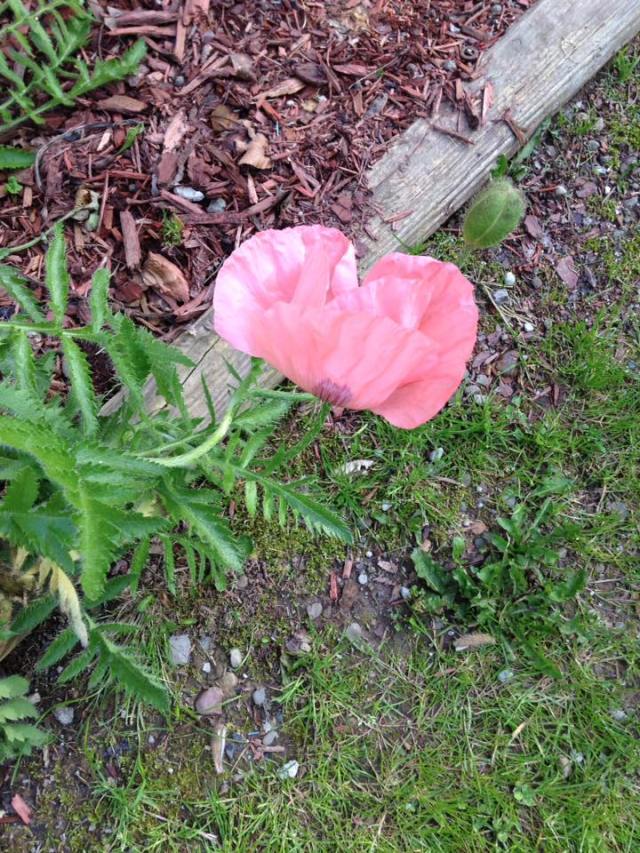
My sister-in-Law's favorite flower

My sister-in-law  Teresa’s favorite flower

Ted Manzer teaches agriculture at Northeastern High School (tmanzer@ecpps.k12.nc.us).
Posted in Uncategorized | Tagged , , , , , , , , , | Leave a comment

Explore every angle to combat mosquitoes


A few weeks ago I wrote about ways we could get the upper hand on mosquito populations. Eliminating their habitat is the best option. However, living in a region with ubiquitous standing water, that can be difficult.

Many plants contain chemicals that repel mosquitoes. Citronella grass, lemon balm, lavender, catnip, rosemary, marigold and scented geraniums (what most people call citronella) are just a few. Several of these are either attractive ornamentals or useful cooking herbs.

The problem is that a little may not be enough. These plants must be planted in dense populations to be effective. One or two plants on the patio won’t cut it. That is unless we rub these plants on our skin.

Here’s where the herbs are promising, at least in the beginning. I seldom use insect repellants, so when I find myself in dense mosquito or yellow fly populations and have no fly dope or domestic herbs I reach for nature. Crushed dog fennel or wax myrtle leaves have natural insect repellant properties. The problem is that they need to be applied often as effectiveness is short-lived.

Unfortunately, that’s the same problem we have with the herbs I mentioned earlier. Numerous sources cite that catnip can be as much as ten times as effective as DEET, the most widely used commercial product. If we were only to be outside for a few minutes this would be true. Frequent reapplication is necessary though. DEET will last a few hours. Most herbals only last a few minutes without retreatment.

As chemicals go, DEET is generally considered safe. In fact it is labeled for infants as young as two months. Concentration should be less than 30%. It’s not quite that simple, so we must consider potential problems. DEET has an average dermal LD50 of about 3300 and an oral one of about 1100 depending upon the animal tested. LD50 is a measure of toxicity and it’s relatively low. That’s good.

Here’s the bad. Chemicals absorb into thinner less mature infant skin more quickly. Furthermore, babies and toddlers are more likely to lick their arms and hands and ingest the chemical than adults are. Children also don’t hold still, so we must be careful to keep spray from their eyes. Finally, kids are smaller, so doses are magnified.

Other chemicals are out there. When I was a kid my mother used a lot of Avon products. One was skin-so-soft. Mom often mixed this stuff with baby oil as many Maine woodsmen lathered their hardhats with baby oil to control blackflies. Hardhats went from bright yellow to black by day’s end.

All the research I found showed that this product far less effective than the old standby, DEET. You can bet companies are busy at work trying to develop herbals with DEET’s long-term effectiveness. In the meantime be prepared to apply natural products frequently.

Also, use netting where infants are exposed to mosquitoes and consider screening open porches. Above all, consult your medical professional if you or your children develop a rash you think may be the result of some insect repellant, natural or otherwise.


Ted Manzer teaches agriculture at Northeastern High School (tmanzer@ecpps.k12.nc.us).

Posted in Uncategorized | Tagged , , , , , , , , , , , , , , | Leave a comment

There’s a tomato for everyone


Tomatoes continue to be the most common garden vegetable plant. Actually they aren’t really a vegetable at all. They have seeds in them, so they are a fruit.

Tomatoes have two growth habits, determinant and indeterminate. Determinant types are usually shorter and basically fruit all at once. Indeterminate types continue to fruit until they are killed by frost.

Determinant varieties are often used for canning, since they mature in bunches. Popular varieties are: Celebrity, Roma, Rutgers, Homestead and Amelia. Newer ones are: Spitfire, Solar fire, Sunbeam and Sun Master. Popular indeterminate varieties are: Beefmaster, Big Boy, Better Boy, Early Girl, Jet Star, Park’s Whopper, San Marzano, Yellow Pear and Brandywine.

Colors, sizes and shapes are almost too numerous to mention. Often you’ll also hear the term heirloom bandied about. Heirlooms are simply open pollinated selections handed down over several generations. Back in the day people saved seeds from year to year. Some commercial tomato varieties are marketed as heirloom simply because they have been around so long.

Brandywine is a popular heirloom variety with tremendous flavor. Seedlings are easy to recognize because the leaves resemble potato foliage. German Johnson is a huge pink fruited heirloom. It is a parent to another wildly successful huge fruited variety called Mortgage Lifter, a beautiful solid beefsteak type. Other popular heirloom tomatoes are: Black Cherry, Yellow Pear, Rutgers, Marglobe, Mr. Stripey, Roma, Beefsteak, Golden Jubilee, Arkansas Traveler and Cherokee Purple.

Most tomatoes on the market are what we call hybrids. They are bred from at least two other tomatoes and the seeds either are sterile or will not breed true to type. In other words, if you plant the seeds you will not get what you started with.

Better Boy is a good example. You wouldn’t want to save and plant the seeds, although some might actually be better than the original. The problem is you don’t know what you’ll get.

One trouble we have in our climate is getting tomatoes to set fruit in hot weather. Most varieties struggle, but some of the newer cultivars have been selected for that trait. Popular large fruits are: Manalucie, Big Beef, Sun Chaser and Super Fantastic.

Sweet 100 is an indeterminate cherry tomato that sets amazing quantities of fruit in hot weather. A single plant is usually enough for most families.

Everyone knows tomatoes can be picked green and ripened on the shelf. What many don’t realize is that once a fruit is removed from the vine sugar production ceases. So even though the tomato ripens overall quality must be much lower than one ripened on the vine.

What is the best overall tomato cultivar? That’s a loaded question. It depends upon what you want. If you want to impress your neighbors on your big tomato growing prowess you might try German Johnson or Mortgage Lifter. The problem there is that they show little disease resistance, so you better be lucky and escape it.

For general use I like meaty medium sized tomatoes that are sweet but have a strong acid tang. Most large fruits are seedy with a lot of waste. My favorite all-purpose tomato is a selection developed by a truly great guy I knew in graduate school. Dr. Mannon Gallegly was the department chairman and he bred a gem called WV-63. It’s often called the West Virginia Centennial tomato.

The only problem with this one is that I’ve never been able to get the same type of production from it in eastern Carolina as we did in the mountains of West Virginia. That’s truly a shame. What’s not a shame is that Gallegly is still active Professor Emeritus in his mid-nineties.


Ted Manzer teaches agriculture at Northeastern High School.

Posted in foraging | Tagged , , , , , , , | Leave a comment

Three tomato diseases that can destroy the whole crop


There are numerous diseases that affect tomatoes, but I’m only going to focus on three. As far as I’m concerned they are important, since few common cultivars have been bred for resistance.

Because of our hot humid climate in eastern Carolina, bacterial wilt is a disease of great importance. Bacteria live in the soil and enter plants through wounds, usually from transplanting.

Once plants contract the disease they wilt but leaves stay green temporarily. If you are sure this isn’t water stress, remove these plans from the area immediately. There is no feasible chemical control. The only variety I have encountered that shows even partial resistance is Kewalo.

The most common tomato disease prevalent with our sandy soil is blossom end rot. It is more properly considered a disorder, as the problem is not caused by a pathogen. Water soaked spots develop at the ends of the fruits and they expand and eventually become black. This rotting is caused by a secondary infection.

What initially causes blossom end rot is a calcium deficiency in the soil and sandy soils are usually low in calcium. Often fluctuating soil moisture plays a part too. So does excessive ammonia nitrogen fertilization. Calcium nitrate is probably the best nitrogen fertilizer to use.

Soil calcium must be kept high, but sometimes this can cause soil pH to become too high. On sandy soils I would recommend using gypsum in conjunction with lime to keep the pH stable and calcium levels sufficient.

A handful of varieties show some resistance to blossom end rot. The only ones that are also well adapted to the heat and humidity we have in the coastal plain are Ravello and Manalucie. Ravello is a paste type resembling Roma. Manalucie is a large heirloom type.

The latest tomato plague to this area is the tomato spotted wilt virus (TSWV). This disease is causing increased frustration locally. TSWV is spread by thrips, tiny insects similar to the ones found on wheat at harvest time. These insects contract the virus from weeds and carry it to the tomato plants.

After several weeks some plants may look stunted. Younger ones usually wilt and die. Some leaves develop dark spots and/or purple veins. Often the foliage looks twisted almost resembling herbicide injury. Fruits usually have yellow spots.

The first step in combating this disease is sanitation. Keep the area as weed-free as possible and make sure adjacent places are mowed. Crop debris from the previous year’s growth may be contaminated with thrips, so remove old crop residue and mulch the area for the winter. This will discourage weeds. Promptly remove any plants which show symptoms of TSWV.

Several newer varieties show promise. The first cultivar with TSWV resistance was Amelia, an attractive bright red tomato. My problem with this selection is that it is too firm and crunchy. One promising cultivar is Bella Rosa, a large round tomato that looks a lot like Amelia but is not as crunchy. BHN 444, BHN 640, Talladega and Top Gun are also becoming popular. Plum Regal is a paste-type that also shows resistance to Fusarium and Verticillium wilts.


Ted Manzer teaches agriculture at Northeastern High School.

Posted in foraging | Tagged , , , , , , , , , , , , , , , , , , , , , , | Leave a comment

Another school year has come and gone


High school graduation was last weekend. Every year I reflect not only upon the past school year, but the previous three as well. Some of these kids change so much going from freshmen to seniors.

Teaching these young people can be challenging, but it also has to be one of the most rewarding jobs around. I look back and know I’ve made an impact on many of them. Too often we teachers beat ourselves up on the ones that got away, just like fishermen do. We shouldn’t.

I know every year I gave it my best shot. There are many reasons success is not always consistent. Different students respond to different stimuli. Sometimes classroom chemistry influences success. Certain student combinations can have a positive or negative affect on the rest. Kids have changed over the past 20 years, but hard work and attention to detail usually yields good results.

Every year I change a few things. Most teachers do, but general experience in the trenches tells you what works. I know that’s why I’m still teaching. Watching teenagers turn into young adults never gets old.

We take a lot of criticism in the public schools. I’d be willing to cede some may be warranted. However, we learn to get by with what we’ve got. Public schools have an obligation to conserve funds, educate anyone who comes through our doors and motivate students as best we can. We don’t have the resources they have in the Raleigh area. It’s my job to make my kids understand they can compete with those students from the Triangle and other wealthy districts.

This has been a school year for many of our students to remember. I know at Northeastern where I teach we’ve had successful sports teams and a Morehead scholar. We haven’t had one of them since 2003. I’m proud of Maggie.

I’m also proud of our football and basketball teams that were so successful. Our track team showed how it takes more than four fast guys to win relay State Championships. They won several this year. Runners must pass that baton and that’s often where relays are won or lost. Teamwork is an important soft skill successful people need.

We often overlook soft skills, but that’s what business leaders tell me they’re seeking. It’s not always that valedictorian that becomes the most successful in the long run. Communication and general leadership skills can be as helpful toward long-term success as that impressive SAT score.

One of the most gratifying parts of my job comes when former students return to visit. They seem to appear when I’m struggling to maintain my sanity, and just seeing them and hearing their stories instantly recharges me. I can’t express the gratitude I feel when alumni tell me that my class made a difference in their life.

If one teaches long enough, second generations eventually appear. I’m beginning to experience it. It’s cool because I already know mom or dad, giving me an edge for motivation.

This time of year always gives me a reason to be positive. Watching those young adults walk across the stage, handing them a rose and shaking their hands are awesome. I’m blessed.


Ted Manzer teaches agriculture at Northeastern High School.

Posted in Uncategorized | Tagged , , , , , | Leave a comment

A countryside view of invasive plants from here to Maine


Memorial Day weekend I drove to Maine to attend my uncle’s funeral. I made a conscious effort to note the roadside flora along the 900 mile trip. This was not an intensive inventory mind you. I just wanted to see if my preconceived notions would pan out.

As everyone knows, kudzu is a major invasive plant throughout this state, but I noticed only small patches from here to southeastern Virginia. After that it was absent altogether. The same can be said for wisteria.

Chinese privet, common privet and Japanese honeysuckle were the easiest to spot for the first couple hundred miles at 65 mph. That’s largely because they were in full bloom. The most common weedy trees I observed were Chinaberry and Tree of Heaven. Chinaberry disappeared north of the Great Dismal Swamp, but Tree of Heaven hung on for a few hundred miles.

Shortly thereafter, multiflora rose and autumn olive became common and in some cases dominant. Both species are found locally but make a greater impact further north and away from the coast.

By the time I hit New York State, Japanese knotweed was a problem. It’s an aggressive bamboo-like plant that spreads by underground stems. This perennial is hardy all the way up to Alaska and northern Canada. I wouldn’t wish this buckwheat relative on anyone.

Purple loosestrife was the most obvious intruder throughout wet areas in this portion of the trip. Plants have beautiful summer bloom but they wipe out native wildflowers. Rare in southeastern states, it’s very common from the Mid-Atlantic States northward.

By the time I reached southern Maine, bush honeysuckles appeared to be the most severe invaders. Again, they were easy to spot because they were in bloom. Native honeysuckles exist, but every sample I found was exotic. Native honeysuckle bushes have branches with solid centers, while pith tissue of exotic types is hollow.

Exotic honeysuckles can be of special concern because they have allelopathic properties. This means that plants release toxins which inhibit other plants, usually native ones. Honeysuckle bushes create thick expanses along woodland edges and in open areas.

Bush honeysuckles have a similar effect as the wild privets and Japanese honeysuckles do here. They generate a canopy so thick that nothing else can grow. My brother’s property was full of them. I told him if he wrapped a chain around the clumps and pulled them out with his truck whenever he had the time, he’d eventually get a handle on them.

My survey is woefully incomplete. The only plants that struck me were expanses large enough to be seen at highway driving speeds obeying the nine mile per hour rule. Many low growing species weren’t even evident yet, especially further north where some of their trees are just beginning to leaf out. I couldn’t spot aquatic aliens either.

Traveling to a funeral on Memorial Day Weekend wasn’t what I planned to do. However, Larry was a Marine Corps Korean War Era veteran. He was lucky enough to make it back for another 65 years and we were lucky enough to enjoy his company. Several of his friends didn’t. Bless them and their families.


Ted Manzer teaches agriculture at Northeastern High School (tmanzer@ecpps.k12.nc.us).

Posted in Uncategorized | Tagged , , , , , , , , , , , , , , , | Leave a comment

Marsh pennywort can hide, and it’s tough to remove from your lawn


A while ago a gentleman asked me about a weed he had in his lawn that was keeping his new grass from establishing. He described it as having round shiny lily pad-like leaves. I thought for a minute, for there are several that could fit that description.

Ground ivy and Dichondra quickly came to mind, but the more he described it I figured it had to be marsh pennywort (Hydrocotyle umbellate), often called dollar weed. It’s in the carrot family. I don’t know where the dollar weed name came from, but the leaves are round and often about the size of a penny. I guess some might be as large as a silver dollar.

The plant has clusters of small white star-shaped flowers but they are often inconspicuous. As the name implies, this plant thrives in wet areas but often struggles where there’s good drainage. It also performs well in acid soils. Raising soil pH is one way to make it less competitive, if that’s your goal and it usually is.

This is a tough little devil to rid from your property. It propagates by seed. It also spreads by creeping underground stems. Broadleaf herbicides like 2,4-D, dicamba and mecaprop are usually effective, especially on cool-season turf. Some of the triazine herbicides used for growing corn are effective in warm-season turf, like bermudagrass.

Cutting management is important too. If you leave your lawn a little on the long side the weed will be less competitive. Never scalp a lawn and don’t overwater. This short statured weed loves a wet environment and it needs sunlight. This combination makes it a potential problem during initial lawn establishment.

I wandered my yard and found significant quantities in areas of poor drainage. Grass was already thinning in those locations. I spotted significant quantities in the grassed waterways at school too.

So what do we do if we want it gone and don’t want to use chemicals? We can eat it. Dollar weed is edible and could save you a few dollars off your grocery bill.

Some people eat it raw in salads. I think it is a little tough and chewy for that, but it makes a good cooked green. Flavor is quite mild, much like cucumbers. Some people even juice the leaves, but I’ve never been too big on leaf juice.

If you get the urge to partake, make sure no chemicals have been applied to that area. Also, be careful to collect in places that aren’t contaminated by sewage. Many wet spots often are.

I think the best solution to this little carrot relative is a change in land culture and a little tolerance. Water management is important. Don’t waste water and keep areas too wet. Try to provide better drainage to chronically wet places and keep soil pH from becoming too low.

We all like the looks of a closely clipped lawn, but that opens us up to thinning of the turf. That leads to weed problems. For example, St. Augustine grows well in damp places, but it shouldn’t be cut too short.

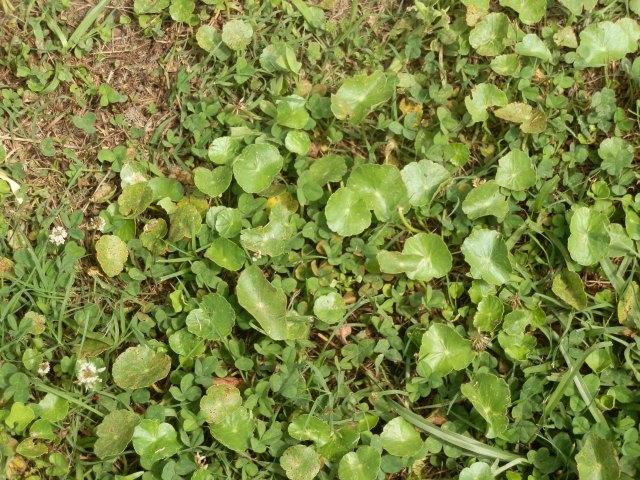
Marsh pennywort emerging in a poorly maintained scalped lawn

Marsh pennywort emerging in a poorly maintained scalped lawn

Ted Manzer teaches agriculture at Northeastern High School (tmanzer@ecpps.k12.nc.us).

Posted in foraging | Tagged , , , , , , , , , , , , | Leave a comment