Daffodils: Signs of Spring


The daffodils are beginning to bloom. Those glorious yellow trumpets are springing up everywhere, signaling spring is almost here. I’ve always had a soft spot in my heart for them, but never one in my stomach. Daffodils and all related Narcissus are poisonous.

Those with pets, especially dogs, should be especially aware of this. Sometimes dogs indiscriminately dig things up and chew on them, so be careful where your dog hangs out in your absence.  Leaves are also toxic, but a just few grams of daffodil bulb could pose a major problem.

If you suspect that your dog has ingested a daffodil bulb call your veterinarian immediately and explain the situation. Being cautious is fine, but don’t be paranoid. Most animals pass them by without any desire to eat them. They taste bitter.

Common symptoms of daffodil poisoning are diarrhea, vomiting, staggering, and collapse. If a large quantity were consumed, death could occur in just a few hours. Toxins responsible for this are alkaloids, chemical cousins to caffeine, morphine, and nicotine. Drug companies, particularly in Europe, are experimenting with daffodils to treat Alzheimer’s. Galantamine is the alkaloid isolated from daffodils which has shown promise in treating the disease.

Herbal medicines are gaining popularity, but not all naturally occurring chemicals are safe, especially alkaloids. Most alkaloids are fatal in heavy doses, so even though some pharmaceuticals are synthesized from them, don’t ever experiment for yourself. Daffodils are poisonous! Leave it at that.

Even deer refuse to graze these plants, so they are a great choice to include in naturalized landscaping around here. Mice, squirrels and rabbits don’t like them either. Tulips and crocuses are gorgeous, but few have any success with them in this area. Look around, you won’t find many. Deer will yank them up in a heartbeat and mice will whittle the bulbs up before you know there is a problem.

Daffodils hang in there. They also remain healthy for generations. Some have survived in landscapes for over a hundred years, brightening our Februaries and Marches. Soil borne insects and nematodes also are less of a problem on daffodils than on most bulbs.

What weakens a stand of daffodils most is mowing them down too soon after they bloom. These plants need several weeks to build energy back into the bulb after blooming, so they can be beautiful in future years. Let them die down naturally if possible. If that is a problem, try to wait until they begin to turn yellow. Sometimes an answer is planting a few annuals or taller later maturing perennials around them as camouflage.

We have so many beautiful types to adore. Some use the terms daffodil, jonquil and narcissus interchangeably. Others insist there is a difference. Both daffodils and jonquils belong to the genus Narcissus, but as general rule daffodils have only one flower per stem and jonquils have two to several smaller ones and are quite fragrant. The American Daffodil Society gets a little fussier in their classification, so I apologize for my simplicity.
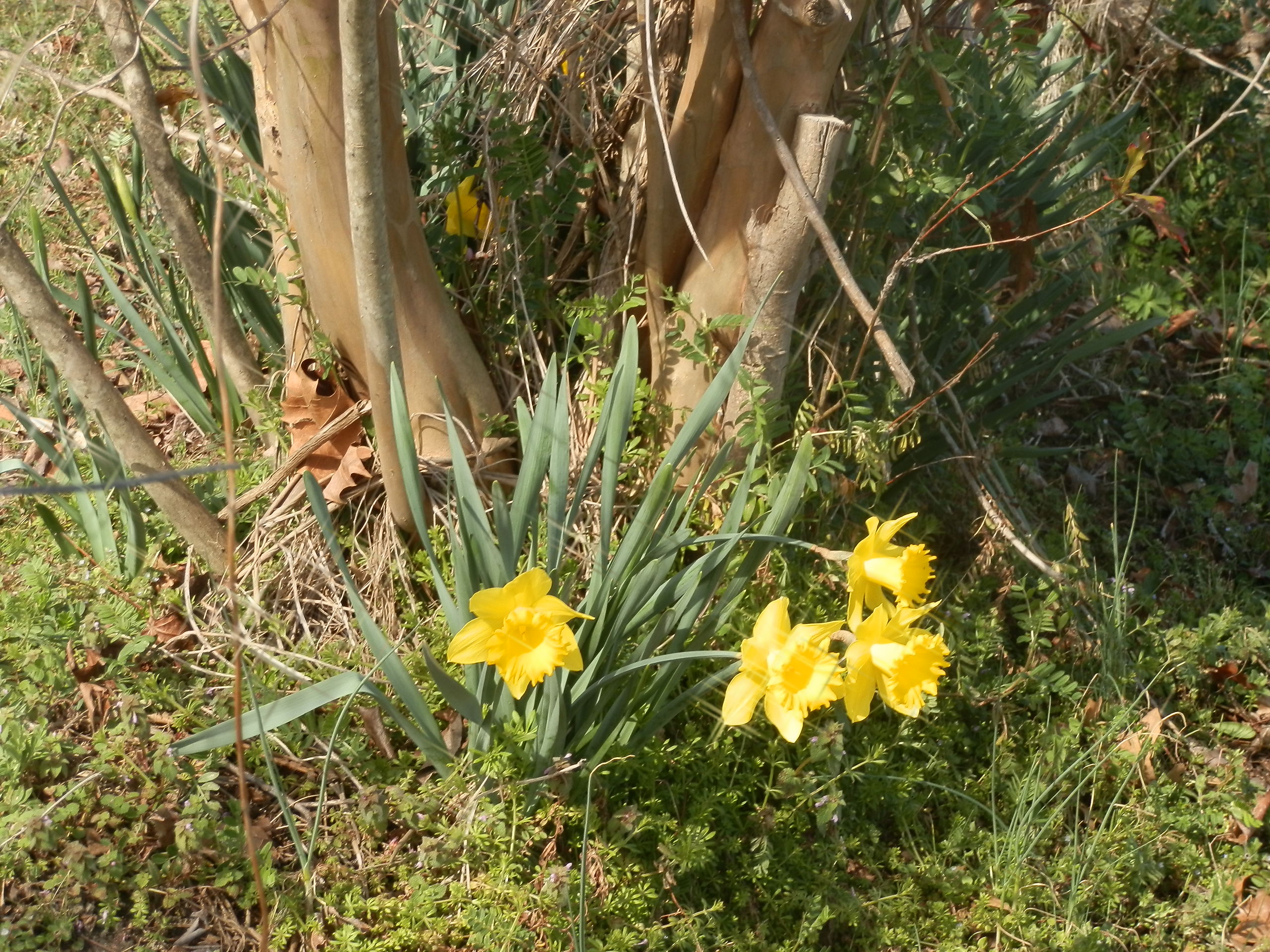
 

Daffodils under crape myrtle

Some daffs popping up under a crape myrtle

Ted Manzer teaches agriculture at Northeastern High School.

Posted in foraging | Tagged , , , , , , , | 8 Comments

Two Spring Mints


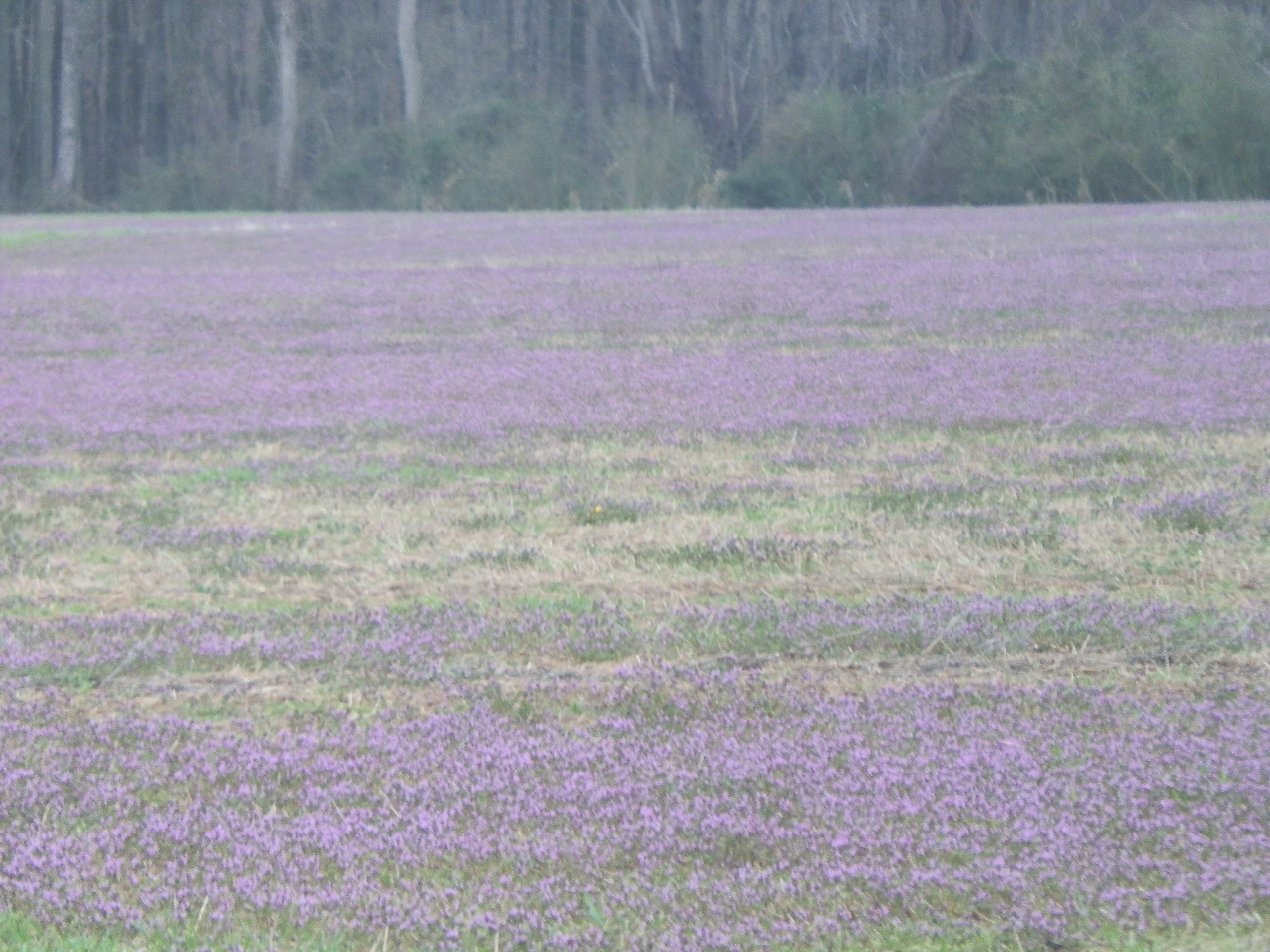
Look around in our soon to be planted fields and you’ll see a mass of pink to purple. The two likely culprits are henbit (Lamium amplexicaule) and dead nettle (Lamium purpurea). Both are exotic invaders from the mint family and both are edible with medicinal uses.

Henbit is more of a loose runner. Its square stems are thinner. Heart-shaped leaves with rounded teeth clasp the stem. They have no little stem (petiole) between the main stem and leaf blade. Amplexicaule is Latin for clasping. Abundant flowers tend to be pink. Dead nettle flowers usually display more purple.

Purple dead nettle grows more upright and a petiole connects the blade to the main stem, which is usually thicker than those on henbit. Plants can get over a foot tall. Leaves are roughly triangular and become purplish and smaller near the stem tips. Dead nettle gets its name because the hairs on the stem will not sting you like true nettles will.

Being mints, both of these Lamiums reproduce profusely by seeds, each plant capable of producing several thousand. Henbit also spreads and gains vigor when stems root to the ground, much like crabgrass does. Both can depress yields of wheat and other cool-weather crops. They can crowd a young stand of row crops and carry disease-causing nematodes and fungi. These mints also contain chemicals that inhibit the growth of other plants.

Most broad-leaf weed killers will knock both out of lawns. This time of year there is very little risk of turf injury to warm-season grasses like Bermuda, St. Augustine, and centipede, since they are dormant. Both henbit and dead nettle will colonize bare spots quickly when grass is dormant.

By the time your turf greens up though, these two species will likely be gone. Warm weather is not their friend. They don’t thrive when temperatures increase and they become very susceptible to powdery mildew, which usually finishes them off. Unfortunately, before they disappear they further inoculate the area with that fungus.

Another control solution could be to let chickens graze the area. They love it, but this is probably not practical. Hummingbirds sample their flowers on warm early spring days too, but with no harm to the plants.

If you can harvest these mild mints before the leaves are covered with dusty white mold they are quite palatable and nutritious. I prefer them cooked with a little salt and butter, but some people eat them raw in salads. Seeds are extremely high in antioxidants and the leaves are rich in fiber and vitamins. Foliage has diuretic properties and increases sweating and urine flow. Like the plantains, dead nettle and henbit also diminish bleeding. Extracts and teas are used for menstrual problems.

They also show promise as anti-inflammatories and pain reducers. Purple dead nettle works by interfering with the release of the hormone prostaglandin-2. Dead nettle contains chemicals called sterols, which among other things help treat enlarged prostates. It appears they can be good for men and women.

purple deadnettle

purple dead nettle

Henbit

Henbit

powdery mildew on henbit

powdery mildew on henbit

"pretty" field of henbit on a cloudy day

Ted Manzer teaches agriculture at Northeastern High School.

Posted in foraging | Tagged , , , , | 8 Comments

Wild but Mild – Common Chickweed


Now that cool weather is upon us common chickweed (Stellaria media) is everywhere. It’s that light green carpet-like weed with the tiny white flowers taking over flowerbeds and gardens right now. In fact, recent mild weather probably has facilitated exponential new invaders to any bare soil in sunny locations on your property. Each plant can produce thousands of seeds.

Don’t despair. It’s another delicious mild green, raw or cooked. Even when plants are blooming their flavor has no bitterness, which is unusual. If free-range chickens could talk they’d tell you. That’s how chickweed got its name. It can constitute a good portion of their diet.

When eaten in a salad it has spinach-like texture, but leaves are much smaller. Mild flavor and tenderness are its most desirable traits. You’d be surprised how much you can eat until you cook some. Leaves are mostly water so it shrinks down to a fraction of its fresh volume when boiled or steamed. Don’t overcook it unless you like mush.

Chickweed is another of a long list of old-world plants introduced centuries ago. It belongs to a group of plants we call winter annuals. They begin to grow in the fall and more or less disappear when the weather warms in early summer. Common chickweed is not tolerant to drought and will disappear quickly on warm dry soil.

Leaves emerge from the stem in groups of two. Some have little stem-like structures called petioles attached to leaf blades and others do not. Foliage is smooth and delicate and the plants run along the ground, rooting freely.

Chickweed is nearly always flowering, except in the coldest weather. It has numerous tiny white flowers about a quarter inch in diameter. They have five deeply notched petals that look like ten. Flowers close at night and open in the morning. They also close when rain is imminent. At night, chickweed folds its leaves over the growing tip. This helps protect it from freezing. Chickweed has a strong will to live and there are reasons to let it grow.

Common chickweed is very healthy for you in moderate quantities. Foliage accumulates oxalates, which could be a problem for kidney stone formers though. However, leaves and stems contain high levels of saponins, which lower blood cholesterol levels. Muscilage is a gelatinous soluble fiber found in chickweed that also lowers serum cholesterol. Both have laxative properties and interfere with the body’s absorption of fat. Several weight-loss and colon cleansing products contain chickweed, which is also high in vitamin C.

On the negative side, common chickweed is a host to several damaging crop virus diseases. Some can be carried in chickweed seeds, which grow into infected plants. The virus can persist in seeds for several months. Numerous nematode species also infest common chickweed. Pre-emergent and post-emergent chemicals are available, but tillage usually controls this plant for homeowners.

Mouse-ear chickweed (Cerastium vulgatum) is a major lawn weed. More compact but also edible, it is better cooked as leaf texture is fuzzy. Plants can be controlled with most common broadleaf weed-killers.

Florida Betony above and common chickweed below

young mouse-ear chickweed clump

Ted Manzer teaches agriculture at Northeastern High School.
Posted in foraging | Tagged , , , , , | 8 Comments

What’s up Dock?


curly dock with flower stalk

Now that winter is here, most of us don’t have to mow our lawns. Our flower gardens have probably fizzled out too, but we still have weeds. Curly dock (Rumex crispus) is one of those ugly coarse textured plants that will plague us for the next several months. Crispus is Latin for curly. I bet you figured that out.

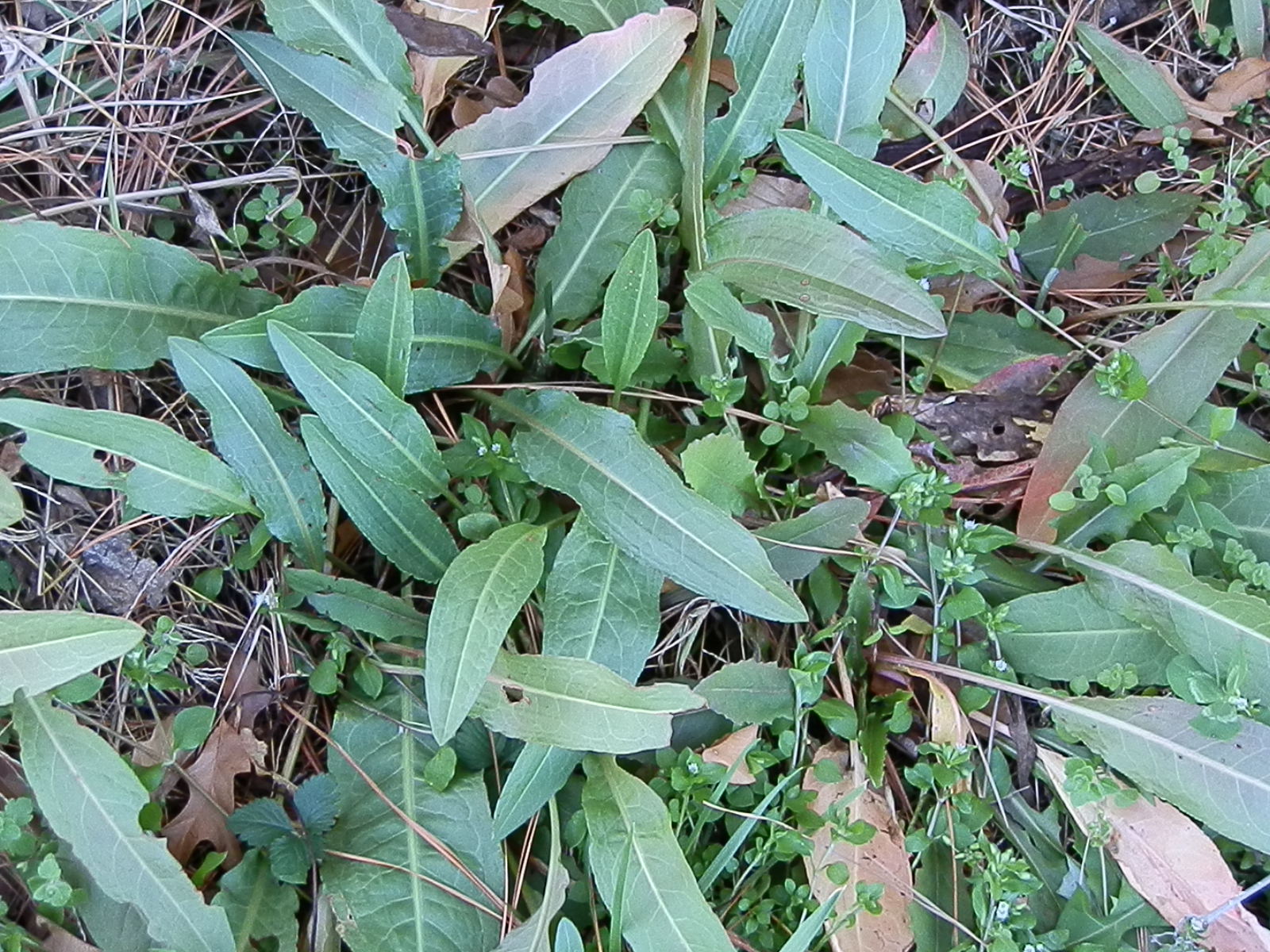
Dock is what we call a biennial, meaning it completes its lifecycle in two years. Large elongated leaves grow in a circular pattern. Individual leaves can be two feet long. The lengthy taproot makes this invader hard to pull too. Yellow color of the root flesh is responsible for its often being called yellow dock.

In late spring this rhubarb relative will send out a flower stalk two or three feet tall. It’s edible but a little bitter. Leaves are too astringent to eat at this point too. Tannin content is too high.

When seeds mature they can be ground into flour and used like buckwheat, not surprising since they are in the same family. Seeds also can be roasted and used as a coffee substitute, explaining another common name, coffee-weed. Triangular-shaped winged seeds are dark brown. Each plant can produce 40,000 of them.

People eat leaves raw but they taste better cooked. I don’t like them quite as much as some other common greens like chickweed or lambsquarter, but they are phenomenally high in iron, namely organic iron compounds. Common inorganic iron compounds tend to bind and constipate but the laxative properties of curly dock mean an abundance of iron without constipation. Vitamins A and C are also plentiful. Like all greens curly dock is rich in fiber.

Young leaves are tender but somewhat sour. Oxalic acid among other things causes this, and rinsing the leaves removes some tartness. Foods high in oxalate may contribute to calcium oxalate kidney stone formation. Large doses of oxalates also increase inflammation, pain, and irritate tissues and mucous membranes.

Since dock is not a major human food source, overconsumption poses no problem. Nausea and diarrhea are possible if we eat too much, but we can get those symptoms from many foods.

Livestock frequently struggle with it though, as dock can be abundant in pastures. At certain times of the year it can comprise much of their diet. Sheep, in particular are very sensitive to oxalate poisoning and large quantities can be fatal. Consequently, livestock farmers try to eliminate it from grazing areas.

Curly Dock is difficult to control using cultural weed control methods. It withstands mowing and large variances in soil moisture. Even if roots are pulled, seeds still can live for more than 50 years. The most effective weed-killers are systemic ones that kill the whole plant. Several selective chemicals for broadleaf weeds will suffice. Pre-emergent herbicides prevent germination.

Historically, dock has been used to treat skin irritations, infections, hemorrhoids, anemia and menstrual problems. Improved liver function is also documented. Many commercial herbal extracts are available and formulated from both leaves and roots. Before trying anything consult your doc.

curly dock foliage

Ted Manzer teaches agriculture at Northeastern High School.
Posted in foraging | Tagged , , , , | 3 Comments

Whistle Pig


Since Groundhog Day is this week, I decided this varmint deserved mention. Farmers and gardeners experience their destructive behavior. Most consider them a cute little rodent.

These squirrel relatives also called woodchucks or whistle pigs have a portly body, and short muscular legs. Front feet have curved claws for digging, and they are good at it. They also have a short dark furry tail. Like squirrels, they can even climb trees. Both sexes have similar builds and colors, though males are usually larger. Chucks average less than 10 pounds each and are social creatures. Their shrill call which signals danger earned them the nickname whistle pig. Groundhogs also make this sound when fighting other groundhogs for territory.

We are near the southernmost range of these marmots, which are adapted to much cooler climates. These animals undergo a true hibernation, meaning they enter into a deep sleep and can be touched while hibernating and not know it. They also construct a separate den just for winter. During dormancy their heart rate drops from 80 beats per minute to four or five, and body temperature drops from about 90 degrees Fahrenheit to about 38.

Hibernation varies greatly among locations. In northern Maine, for example, they might stay in their burrows for nearly six months. The most famous groundhog in Punxsutawney, Pennsylvania hibernates for about a hundred days, and around here they barely sleep more than two months.

In spring they mate and females give birth to an average of four young after a 28-32 day pregnancy. At birth, baby groundhogs are naked, blind and less than four inches long. They seldom venture outside until they are between six or seven weeks old. After that young whistle pigs grow quickly and reach adult size in a few months.

When they are awake they can be one of the most annoying critters around. Contrary to insurance commercials they don’t chuck wood, but they have sharp teeth that can chew it up quite a bit. With the exception of a meal or two here and there, we have benefitted from whistle pigs far less than they have benefitted from us. Clearing woodlands for agriculture opened up ideal habitat for them and across North America their numbers exploded.

Groundhogs are a minor problem here compared to most areas. Our high local water table frequently floods them out. Still, they dig holes in fields, causing damage to farm equipment and injury to livestock. They also eat our crops and can devour considerable amounts of them. Underground water and electrical lines are not immune to damage either. Whistle pigs do make acceptable table fare, particularly young ones not laden with fat.

Skin a youthful specimen, cut it into pieces and fillet each piece. Brown them in a skillet with your favorite meat seasonings. I like lots of garlic. Cover meat with water and let mixture simmer under low heat for at least a half hour. When the meat is tender, thicken the gravy with flour or starch. Serve over rice or potatoes, and enjoy.

Ted Manzer teaches agriculture at Northeastern High School.

Posted in foraging | Tagged , , , , , , | Leave a comment

‘Gourmet Rabbit’ – The American Muskrat


I attended high school and college in the 70s. Back then people weren’t criticized for wearing fur, a renewable resource. To make money I trapped muskrats on the Stillwater River behind our home in Old Town, Maine.

Furs brought a good price and I made several dollars a week in late winter and early spring. I usually kept the meat for dog food, and my finicky beagle mix loved it.  That is until my grandfather chastised me for wasting such a delicacy. He convinced me to try it and sold me immediately.

Muskrat (Ondatra zibethicus) is a lean meat. Dark like venison, it is tender and mild tasting. I detect no gamey flavor whatsoever. I think part of the reason for the mild taste is that muskrats are total vegetarians. Like venison, any fat should be removed before cooking as should the musk glands for obvious reasons. Their name is not coincidental.

I found the fat easier to remove if I let the carcass partially freeze or at least approach that in the freezer. If it was especially cold, I hung them in the garage while I was at school during the day. When the meat and fat were firm I could separate the two easier.

As for flavor, it is similar to rabbit. Texture is more tender. The grain of the meat is slightly coarser, but still much finer than beef or pork. I found muskrat meat was even better if marinated in a cold slightly salty vinegar mixture for several hours.

Roasting is my preferred culinary method, and I like a gravy spiced heavily with garlic. A little sour cream added right before eating can bring out the flavor too. Younger specimens are good fried with or without breading.

Probably the most important factors in palatability are cleaning and skinning immediately upon catching them. That and being careful not to leave any hair on the meat, just like any other game.

Muskrats have been served in restaurants under the names ‘marsh rabbit’ or ‘gourmet rabbit’. A species of rabbit called marsh rabbit does exist. We call them swamp rabbits around here.

I know of nobody who raises muskrats but wouldn’t be surprised if some niche market sprung up somewhere. Alligator meat is becoming more accepted by the public and at least one farmer in southern North Carolina raises them. The meat is light colored, quite dry and not nearly as flavorful as muskrat. I’ve eaten it.

Muskrats inhabit our ditches in large numbers. They can cause significant damage to farm pond and lagoon levees by making homes burrowing into them. They also can destroy pool liners. Thinning their population is sometimes a necessity, but we usually can coexist.

If you must exterminate muskrats don’t immediately dismiss them. At least during cooler weather try cleaning a few up and cooking them. I have a few recipes. It’s a shame to kill something and not derive any use from it. They may be a lowly rodent, but you’d be surprised how good they are. So don’t hate on the muskrat.

Ted Manzer teaches agriculture at Northeastern High School.


‘Marshenpfeffer’


1 large onion (sliced )                   2 bay leaves or 6-8 waxmyrtle leaves

3 cups white or cider vinegar     8 whole cloves

3 cups water                                 2 small to medium muskrats (3 lb. total) cut in pieces

2 tsp. pickling spice                      ½ cup all-purpose flour

1 Tbsp. salt                                    3 Tbsp. butter

½ tsp. pepper                               1 cup sour cream

1 Tbsp. granulated garlic or several cloves chopped garlic


Combine onion, vinegar, water, seasonings, and muskrat into a large sealable bag. Refrigerate for 24 hours. Shaking every once in a while enhances the marinating process. Remove meat and save marinade. Pat meat dry and coat with flour. Brown meat in an iron skillet in butter.  Gradually add

about half of the marinade.  Bring to a boil. Reduce heat and simmer for 30 minutes or bake in cool oven (325 degrees) for 50 minutes. Remove from heat or oven and stir in sour cream. Makes 6 servings.


Baked muskrat with rosemary/garlic sauce


2 medium muskrats cut in pieces                             4 large sprigs of rosemary

2 Tbsp.  Salt                                                                  3 cups vinegar

3 cups water                                                                  2 tsp. pepper

4 tsp. granulated garlic                                                ¼ cup butter

1 cup sour cream


Marinate muskrat in water, vinegar, salt, rosemary and half of the pepper and half of the garlic. Refrigerate for at least 12 hours. Drain and place in a greased baking dish with the butter. Discard the marinade but save and strip the rosemary saving a teaspoon or so for the cream sauce. Chop this rosemary and sprinkle most of it over the meat. Sprinkle all but about ½ teaspoons of the garlic on the meat. Sprinkle remaining pepper on the meat. Cover with foil and bake for 45 minutes at 325. Pull off foil, increase heat to 375, and and bake for 15 more minutes.  Mix sour cream and remaining garlic and rosemary and spread over meat.  Makes 6 servings.


Posted in foraging | Tagged , , , | 3 Comments

Live Oak – The Heritage Tree


When the topic of survival food comes up, acorns can’t be far behind. Unfortunately, not all are created equal. Oaks are divided into two groups, white oaks and red oaks. The acorns of red oak species like water, willow, scarlet, black, and Southern red oak are high in tannins and very bitter. These acorns also take two seasons to mature. White oak species like white, post, chestnut and swamp chestnut oaks have less bitter acorns, which mature in one year.

Another species is a bit enigmatic. Live oak (Quercus virginiana) has leaves without lobes that are evergreen. Wood grain is similar to red oaks, but acorns mature in one season and are generally sweet, although some individual trees produce less palatable nuts. Botanists have been confused on how to classify this species. Some call them white oaks, some a red, and some put live oak in its own group.

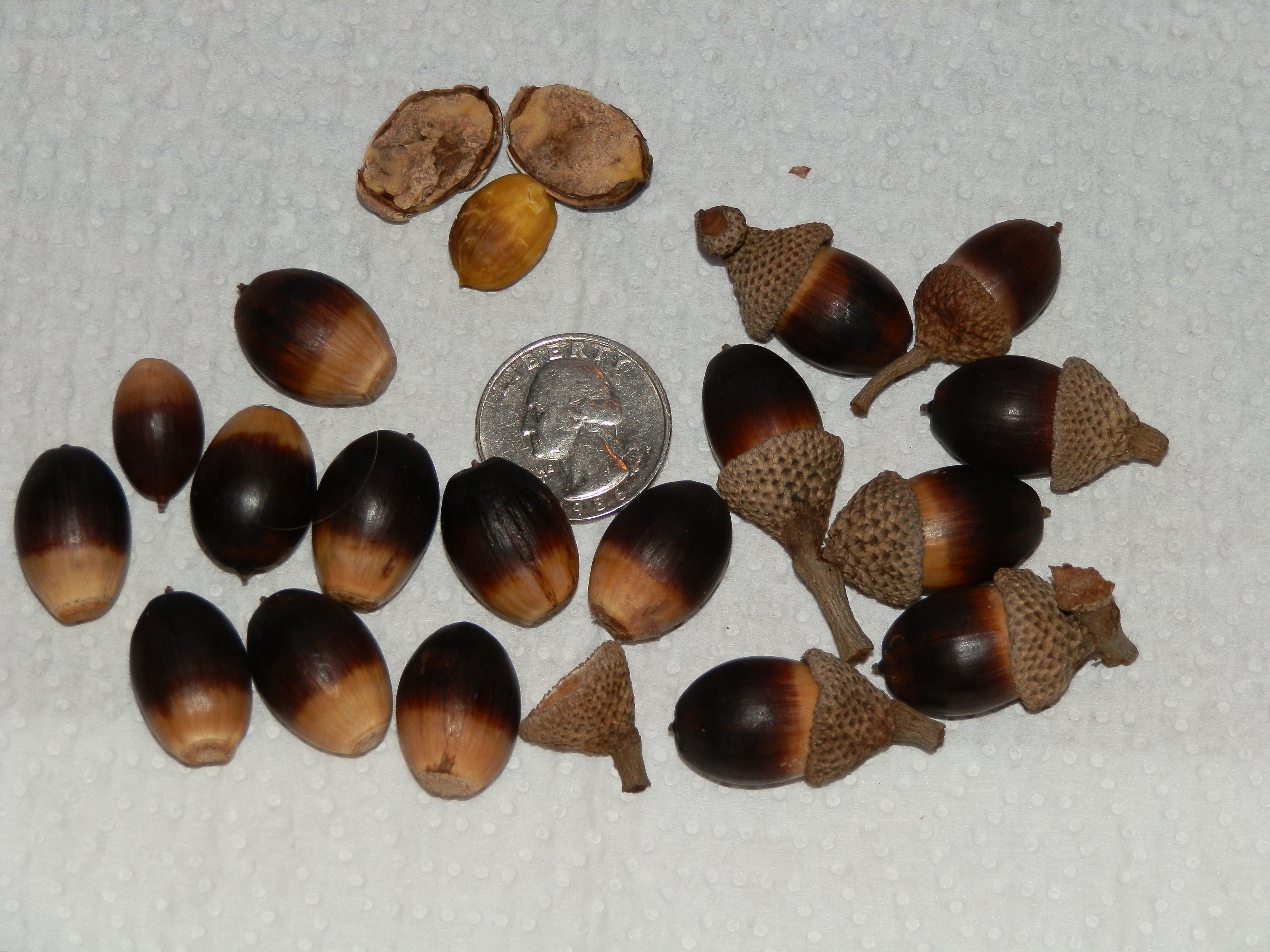
Live oaks produce long narrow shiny dark-colored fruits in clusters of three to five. Live oak is also one of our historically more valuable trees. They have curved spreading branches that were once used in shipbuilding. The wood is very dense and very hard. The frame of the famed USS Constitution and many other ships of that era were made from it. Wheel hubs and machine cogs were also carved from this dense wood. Heating value is high, so it is mostly used for firewood now.

In earlier days the acorns were used for making flour like many acorns were. Usually nuts must be soaked in water to leach out the bitter tannins. Floating acorns are discarded as they either contain insect larvae or have not developed properly. After several rinses the nutmeats can be dried and ground into a flour that has a nutty flavor and contains no gluten.

Acorn flour is available at certain natural food stores and outlets online, but it is pricy. The extensive leaching process makes it that way. That is why I like the live oak. Two advantages are that nut set is usually prolific and tannin content is low, meaning less leaching or none at all.

I have found that there is tremendous variation in nut sweetness among live oaks. Some trees produce nuts that are nearly as mild as pecans and others are too bitter to eat without some preparation.

I always sample a few before I pick very many. It is the only oak species I collect around here. White oaks have mild nutmeats, but trees aren’t used in landscaping very much. In the woods, wildlife usually clean them up fairly quickly.

Live oaks, on the other hand are used much more ornamentally. Their broad crowns throw tremendous shade and curb the wind. Some beautiful specimens are at Albemarle Hospital and the College of the Albemarle. Seed set wasn’t too good this year, so I didn’t forage any acorns. I always admire these trees though. They are a symbol of the south and one of our most important soil conservation trees on the outer banks. Ocracoke Island is covered with them.


Live Oak Acorns - This batch is acceptable with little or no treatment

Ted Manzer teaches agriculture at Northeastern High School.

Posted in foraging | Tagged , , , , , , | 6 Comments

Sow Thistle: Versatile Wild Green


It sure doesn’t look very appetizing. The name won’t arouse your palate either, but sow thistle (Sonchus oleraceus) makes a tasty salad or cooked green. Sonchus is Greek for hollow (referring to the stems) and oleracea means vegetable or herb-like. This species is an annual, but perennial sow thistle (Sonchus arvensis) can also be found here.

This lettuce relative thrives in cool weather. Like its composite cousin its stems produce a milky substance that can be a little bitter, but the leaves are mild. Young foliage is great for salads, while older specimens are better stir-fried, boiled or steamed. They taste similar to Swiss chard or spinach. At any growth stage they are milder than dandelion greens. Sow thistles are also one of the more plentiful weeds in our area.

Elongated silvery tinged leaves with reddish edges and midribs vary in shape. Leaves are roughly oval-shaped on young plants but become what botanists call ‘pinnatifid’ (lobed on opposite sides of the midribs) when they are older. Leaf edges look prickly but are only slightly so. When the plant matures, yellow dandelion-like flowers generally bloom in the morning and close in the afternoon. As they further mature flowers ripen to a white down like dandelions do, and seeds blow everywhere. For this reason we need not encourage them. Leaves also become bitter when plants flower.

Sow thistle was originally brought here from England as a livestock feed. It was originally fed to lactating sows. Those who have rabbits can supplement their rations with this herb also known as hare’s thistle.

It has also been called milk thistle because of the milky juice in the leaves and stems. True milk thistles are one of the most widely used medicinal herbs, but they’re an entirely different plant with spiny leaves and purple flowers.

Sow thistles begin to grow in numbers in early fall, but you must be careful harvesting then. Aphids love them and finding hundreds of tiny crawling insects in your stash can put you off feed. When the weather warms up in late spring aphids again are prevalent. Otherwise, sow thistles are fine table fare. Leaves are high in Calcium, Phosphorus and iron as well as vitamins A and C.

As mentioned earlier sow thistle is invasive. You might not want it in your lawn or flowerbeds. Annual sow thistle can be controlled quite easily without chemicals. Keep your flowers weeded initially and don’t let plants go to seed. They are easy to pull as they have a single taproot that generally stays in one piece. In lawns, sow thistle is often a problem in the establishment phase, but after that a healthy thick turf usually chokes out emerging seedlings.

Cultivation is of little help with the perennial type. Roots can spread to five feet deep and are more branching. Even the tiniest root sections left in the ground can produce new plants. Eliminating it until your lawn gets established is a challenge. This perennial type is a double threat as it also is a prolific seed producer.

Ted Manzer teaches agriculture at Northeastern High School.
Posted in foraging, Uncategorized | Tagged , , , , | 4 Comments

Calm your sore throat


Slippery elm, (Ulmus rubra), is a medium sized tree found over nearly all of the eastern United States. It favors moist soils and is quite tolerant of flooding. The best place to find slippery elm is on the edge of swamps. Though common, identifying it might be difficult.

American elm flourishes in the same areas and to a novice they look nearly identical. Both have roughly oval shaped leaves pointed on the ends that are somewhat asymmetrical at the base. The edges or margins of the leaves have two different sizes of teeth. Slippery elm leaves are rough textured and a bit broader than those on American elm. The twigs are a bit stouter and the buds are darker also. Slippery elm is also more tolerant to the Dutch elm disease, and they have a narrower branching pattern than American elms. Why do we care about elm identification?

Slippery elm bark is a great sore throat remedy. Some use it to treat acid reflux, ulcerative colitis, diarrhea, toothache and skin conditions. It is a major ingredient in numerous commercial preparations. Slippery elm has no known side-effects. Since it coats the stomach and digestive tract one might assume it could interfere with nutrient absorption, but that has never been proven.

The ingredient that is effective in coating the throat is mucilage, a jelly-like substance that is found in the inner bark. A piece of whole, shredded or powdered bark steeped in hot water is all that is necessary to coat the throat and relieve the pain. My experience has been that each treatment lasts a couple hours, sometimes longer. The stuff works.

Collect the bark by making deep parallel vertical cuts on the trunk a few inches apart and teasing the bark away from the wood. Remove the bark in long strips leaving plenty intact so the tree doesn’t suffer. This bark can be air dried and stored in a cool dry dark place. Leave the samples as they are until using some or grind the dried inner bark into a powder. Store this in a sealed container. The mucilage keeps a long time.

Other ingredients may make the tea more palatable. I looked at the ingredients of a commercially formulated product and found licorice root, cinnamon, and black cherry bark listed as prominent ingredients. I use a little cinnamon in mine along with some honey to increase palatability. I mentioned in an earlier article that black cherry leaves and bark are toxic, and in appreciable quantities they are. Some sources tout small amounts of cherry bark as being therapeutic, but I generally shy away from it.

Whether you are using a commercial preparation or your own mixture, drink the tea slowly, letting it slide down your throat. If you can tolerate a hot liquid, results will be better. By the time your cup of tea is gone, so will be your sore throat.

For those hesitant about making their own, many commercial preparations are available. Some are a little pricy, but probably no more so than traditional pharmaceuticals. Also, I believe there is psychological benefit from attacking a problem and not taking what we consider an artificial drug. Sometimes perception and the feeling of self-sufficiency can be important healing aids. I’m not suggesting that we all become our own pharmacists and treat ourselves for everything, but the power of the mind is great. It just makes you feel good when you solved the problem yourself.

Ted Manzer teaches agriculture at Northeastern High School.
Posted in foraging | Tagged , , , , , | 3 Comments

Enjoy what you do – It’s certainly true for writing


When I was in school I hated to write.  Likely the biggest reason was that I hated what I had to write about.  Being forced to do something tends to lower the quality of ones output.  I don’t consider myself a great wordsmith by any means, but I’ve found a niche that energizes me and utilizes my talents and interests.

When you like what you do you do it better.  When you write about what you know you know it’s more believable.  I realize it doesn’t take a genius to figure that out, but sometimes we forget how little details can sometimes ruin an otherwise acceptable manuscript.

Take geography for example.  It peeves me when an author tells a story which has all the ingredients necessary to peak my interest, but he or she blows it by getting the geography wrong.  In other words, when writing about real places, get it right.  If an author is not willing to research streets, rivers, creeks, local botany and wildlife, etc., then perhaps it would be better to make the setting a fictitious one.  That eliminates people like me being critical.  It might not be fair, but a few inaccuracies early in a book closes the cover permanently for me, and I think others as well.

Writing from experience is also easier.  The words flow onto the page with less effort.  I teach high school (but not English) and constantly listen to students complain about how hard it is to write an essay or other assignment.  They struggle with word counts and eventually become content to hit the word or page requirement while not worrying about the content very much.  I know why teachers insist on minimum numbers of pages or words, but it is still frustrating.  Two pages of well written concise manuscript beats six pages of redundant crap any day.  However, if the teacher had no guidelines, he or she would have received one or two pages of crap instead of six.

Students succeed at what is important to them.  Few ever fail driver’s education, because they want their license.  Even marginal students struggling in all their classes don’t screw this one up.  We need to find a way kids can cultivate their excellence.  They can do that by gaining confidence.  Confidence gives us the desire to get even better.  The better we become the more fun it is.  We become better writers when we are enjoying ourselves.  We enjoy it more when we are confident we know what we are talking about.  It keeps building after that, but we have to taste a little success first.  For a teacher that can be the greatest challenge.

Posted in Uncategorized | Tagged , , , | Leave a comment