Long Live the Beech


You’re probably familiar with the word beechnut, but likely your first thoughts pertain either to smokeless tobacco, baby food or chewing gum. American beech (Fagus grandifolia) is one of our more common trees and yes, the nuts are edible.

Small size and tightness to the hulls renders them of little commercial use, but their flavor is quite pleasing. Dried and ground into a coarse flour, beechnut meal gives pancakes a nutty flavor similar to buckwheat. Some people even roast the nuts, grind them, and use the product to make a coffee substitute. I haven’t tried that.

The triangular-shaped nuts are borne in spiny husks. They look somewhat like buckwheat seeds, but are a little larger. They can be eaten fresh or lightly roasted and contain significant amounts of oil. Much of it is the desirable monounsaturated Omega-3 type. Other than that, nutritional value is nothing to get excited about, but nuts are calorie dense and will keep you going in survival situations. Numerous wildlife species depend on them. Deer and rabbits browse the twigs as well.

If you rarely stray from cultivated landscaping it is possible you haven’t noticed this tree much. Beech has attractive smooth gray bark and copper-colored fall foliage. Leaves persist long after they have turned brown. After the leaves fall the long pointed buds are showy as well. When grown in open areas they develop into handsome shade trees.

They don’t usually mature and produce nuts until trees are about 40 years old. After that, fruiting can be sporadic. Some years they may produce little at all.

These slow growing trees are among the longest living things in our area. Some can live up to 400 years. Older specimens develop hollow trunks, ideal homes for wildlife. They are abundant throughout the eastern US and southern Canada.

So why aren’t they used more? Beeches have shallow but sprawling root systems, making them incompatible with most of the rest of our landscaping. Roots interfere with lawns and flowerbeds. Many suckers spring up from the roots as well. These shallow roots and persistent leaves in late fall and winter make them susceptible to fire damage. This alone likely accounts for their absence in the western US.

So what good are they other than survival food? The wood is quite durable underwater and was once used for making waterwheels for grist mills. Today the wood is still popular for making barrels to age beer.

Actually, most beer is aged in steel tanks filled with beech wood chips, not in barrels, but that doesn’t sound as appetizing or romantic.  At the breweries, the chips are placed in the bottom of tanks where the beer is naturally carbonated. The chips impart no special flavor, but they become a substrate for the yeast to grow on so the process is more efficient. Anheuser-Busch frequently refers to its beech wood aged Budweiser beer in its commercials.

Beech is also used for flooring, furniture, and gunstocks. Due to its density and high energy output, it is a leading source of firewood. Long live the beech.

Ted Manzer teaches agriculture at Northeastern High School.

Posted in foraging | Tagged , , , , , | 2 Comments

The Versatile Sassafras


If you’ve strolled around the edge of the woods you’ve encountered a sassafras tree, though it might have been only a seedling.  Unless you knew what you were looking for you probably walked right past without giving it as much as a fleeting thought.  Its natural range covers most of the eastern U.S.

Sassafras albidum is one of the more unique specimens we have in eastern North Carolina and it’s one I always show my students when teaching the art of plant identification.  You can use four of your senses to identify this one, and once you learn it you’ll be able to recognize it all over your neighborhood.

Leaves come out of the stem singly and can be either roughly oval, three lobed, or shaped like a mitten.  Their texture is slightly rough, especially on the lower side of young leaves, and they show early orange red fall color.

That’s all rather bland, but the unique characteristics of sassafras make it easy to distinguish by taste and smell.  Leaves and bright yellowish green stems have a citrus aroma.  My students call it the fruit loop tree.  Roots smell like root beer, quite appropriate since that was their use once.

Many are familiar with sassafras tea, but far fewer have experience with the tremendous potential of the unique foliage.  When dried and ground it makes a great thickener for soups and sauces, imparting a slight citrus flavor.  If you’ve eaten file gumbo you’ve eaten sassafras leaves or file.

The sticky thickening agent is natural mucilage that was once used for making postage stamps.  It has far fewer carbohydrates and calories than potato or corn starch, so I use it when I embark on a low carbohydrate diet.  It gives me a few more food options as gravy and other thick sauces normally are off my list.

File can be bought on the internet, and likely in some natural foods stores, but I prefer to make my own.  Dry the leaves in the open air, crush them and remove the veins and other fibers.  The next step is to grind the leaf tissue into a fine powder with a coffee grinder.  Now the file is ready to use.  A little goes a long way, so you might want to experiment on how viscous you want your final product.  For maximum shelf life make sure to store the powder sealed tightly in a dark place.

There has long been controversy with sassafras.  The roots which yield the flavorful tea contain an alkaloid and supposed carcinogen called safrole, which has been banned by the FDA since 1960.  For this reason many recommend not drinking large amounts of sassafras tea.

Researching the topic yields mixed opinions on how much tea is safe.  Some scientists say that a person would have to drink nothing but sassafras tea their entire life to significantly increase the risk of liver cancer.  There are only trace amounts of safrole in the leaves, however, and there is no evidence to suggest that they are harmful.  For centuries Native Americans used extracts of sassafras to treat various ailments.

Ted Manzer teaches agriculture at Northeastern High School in Elizabeth City (tmanzere@ecpps.k12.nc.us).

Posted in foraging | Tagged , , , , , | 4 Comments

Purslane – A Hot Weather Green


You’ve probably seen it in your garden when the weather has been so dry that nothing else will grow.  You might even plant one of its cousins in your flower garden.

The plant in question is purslane (Portulaca oleracea).  The name oleracea means vegetable or herblike.  Purslane is a fleshy prostrate growing weed that can give you sustenance when the rest of your garden forsakes you.  There are no poisonous species that closely resemble it either.

The thick soft stems are round, smooth and give rise to small oblong thick green leaves.  These leaves are nearly but not quite opposite each other on the stems.  There is also no petiole, which normally connects the leaf blade to the main stem (sessile leaves).  When flowers form they are yellow and also edible.

It thrives under drought conditions in full sun, which is why it can be a problem for gardeners.  It is also why it has value.

Purslane in its young state is great mixed with other greens in a salad with a vinegar based dressing.  I think when raw it is better mixed.  The leaves and stems contain sticky mucilage that might be too pronounced alone.  When eaten with lettuce or spinach it is an asset, giving the salad extra body.

When consumed as a potherb it doesn’t cook down as much as other greens.  Purslane is mild tasting but filling.  Try stir-frying it with other vegetables like onions and peppers.

Probably its greatest culinary asset is its ability to add body to a soup.  It’s a great thickener, much like okra, and has far fewer calories than starch.

On the nutrition side, purslane contains linolenic acid, one of the essential omega-3 fatty acids.  These are commonly found in fish and nuts.

Research indicates consumption of foods rich in omega-3 fatty acids may reduce the risk of heart disease and stroke.  Some studies link these chemicals to preventing the development of ADHD and autism in children.

Purslane is also high in vitamins A, C and some of the B vitamins.  It is also rich in iron, calcium, magnesium, potassium, copper and manganese.  Betacyanins and betaxanthins, both potent antioxidants, are also present as is a healthy amount of fiber.

If you collect it from your garden you have a pretty good idea what contaminants might be in it, so that’s not a problem.  However, if you gather some from the roadside you can’t be sure what chemicals might be there.  Some pesticides persist for long periods.

It’s interesting how some obscure plants which we call weeds can be very beneficial when we give them a chance.  I’m not advocating we all turn into subsistence gatherers and abandon traditional crops.  I only suggest we take advantage of the many wonders around us.

Learning new things about our surroundings can be fun and rewarding.  As with anything new though, always consume small amounts until you are sure your system agrees with it.  Some have aversions to traditional foods as well.  Don’t ever be afraid to ask questions.  Be a lifelong learner.

Healthy purslane plant

Healthy purslane plant

Ted Manzer teaches agriculture at Northeastern High School. (tmanzer@ecpps.k12.nc.us)
Posted in foraging | Tagged , , , , , | 1 Comment

Persimmons – Sweet Gems of the Fall


The persimmon (Diospyros virginiana) is one of the true delicacies of the southeastern states.  They grow as far north as southern Ohio and parts of Pennsylvania and New Jersey and west to east Texas and Oklahoma.  We are in the heart of persimmon country.

These unique fruits which are about an inch in diameter or slightly larger and have a cross-shaped calyx on the stem end.  Trees are large with dark brown blocky bark.  Once you find a persimmon tree you will be able to locate them from a distance just by the bark.  The leaves usually have noticeable white veins.

In the fall when the fruits are ripe the leaves are often covered with a black powdery substance called sooty mold.  It is unattractive and depresses the yield, but it doesn’t affect fruit quality.  There is one other item to note, however.  In your quest to find these tasty morsels you will notice that not all trees bear fruit.  Persimmons are dioecous.  This means that some trees are male and some are female.

Most people think persimmons have to be exposed to frost to be palatable, but this is not necessarily the case.  They do have to be ripe, however.  Anyone who has ever bit into a firm persimmon isn’t likely to forget the experience.

They can be ripened off the vine the same way green tomatoes can and aren’t edible until they are soft and somewhat wrinkled.  Their color is usually some shade of orange and the sweet pulp inside is orange as well.

While packed full of seeds, wild ones have a more concentrated flavor than their cultivated Asian cousins. While the Asian types are more versatile and can be eaten while the flesh is firm, they don’t have as concentrated persimmon-like flavor the wild ones do.

I like the flat Asian persimmons fresh in a salad, but not so much in cooking.  Cooking is the primary use for the wild types, and the flavor goes a long way.  After gently washing your stash and blotting off any excess water with paper towels, crush them and sieve out the seeds.  A colander works well if you have one.  If you don’t a clean onion bag does the trick too.

Once you have your pulp you have plenty of options.  Persimmon can be substituted for the mashed carrots in your carrot cake recipe.  Use it in your Pumpkin or Zucchini bread recipes or cook it down with some added sugar and fruit pectin for a delicious jam.

My favorite use is persimmon pudding, and my favorite recipe is the one in Joy of Cooking.  It’s outstanding and easy to make.  This Persimmon concoction might remind you a little of bread pudding if you cook it thoroughly, but it is much richer.  Cook it a little less and it is more like pumpkin or sweet potato pie filling.  Other recipes are similar, and they’re all loaded with Vitamin A.

A walk in the woods in the fall can yield some unique and rewarding prizes.  Persimmons are just one of the bounties our state has to offer.  Anyone for wild muscadines or hickory nuts?

Ted Manzer teaches agriculture at Northeastern High School in Elizabeth City (tmanzer@ecpps.k12.nc.us).

Posted in foraging | Tagged , , , , , , | 3 Comments

Mulberry – A Healthy Secret


They are a fruit few have eaten. The trees are common in our area, but most people don’t know what they are or even what the fruits look like.

Mulberries are small trees up to 30 feet tall.  Their leaves have varying numbers of lobes.  Many have none.  They have separate male and female flowers, sometimes but not always on the same tree.

The fruits, while called berries, are a multiple of drupes, much like blackberries.  Fruits ripen in late spring, but usually over a longer period of time than most tree fruits.

There are two common species in our area.  The red mulberry, (Morus rubra), is the only native species.  The white mulberry, (Morus alba), was introduced from Asia, has escaped cultivation and now is probably more common.

Why was the white mulberry originally brought here?  White mulberry is a favorite food of the silkworm.  Silk farming was attempted in America, but the worms never flourished.  The mulberries did.

The trees are considered invasive by many states and are not promoted for landscape or agricultural use.  It’s a shame.  The wood is flexible and resistant to decay.  Fruit is palatable and leaves are used medicinally.

Both red and white mulberry are food for many species of wildlife.  Most people don’t know what they are or if we can eat them.  The birds, squirrels, deer, and bear do.  So do foxes, turkeys and copious species of songbirds.

The fruits look a lot like blackberries.  White mulberries vary from off-white to lavender to nearly black.  Red mulberries vary in color from deep red to nearly black.

I harvest mulberries by placing tarps under the canopy and climbing the tree.  I then shake the branches to free the fruits.  Along with the mulberries come twigs and leaves.  Most of this trash must be picked out manually.  After that I winnow them using two 5-gallon buckets and a box fan.  This removes the tiny fruit stems.

Flavor of both species is bland compared to blackberries but seeds are smaller.  Mulberries also are low in pectin, so to make jellies or jams one must add more fruit pectin to produce a thickened product.  I usually add some crabapple juice to achieve the same effect.

Health benefit claims of mulberry are too numerous to mention.  Unfortunately, many have not been thoroughly proven.

Leaf extracts are marketed worldwide for weight loss.  Mulberry leaves contain a substance called moranoline that inhibits an intestinal enzyme from breaking down complex carbohydrates and sucrose into glucose (blood sugar).

This would certainly help with weight loss if it works as well in the body as it does in a test tube.  Numerous studies link mulberry extracts to improved blood glucose management for diabetics.

Mulberries are an excellent source of vitamins B, C and K. They are also full of fiber, iron, phosphorus, magnesium and potassium.

Morus species also contain resveratrol, an antioxidant found in red grapes and red wine.  It is linked to lowering cholesterol, preventing cancer, blood clots, diabetes and aiding in weight loss.

In short, mulberries are  more than nursery rhyme trivia.

Ted Manzer teaches agriculture at Northeastern High School. (tmanzer@ecpps.k12.nc.us)

Posted in foraging | Tagged , , , , , , , , | 2 Comments

More Pesky Vines


Kudzu has the reputation for the fastest growing and most aggressive.  Poison ivy is likely the most feared.  A few others deserve merit for most annoying.

I bet in the last 20 years I’ve had hundreds of people show me a sample of Virginia creeper (Parthenocissus quinquefolia) and either inquire or try to convince me it was poison ivy.  “That’s poison vine,” they’ll say.

Virginia creeper has leaves with five blades fanning out in a circular pattern.  Poison ivy has only three leaflets per leaf.  Virginia creeper has a relatively smooth bark, whereas the bark of poison ivy is almost furry.

Both are aggressive climbers and they often grow together.  Pulling down Virginia creeper from a tree often means touching poison ivy. However, it does not contain the toxin that causes poison ivy dermatitis.

Virginia creeper does contain chemicals called oxalates, which can cause skin rashes in sensitive people.  It also has bluish purple berries that are quite poisonous when injested.  This can be a problem, since it often grows together with wild muscadine grapes.

If people aren’t careful they can mix a few in with their grape harvest.  Children are especially prone to this, so we must be careful to point out the differences.

Virginia creeper can actually cause much more harm to trees and shrubs than can poison ivy.  It grows faster and covers quicker.  This hardy woody vine spreads voraciously, and the birds are unfazed by berries that would make us deathly sick.

Another thorn in the side of most homeowners is the trumpet vine, (Campsis radicans).  Other than having beautiful bright orange flowers that attract hummingbirds this menace has no redeeming features.

Trumpet vine has leaves, which come out in pairs and are divided into multiple opposite blades.  Each blade has a serrated margin.  Along with elderberry trumpet vine is one of the few native woody plants with opposite compound leaves.

This woody vine, once established, will find its way into every tree and shrub on your property.  It spreads by seeds and underground stems.  Additionally, no part of the plant is edible.  In fact, all parts are poisonous, though not life threatening.  The only problem normally encountered is a mild dermatitis, nothing compared to poison ivy, oak, or sumac.

The third menacing vine to our backyards is one commonly called the “wait a minute” vine.  Greenbrier, (Smilax sp.), is a woody vine with green stems with sharp spines. There are several common species around here.  All have broad roughly triangular shaped leaves that emerge from the stems singly.

One redeeming feature is that the new emerging shoots are edible and can be eaten raw or cooked.  Take your victories when you can.

Controlling all three vines is difficult.  About the only way is to separate the vines from their hosts.  This often results in the desired plant being torn apart.

Sometimes cutting the vines off and treating the stumps with concentrated Round-up is the best method. I suggest not allowing them to achieve a strong foothold in the first place, which can be easier said than done.

Ted Manzer teaches agriculture at Northeastern High School. (tmanzer@ecpps.k12.nc.us)

Posted in foraging | Tagged , , , , | 1 Comment

Harvest the Strangler


Kudzu (Pueraria lobata) is the single biggest scourge of the southern landscape.  Vines can grow to the top of the tallest trees and head back down again, all in a single season.

It can choke out trees and landscaping almost before the problem is realized.  Park a car next to a vigorous plant and it won’t be visible in a few weeks.

The species is tough to deal with because most herbicides that kill the Kudzu will also injure or kill the strangled plant.  Spraying the vine could destroy the trellis so to speak.

Kudzu is a member of the bean family and has large trifoliolate (3-part) leaves with tendrils that wrap around anything they meet.  Beautiful clusters of pink to purple flowers smell like grape flavored candy.  Bees love them.  Vigorous roots can be nine feet deep and seven inches thick.

This menace was brought here in 1876 at the Centennial Exposition in Philadelphia.  The large leaves and sweet-smelling blooms mesmerized plant enthusiasts who wanted it in their gardens.

About 50 years later it was promoted for livestock feed and in the 1930’s was pitched as a soil conservation savior.  In 1972 it was officially declared a weed.  Since that time the legacy has spread further.

So do we surrender and accept our fate?  Of course not; we eat it.  Three parts of kudzu are edible.  When In the spring emerging young shoots make great table fare.

Cook them briefly like you would spinach, and don’t let them get too mature.  Keep clipping them.  They contain more protein than most greens.

Some people dip young shoots in their favorite breading mix and fry them like okra or green tomatoes.  Others stir-fry them and serve them over rice.

Later in the year when the plants are flowering harvest some.  The flowers can be eaten fresh in a salad.  They give it some color.  While the blooms smell like grapes they taste only slightly sweet.

Another use for the flowers is to make tea from them.  Let a handful of flowers steep in a cup of boiling water for a few minutes and sweeten it if you like.  Some people even make wine out of sweetened kudzu tea.

The final part of the plant that is prized by some is the root.  These are full of starch that is extracted and can be used like corn starch or arrowroot.

Harvest your roots in the winter and choose large healthy ones at least an inch thick.  Wash them thoroughly and cut them into pieces small enough to feed through a blender without bogging it down.  Add enough water to make a puree.

Strain this puree, squeezing out as much water as possible.  Add more water and repeat the mixing and straining process.  Let the liquid portion settle.  The starch will collect on the bottom of the container.  Purify it by adding water, stirring, settling, and pouring off the liquid.

Use this starch in its moist state or dry it in the oven or a dehydrator.  Store starch in a sealed container in a cool dark place.

Ted Manzer teaches agriculture at Northeastern High School.

Posted in foraging | Tagged , , , , , | Leave a comment

Lambsquarter – A most delicious weed


If a plant is growing where we don’t want it we call it a weed.  However, when it makes delicious table fare maybe we should rethink our rules.  Lambsquarter, Chenopodium album, fits the bill perfectly here.  It’s probably my favorite green that can be grown here in eastern North Carolina.

Last fall I spoke to a farmer in Elizabeth City about some of the nuisance plants he had in his fields and he mentioned lambsquarter.  I told him I’d just as soon have it on my table as the lettuce or broccoli he had in that field.  “I’ve never eaten it,” he said.  “You’re welcome to pick all I have.”

Tom Campbell, horticulture extension agent for Pasquotank County, has been a fan of this beet relative for years.  “I like to call it Inca Spinach.  A close relative of it called quinoa was used by early western hemisphere civilizations as a grain as well as a green.”

Others have used the leaves to treat diarrhea as well as scurvy, since it is a good source of minerals and vitamins including Vitamin C.  A cup (180 grams) of chopped greens contains nine grams of carbohydrate of which four are fiber.  There are also six grams of protein and less than a gram of fat.  Ground seeds make high protein flour.  Tom and I have discussed marketing this cosmopolitan invasive green ever since my wife and I moved to the Elizabeth City area in 1996, but we’ve never pursued it.

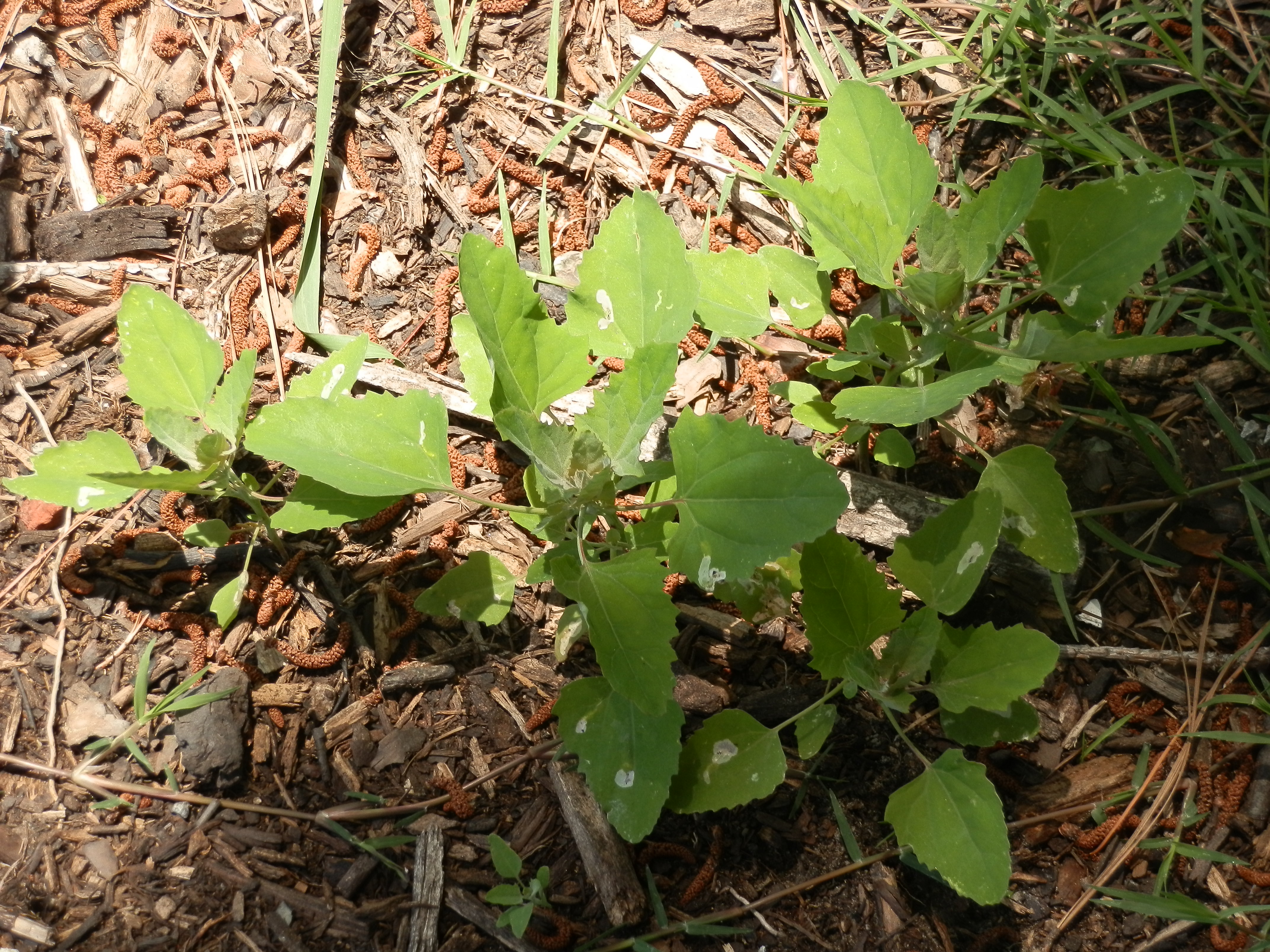
It’s easy to recognize.  Lambsquarter leaves are alternate and diamond-shaped with a toothed edge.  The undersides are covered with white powder.  Growth tips are whitish as well and sometimes exhibit tinges of red. It is best if picked when less than six inches tall.  Sometimes plants can obtain a height of eight feet.

Each plant, when left to mature, can produce 75,000 seeds, so it’s no wonder it has become so widespread.  In fact, this member of the goosefoot family is one of the most widely distributed weeds in the world.  It’s also a host to the beet leafhopper that transmits plant viruses and is resistant to many commonly used herbicides.

I like to steam it lightly and serve it with a little butter and salt, but young shoots are also excellent raw in salads.  It can be substituted in any recipe for spinach, chard or beet greens. Once stems start to get woody only the leaves and youngest growth tips are worth eating, but they are still excellent.

Finding enough for a mess is rarely a problem.  One downside for culinary use is that it is an accumulator of oxalates, so it might not be the best choice for someone who develops kidney stones.

Lambsquarter also contains relatively large amounts of vitamin K like domestic spinach, collards, and kale do, which is generally good, but people on blood thinners might want to avoid these as well.  As for my favorite green of all I’d have to pick fiddleheads, a northern native properly called Ostrich fern, but that report will have to wait for another day.

lambsquarter on poor soil

“Nitrogen starved” lambsquarter growing on a mixture of sawdust and mulch

Ted Manzer teaches agriculture at Northeastern High School in Elizabeth City. (tmanzer@ecpps.k12.nc.us)

Posted in foraging | Tagged , , , , , | 1 Comment

Blueberry – A tasty true berry


Last week I mentioned how blackberries really aren’t berries at all.  I know the botanical definition is not important, but for the record blueberries are true berries.

Eastern North Carolina is not famous for its wild blueberries, but they can be found in good numbers.  The high bush blueberry (Vacciniun corymbosum) prefers moist but well drained sandy acid soil.  They also yield best in full sun.  Look for them on the edges of swamps.

These shrubs can grow twelve feet tall.  The fruits aren’t as large or prolific around here as the cultivated rabbiteye types. They are still well worth your effort if you can beat the birds and other wildlife to them.

Southern or rabbiteye blueberries, (Vaccinium ashei), are far superior for those wanting to grow them in their backyard.  However, if your property borders a swampy area and the native ones are present, encourage them.  They make beautiful tasty natural landscaping.

Bushes have the same general form as azaleas.   Dark glossy green smooth edged leaves are up to two inches long.  Fall foliage is red.  Clusters of flowers in spring are white, and fruits usually ripen in mid to late June.  They are bluish to nearly black.

Fruits with dark bright colors are generally high in antioxidants and the blueberry is no exception.  Blueberries contain more compounds to fight free radicals than any other fruit.  They are real immune system boosters.

Blueberries contain chemicals collectively called polyphenolic anthocyanidins.  These chemicals help protect the body from cancers, aging, and infections.  Some research also indicates blood sugar levels can be lowered by them.  This could be a benefit for Type-II diabetics.

A cup of blueberries contains only 57 calories.  For that paltry amount you also receive about 25 percent of your daily vitamin C requirement.  Blueberries are also high in fiber.  A diet high in fiber contributes to heart health, helping to keep cholesterol in check.

These fruits also have amazing culinary versatility.  Pies and cobblers, cakes, muffins doughnuts, and pancakes await their insertion, so don’t be shy.

Blueberries can add flavor and color to many desserts.  I like to fold in a cup or two into a batch of cornbread.  It’s a great change of pace.

My favorite way to eat them is simply pouring them into a bowl with a little half and half.  That way I can rationalize by saying that the fiber, polyphenols, and manganese offset the cholesterol from the cream.

If you wish to make jams or jellies from your harvest beware that blueberries don’t contain high levels of pectin.  That means that you will have to add extra to get them to set properly.  Otherwise, your preserves will be runny.

While not common, blueberry allergy symptoms are mouth swelling and redness of lips and tongue, eczema, hives, headache, runny nose, watery eyes and gastrointestinal problems.

Those on blood thinners might curb blueberry intake somewhat.  They are high in vitamin K, which can counter the effect of the medicine.  I doubt small amounts would pose any problem, but it is always best to consult your doctor.

Ted Manzer teaches agriculture at Northeastern High School. (tmanzer@ecpps.k12.nc.us)

Posted in foraging | Tagged , , , , , | 1 Comment

Blackberries – Worth the Scratches


It’s almost blackberry season. The thorny canes might scratch the skin off you, but the fruit is worth the effort.  These brambles comprise one of the most confusing genera in the plant kingdom.

There are numerous members of the genus Rubus in our state.  We have several species of blackberry and three types of wild raspberry.  We also have dewberries, which look and taste like blackberries but run along the ground instead of on upright canes.

There are two features that separate blackberries from raspberries.  First, raspberry leaves are silvery or whitish on the underside, while blackberry leaves are green underneath. The whitish receptacle pulls away from a raspberry fruit, leaving a hollow place.  This structure remains with blackberries.

You can confuse your friends by telling them that raspberries and blackberries are not really berries at all, but aggregates of drupes.  A drupe is a fruit with a single hard seed.  Cherries, plums and peaches are simple drupes.

Botanically speaking, strawberries aren’t berries either.  They are multiples of achenes.  We actually eat the fleshy receptacle that holds the fruits.  True berries have more than one seed on the inside.

In eastern North Carolina blackberries are far more common than raspberries, and we have several different blackberry species here.  The best part is that they are all edible and well worth collecting.  Make sure they are fully black and slightly soft.

The fruits can be fashioned into numerous recipes or just eaten raw.  In addition to being delicious they contain chemicals collectively called antioxidants, which help our immune systems fight disease.  Blackberries are also high in Vitamin C.

Don’t think that just because they contain sugars that berries are a bad diet food.  One cup of blackberries contains only about 75 calories and is high in fiber.  If you don’t smother them with sugar they are very good for you.

Even the leaves have value.  Many commercial herbal teas contain blackberry leaves, which many herbalists claim have medicinal qualities.

Supposedly blackberry leaf tea has benefits on both ends.  It has been used to treat mouth sores as well as diarrhea.  I’d say that’s pretty versatile.

My favorite use for the fruit would have to be blackberry cobbler.  It might be calorie dense, but you only live once.  No summer is complete without at least one homemade pie or cobbler.

The berries also make great jams and jelly.  I like to sieve the seeds out of mine, but it’s not necessary.

Wild raspberries are rare in eastern North Carolina.  The black raspberry (Rubus occidentalis) is common in the mountains and less so in the piedmont.  Red raspberries (Rubus idaeus) are only found in the most mountainous parts of the state unless they have escaped from someone’s garden.

The only other raspberry species is the purple flowering raspberry (Rubus odoratus), which is also found in the western mountains.  They aren’t much of a table prize though.

Our wild blackberries are worth every scratch and splinter.  Don’t curse those prickly brambles encroaching into your lawn.  Now is the time to get their tasty morsels.

Ted Manzer teaches agriculture at Northeastern High School.

Posted in foraging | Tagged , , , , | 6 Comments