Smartweed can leave your mouth smarting


Most damp partial sun to shady areas are filled with smartweed now. Plants have always been there but the fall weather makes them more prominent. Some have white flowers while others have pink. This herb has almost as many uses as there are different species of it. About 75 different Polygonums reside in North America and many of them thrive in North Carolina.
Plants usually have variegated leaves and branch freely. Most leaf blades have a purplish blotch on them. Young stems creep at first, and then become semi-erect. Sometimes brittle stems are swollen where leaves attach, so they have a jointed appearance.
Elongated pointed leaves have very short stalks, a wavy but not toothed edge and are fringed with hairs. Flowers reside at the stem tips and are small and in vertical clusters called racemes. These inflorescences usually droop at the ends.
Smartweeds can be found in the same places every year, but few species are perennials. They reproduce by seed. Each plant can produce more than 3000 seeds. Some species even thrive in standing water.
This common but unusual herb is in the buckwheat family. I wouldn’t recommend using it in a batch of pancakes though. It is edible but better used as an accent and not the main course. Most species have a strong peppery taste. It kind of creeps up on you and gets stronger the longer you keep it in your mouth.
Some types, like the lady’s thumb smartweed are far less peppery. Others, such as the very similar looking Pennsylvania smartweed (Polygonum pennsylvanicum) can have a taste so biting that wildlife often won’t eat it unless no other vegetation is available. Still other species like the water pepper are even hotter than habaneros.
In small quantities smartweed makes a great pungent seasoning. Use it sparingly in salads and soups like you would cayenne pepper. Cooking dulls some of the fire. Always make sure to wash it well first, especially if you collected it from a wet swampy area. Also, keep in mind that if you are pulling weeds in an area with a lot of smartweed, you should wash your hands thoroughly before touching your eyes. You might not know the species.
Ridding your property of this weed might take a while. Smartweeds are prolific seed producers. Treating aquatic areas can be costly and difficult. In gardens, smartweed attracts undesirable insects that damage crop plants. It also grows fast, so remove it when you first identify young seedlings.
Smartweed has been used medicinally for many ailments including diarrhea, cleaning wounds, heart ailments, stomach aches, sore throats and stopping bleeding. Leaf teas are often the preferred administration method. Leaves have also been used to treat hemorrhoids.
All Polygonum species contain large amounts of vitamin K like many wild and domestic greens. Vitamin K helps the body make blood clot. Warfarin (Coumadin) is a common medicine used to thin the blood, and some sources say smartweed might decrease the effectiveness of warfarin. Therefore, it’s important to keep this in mind if you are on this medication.
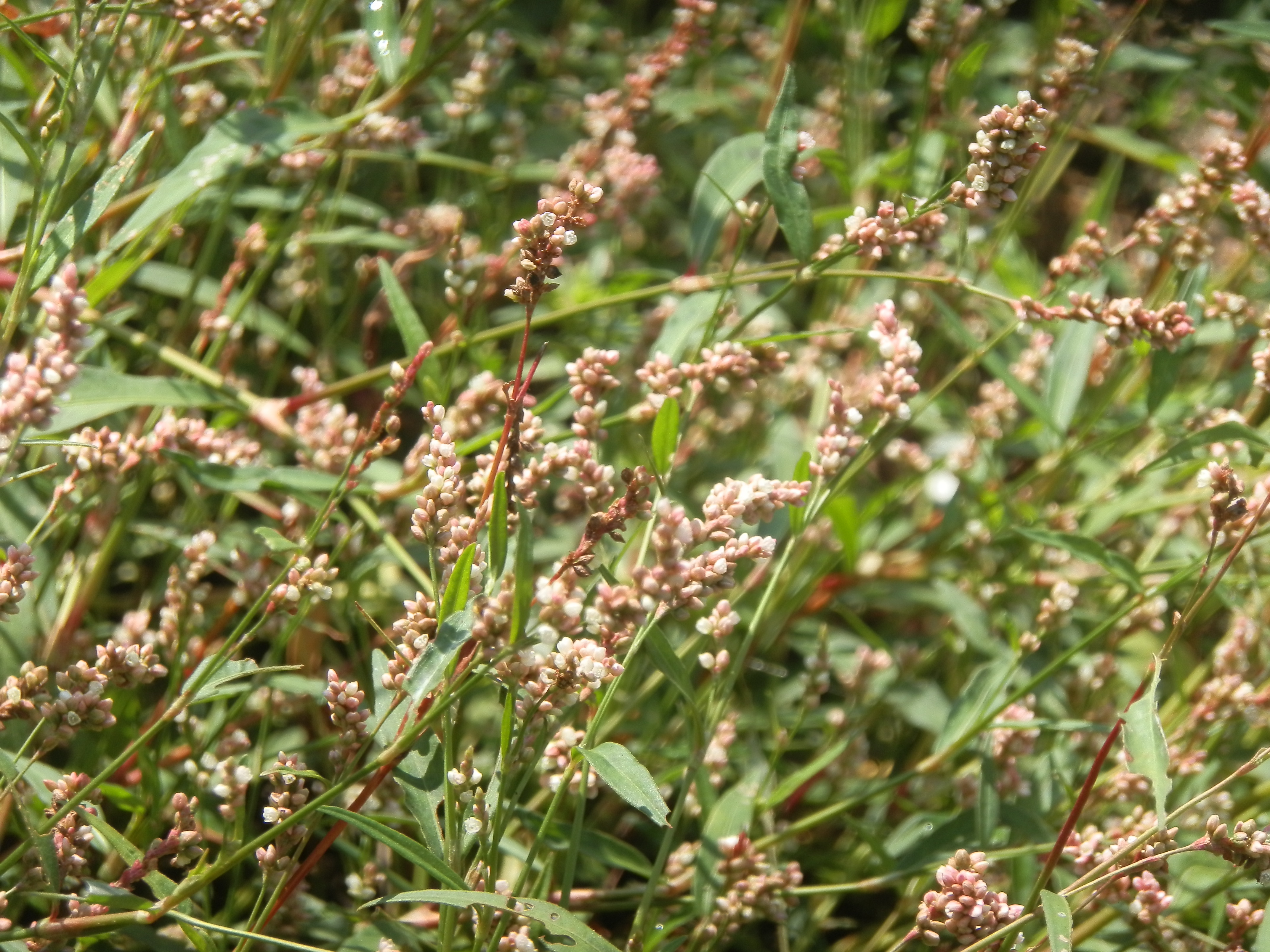
A thick stand of smartweed in flower
A thick stand of smartweed in flower

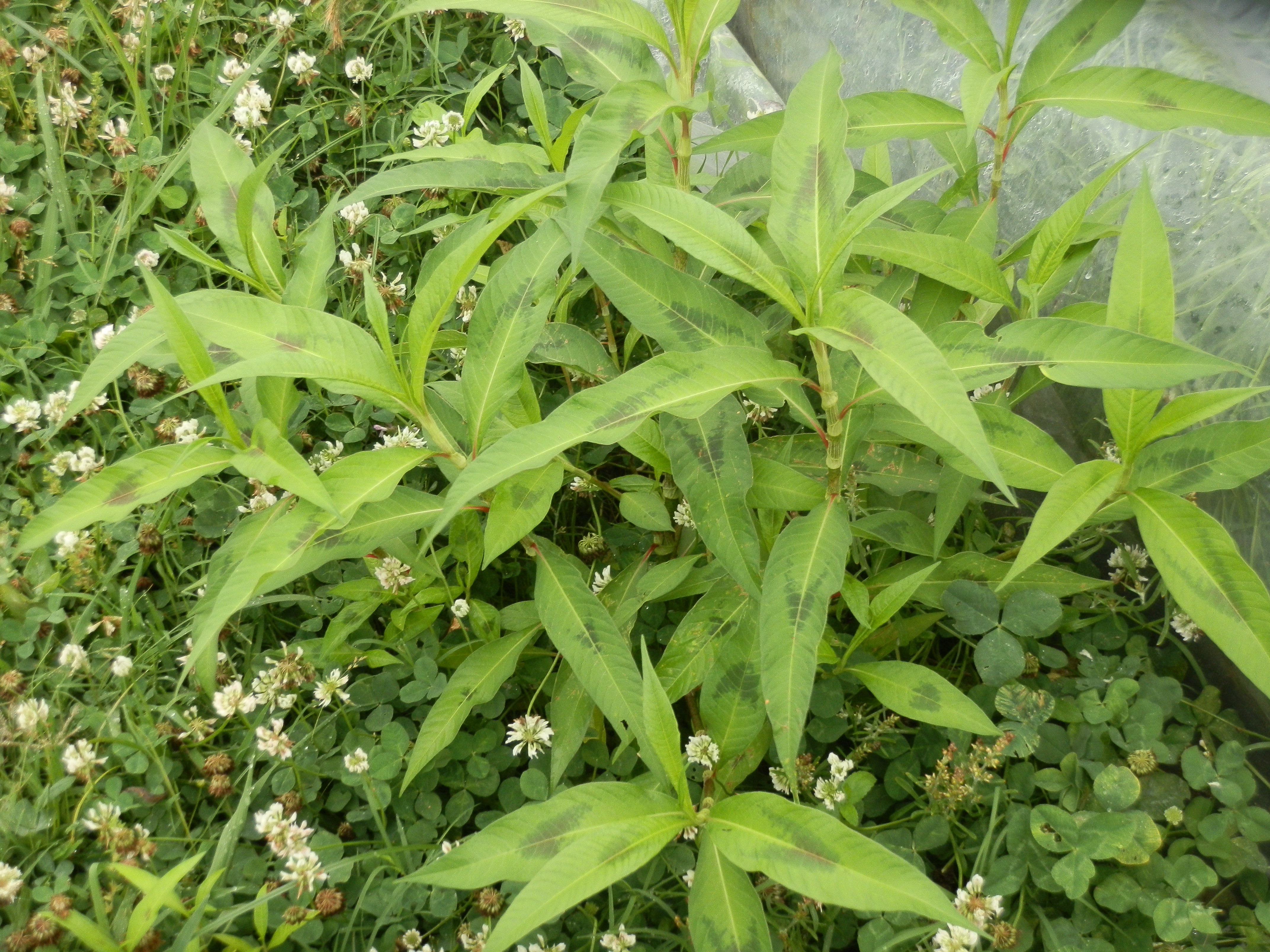
Patch of smartweed within a stand of white clover
Patch of smartweed within a stand of white clover

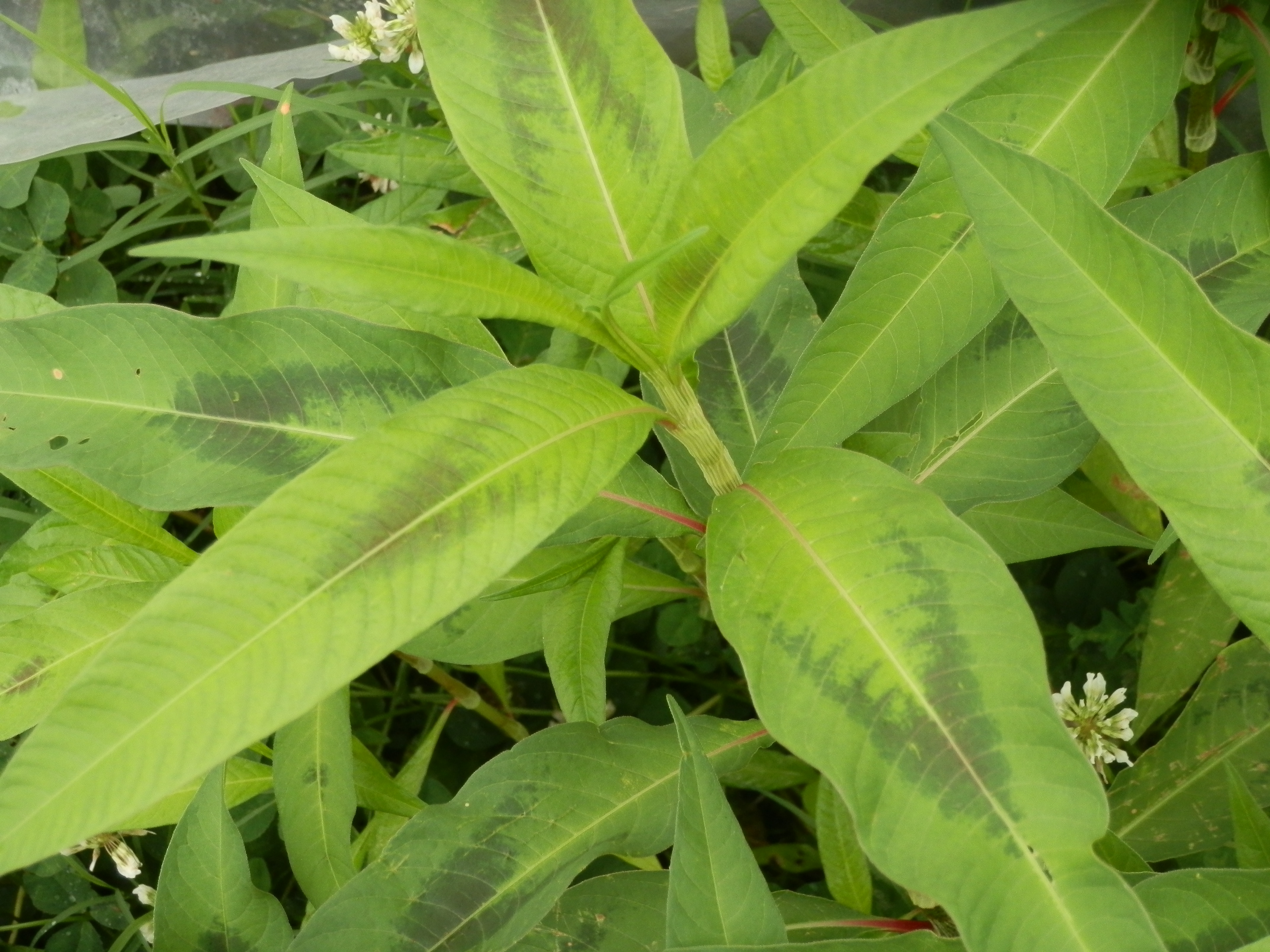
close-up view of Pennsylvania smartweed

close-up view of Pennsylvania smartweed

Ted Manzer teaches agriculture at Northeastern High School.
Posted in foraging | Tagged , , , , , , , , , , | 6 Comments

Something for everyone


For those who like a unique brightly colored specimen tree, shrub, or hedge in their yard, this one’s for you. The flashy flowers are bright red with a hint of orange and are real attention grabbers. Hummingbirds love them too. Fruit is edible and nutritious. Pests and diseases are not normally a problem either.
The plant to which I refer is the pomegranate. Drought and salt tolerant, they are well adapted to our sandy soils and thrive in full sun. Soil pH should not be acid like for blueberries and they respond well to fertilizer.
Narrow glossy leaves are pointed at the ends and turn yellow in the fall. Some branches may have spines. Plants are blooming right now and the tube-shaped flowers are over an inch long. Cross-pollination is not necessary but it will improve fruit set, so having two different cultivars could be a plus.
When it comes to usage in the landscape pomegranates are among the more versatile woody plants. If trained to a single trunk they can achieve heights of up to 25 feet. They can also be sheared into a six to eight-foot hedge and thrive. Some varieties are even dwarf types that get no taller than three or four feet. Probably most typical use is as a multi-stemmed specimen tree 8-12 feet tall.
Fruits usually ripen in the fall but sometimes over a wide time period. When the blossom end of the fruit begins to turn slightly brown fruits are mature. Usually they make a hollow metallic sound when tapped with a fingernail.
One question that always arises with pomegranates is how to eat them. Inside each fruit are membranous walls that harbor fleshy, juicy, red to pink edible morsels. Each one contains a seed that is also edible. Some cut the hard shell in two halves and eat the fleshy pellets.
My favorite method is to lay intact fruits on a hard surface and roll them around using firm but controlled force. After a few minutes the fruit softens and then I place it over a glass and prick a hole in the skin. Deep red juice emerges and I have my prize.
Pomegranates have a long history of medicinal uses. Recently, these fruits have been linked to lower blood cholesterol levels. Likely much of this is due to high concentrations of antioxidant chemicals called polyphenols. In fact, pomegranates may have even more antioxidant power than cranberry juice or green tea.
Research using pomegranates to fight prostate cancer is ongoing. Among other things antioxidants help prevent and repair DNA damage that can lead to cancer.
Pomegranate juice has also been used in weight loss programs, specifically to control belly fat. Other studies link consuming pomegranates to healthy skin. This is probably tied to antioxidants. Another study indicates pomegranate use may reduce cortisol levels. Cortisol is associated with stress.
The same study also found that a daily glass of juice increases testosterone levels which can boost sexual desire in both men and women. Testosterone can also boost memory and calm nerves.

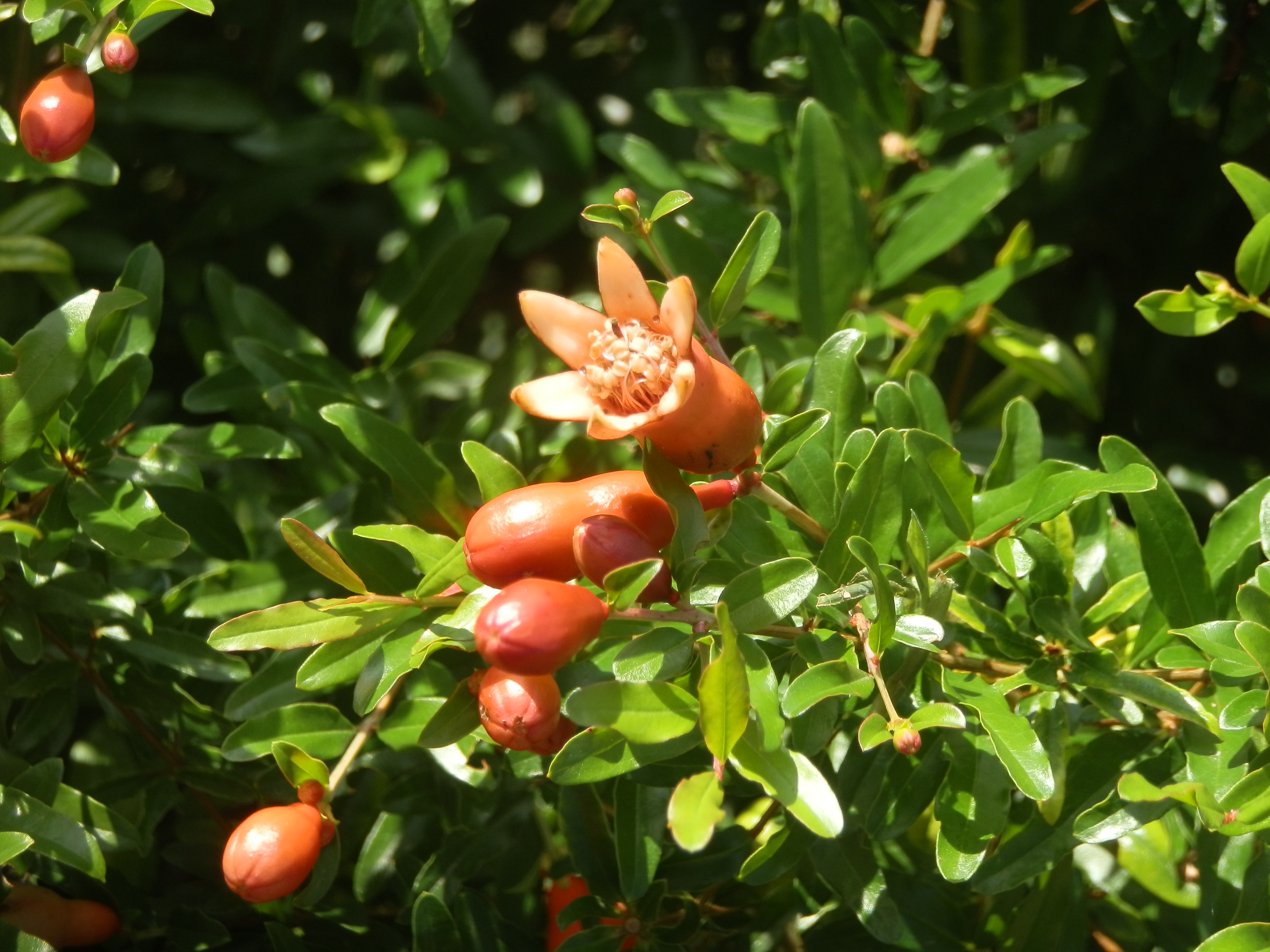
Severe winter temperatures killed this specimen to the ground and less than a year later it's producing fruit

Severe winter temperatures killed this specimen to the ground and less than a year later it’s producing fruit

young suckers are covered with bloom

young suckers are covered with bloom

Ted Manzer teaches agriculture at Northeastern High School.

Posted in foraging | Tagged , , , , , , , , , , , , | Leave a comment

Patio peaches can be a durable landscape addition


Hot humid summers can really take their toll on landscape shrubbery. Improper pruning is hard on them too, and many people either don’t prune enough or prune too much or at the wrong time. Some shrubbery is difficult to contain in smaller spaces. Fruit trees create even more maintenance nightmares.
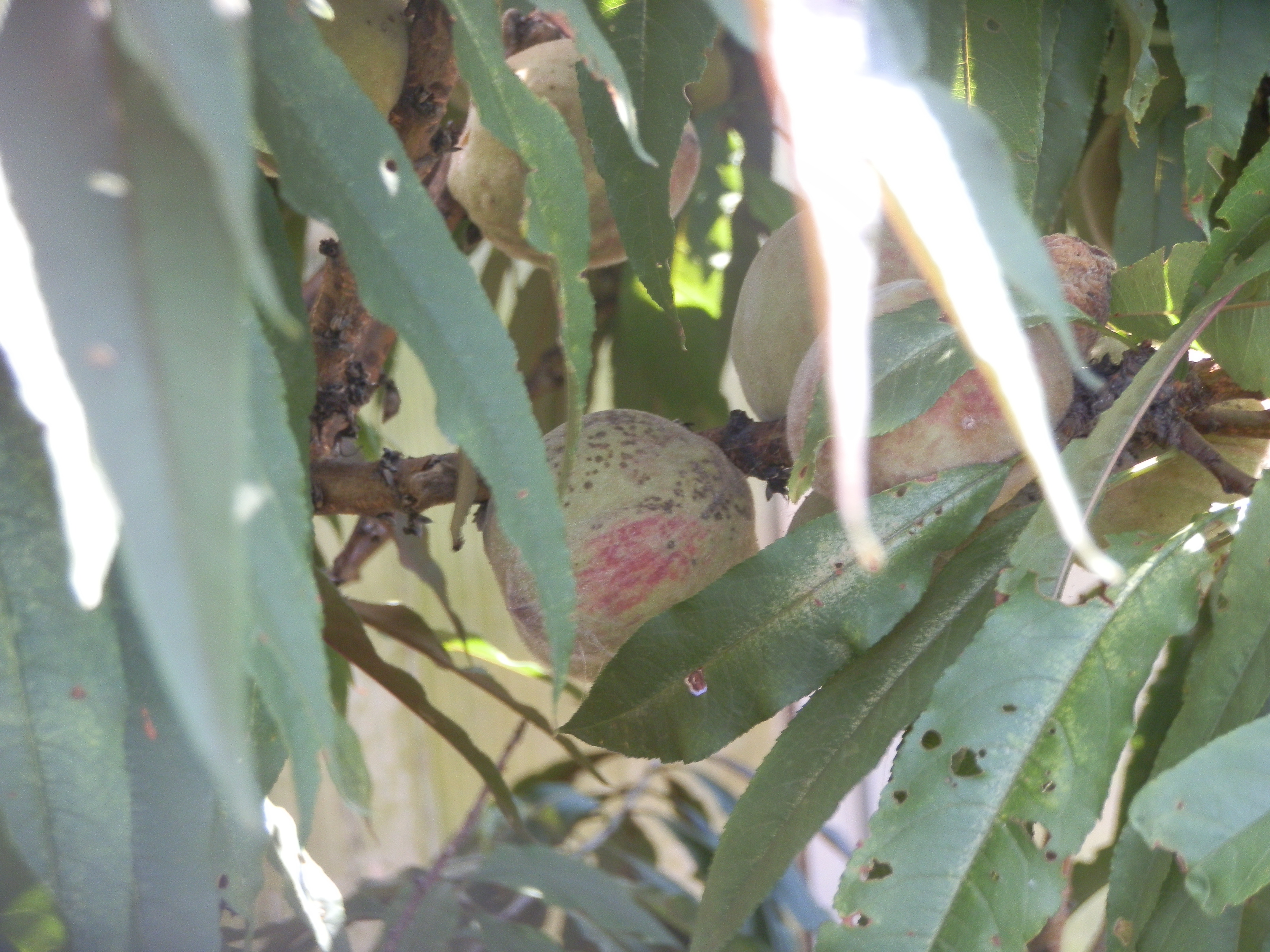
I have two dwarf ornamental peach trees that are thriving in the summer heat. Their canopy is so lush and dense they must be inspected closely to notice they are loaded with fruit. Unlike my other fruit trees, they show virtually no signs of disease and they require little pruning.
My plants are seedlings, but the cultivar they most closely resemble is Bonfire. Foliage is deep purple. Fruit quality is not very good if you like fresh peaches, but they make great peach butter and peach bread. They also make pretty good pies. You’ll have to wait a little longer than most peach varieties. These little guys don’t soften up until September.
These peaches have strong peachy taste and a rich reddish color when cooked. Flesh is rather mealy, almost the consistency of mashed potatoes. Other culinary negatives are that they are small and not freestone.
Their greatest value is not for their fruit, though wildlife might disagree. Dwarf patio peaches provide contrasting color and texture to a landscape. Long slender dark red to purple leaves on compact plants is eye-catching. Plants also have a slightly weeping growth habit.
Autumn foliage is orange and the dark speckled bark is attractive in winter. In spring, deep pink double flowers can be spectacular, and plants are self-fruitful.
These miniature trees rarely grow taller than six feet and they thrive in containers or in the ground provided soils are well drained. Planting them in containers will make them grow a little smaller. They’re also a good choice for container use because they have no thorns.
Regardless of the garden type they should be planted in areas with adequate sun, although they do tolerate substantial shade. High heat and humidity are usually not a problem. Bonfire peaches also tolerate drought well.
Most pruning should be performed when plants are dormant. Remember that peaches fruit on the previous season’s wood, so don’t remove more than half of that. Plants will be healthier if some branches are thinned. This promotes vigorous growth for the remaining ones.
Also, since fruit set can be heavy it is important to notice the angle of the branches in relation to the trunk. Wide angled branches are stronger. This is an important consideration for any tree that produces appreciable fruit.
Other varieties of patio peaches exist and many have better fresh eating qualities than the Bonfire type. Bonfire has by far the prettiest foliage in my opinion. Bonfire also is smaller and easier to train into a desirable shape.
Prioritize what’s important to you. If you want fresh fruit and aren’t as concerned about shape and foliage then Reliance, Bonanza II, Southern Flame, Southern Rose, and Garden Gold have great fresh eating qualities.

Ornamental peach seedling thriving in a very dry location

Ornamental peach seedling thriving in a very dry location

Heavy fruit set is barely visible under dense canopy

Heavy fruit set is barely visible under dense canopy

Ted Manzer teaches agriculture at Northeastern High School.

Posted in foraging | Tagged , , , , , , , , , , , , | Leave a comment

That gold stuff is not Silly String – It’s Dodder


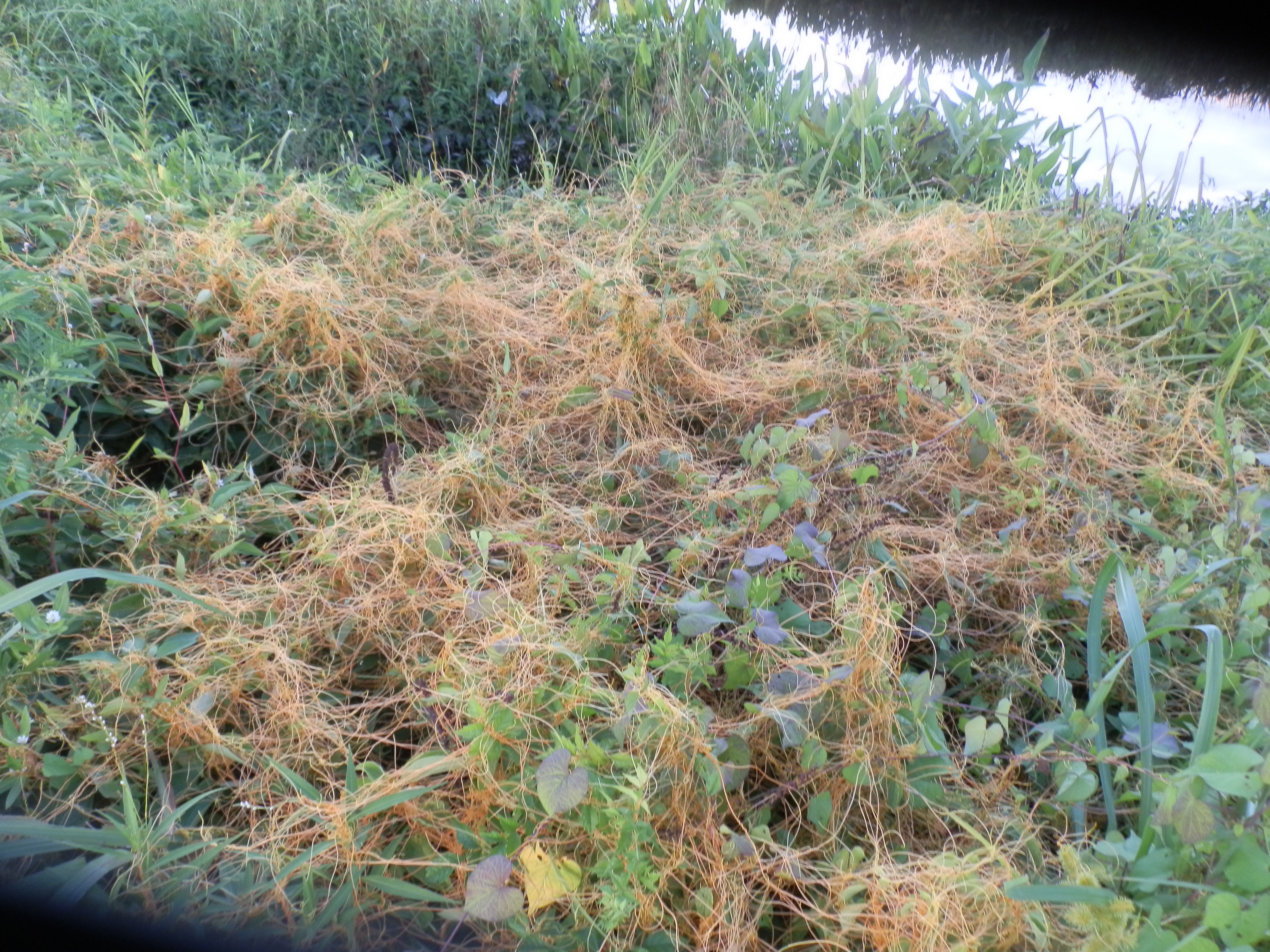
I once overheard somebody complain that some kids killed her tomatoes with silly string. It was none of my business so I didn’t butt in, but I knew that wasn’t the problem. Driving toward the beach recently I spotted several dense patches of the culprit that destroyed her tomatoes and it wasn’t any prank from a spray can.
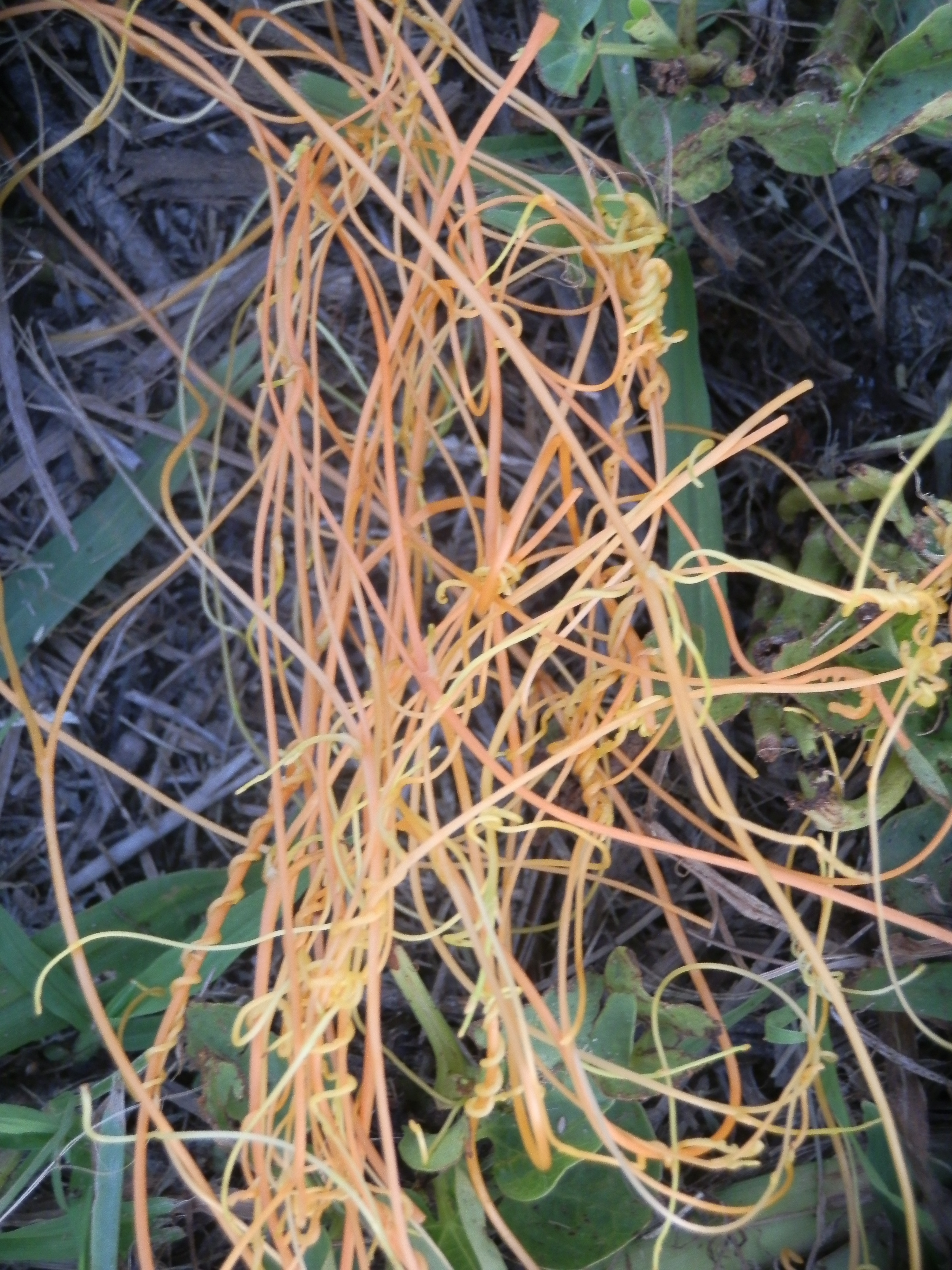
Dodder (Cuscuta sp.)is a parasitic plant like mistletoe. It attaches itself to its host by modified roots called haustoria. Once connected, dodder extracts whatever nutrients it needs from its victim. Unlike mistletoe, dodder plants contain no chlorophyll and have nothing but tiny scales for leaves. Dodder must sponge nutrients and all its energy from host plants.
Most dodder is bright yellow to orange and can form dense patches. Not every plant is susceptible, however. Grasses including corn are immune as are most cool-season plants and vegetables. Dodder is rarely seen before soil temperatures are warm.
Tomatoes, potatoes, peppers, eggplant, melons, beets and carrots are prime targets. English ivy, mums, impatiens and petunias are vulnerable ornamentals. I’ve seen it on azalea too. In waste places I see it mostly on lambsquarter and redroot pigweed.
Sometimes dodder has been called vampire weed for the way it sucks the energy from its host. According to legend, garlic will repel vampires, but dodder is a tougher adversary. Garlic and onions are very dodder susceptible.
Dodder plants are usually hard to find when they haven’t attached to another plant. They spread by seed and seedlings can only live briefly without a host plant. That doesn’t sound very imposing. However, those seeds can remain dormant but viable for 50 years. Individual plants also can produce several thousand seeds.
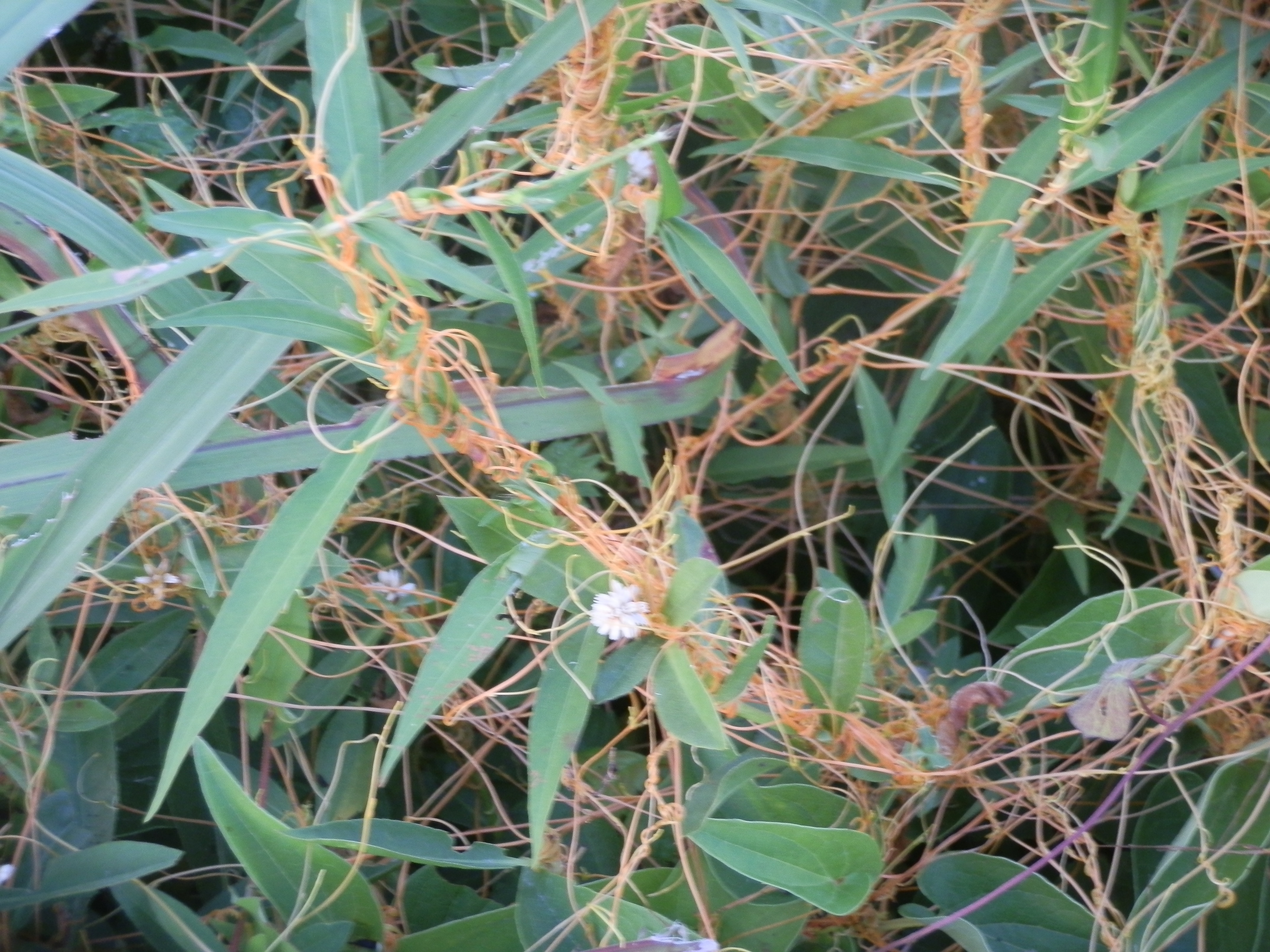
I must admit that I have always been somewhat fascinated by it. Flowers are small, white and often barely noticeable. They look a little like tiny lily of the valley flowers. Fruits look like peas without the pods. When dodder grows it constantly reattaches itself to the host plant or surrounding ones creating a strangling mass of gold string.
As you might suspect, dodder can be difficult to control. It’s a good thing this unusual plant is not super common. Young crop seedlings are least able to overcome the parasite. Weakened plants are also more prone to diseases and insect damage. Furthermore, most chemicals that might kill dodder would also kill host plants.
Generally speaking, the best way to control dodder chemically is through the use of pre-emergent herbicides. They keep dodder seeds from germinating. They also keep crop seeds from germinating, but if crops are already growing that technique could work.
On small areas, continued hand removal helps, but debris should be destroyed. Catching it early before flowering is critical. Finding nearby infested areas and attacking it there can also be helpful.
I have never tried it, but unless dodder is parasitizing poisonous plants it’s edible. I suppose it could be boiled and used as a pasta substitute. I’m not interested. Numerous sources report its use medicinally to treat various internal ailments, but dodder is not a major player in herbal medicine.

A healthy stand of dodder along a ditch

A healthy stand of dodder along a ditch

A closer view - the color is quite pretty

A closer view – the color is quite pretty

Another close-up of the strangling little devil

Another close-up of the strangling little devil

Which is worse, the dodder or the alligator weed it's attacking?

Which is worse, the dodder or the alligator weed it’s attacking?

Ted Manzer teaches agriculture at Northeastern High School.
Posted in foraging | Tagged , , , , , , , , , , , , | Leave a comment

School’s out but learning must not stop


It’s now mid June and the kids are out of school, but that doesn’t mean we stop pushing them. Whether they’re your children or grandchildren, spend some time with them and put them in situations where they have to think. Stimulate their minds.
I’ve taught many teenagers in my teaching career and I’ve noticed a deficiency that seems to be getting worse. Kids don’t think unless they have to. They’re conditioned to regurgitate information, not process it and draw conclusions. We must change that.
I think every child should be homeschooled. Before my colleagues or anyone else jumps stiff legged at my seemingly flippant comment, let me explain. I’m a strong supporter of our public schools, but we all need to supplement what kids get in school. It shouldn’t conclude when the school day or year ends.
Take your children and grandchildren out for a walk. Point things out to them and ask them to describe what they see. Ask open ended questions, ones that can’t be answered by a yes or no. Kids need to learn how to think. It’s not enough to get the right answer. We must strive to learn why.
For example, have you ever noticed that you rarely find little pine trees in a stand of larger ones? You often find plenty of different types of trees though. Certainly there are plenty of pine seeds available. Something is keeping those seeds from growing.
What conditions do plants need to grow? Are all plants the same? Most people never think about things like that, but we know that some plants require more light than others.
Pines are intolerant trees. They can’t develop under dense shade. If we selectively harvest an area we will eventually rid it of intolerant species. That’s why clear cuts are necessary sometimes. Kids have been conditioned to think clearcutting of trees is a bad thing. Sometimes it is or at least if improperly done, but it’s an important forest management tool.
What happens if sediments from a construction site or a field enter our waterways? What domino effect is set in motion by decreasing light levels in some types of lakes, rivers, or streams? What happens if the stream dynamics change such as a gravel bottom becoming a mud bottom? What are the life requirements of the aquatic residents of these places, especially those that can’t move somewhere else like plants and filter feeders? We need to encourage kids to problem solve for themselves.
Nature provides so many situations for thought and analysis. Changing environments and land management can favor one species over another. There are endless questions to be asked and they all can’t be answered by A, B, C, or D in some type of memorized response.
I know I’m prone to come up with biological examples, but there are plenty of questions to be pondered. Spend time with our kids. Try to encourage them to notice what’s around them and use their brains. Everyone can be a teacher in some capacity.
Homeschooling is critical for the success of our young people. Unlike some folks, I view it as a necessary supplement not the total package. Kids gain valuable social skills simply by having to interact with others and work in team situations. Whatever your educational preferences are for your loved ones, please don’t let their education take a hiatus during the summer.

Ted Manzer teaches agriculture at Northeastern High School.
Posted in Uncategorized | Tagged , , , , , , , | 1 Comment

Yellow nutsedge is a noxious weed but it has real potential


Yellow nutsedge is one of the most despised weeds of our flower and vegetable gardens. Eradicating it from your property is almost impossible. Pull it all out and more plants show up within days.
Most people refer to it as a grass, but its stems are triangular in cross-section, which makes it a sedge. It appears in mid-spring and lasts until fall. Plants can grow up to three feet tall if left alone. Nutsedge is extremely tolerant of prolonged wetness, so it survives where other plants won’t.
Seed heads emerge in summer. Light tan to golden brown seed heads are surrounded by a ring of leaf-like structures called bracts. Seeds can spread to form new plants, but that’s not what makes this plant so prolific.
A series of underground stems called rhizomes intermingle with the roots. At the end of each rhizome is a tuber, often called a nutlet. A tuber is a swollen stem for food storage and reproduction. Potatoes reproduce by tubers. A single nutsedge plant may produce several thousand tubers per year. They are a little larger than garden peas.
These nutlike structures remain underground when plants are pulled from the garden. New plants spring up shortly afterwards. Individual tubers contain many buds and can sprout several times before exhausting their energy.
This grass-like weed is common in almost every state as well as many of the Canadian provinces and much of Mexico. Nutsedge isn’t controlled well by most herbicides. Often when plants are sprayed, the nutlets fall off and aren’t affected by the chemical. That’s one reason they are difficult to control. Consequently, numerous chemicals have been developed specifically to control this weed. It’s tough and vilified.
Thirty-six years ago I studied this species in my plant taxonomy class. I remember its scientific name was Cyperus esculentus. In Latin, esculentus means edible, but few farmers or gardeners ever consider eating it.
The tubers are quite good. When dried and roasted they have a somewhat sweet flavor, almost like hazelnuts. I’ve even heard them referred to as earth almonds. Native Americans used nutsedge as food and medicine. They consumed the seeds as well as tubers.
Those familiar with chufa might recognize the flavor. It’s a common food in much of Africa among other places and has been for centuries. According to records, Egyptians consumed it over 4000 years ago.
Tubers are high in Omega-3 fatty acids and make high quality oil similar to olive oil. Chufa and nutsedge are variants of the same species. The only difference is that chufa is less winter hardy. Chufa tubers are also a little larger.
If you want to collect some nutsedge tubers to try, you’ll have no trouble finding some. Obviously, collect from an area not treated with herbicides. Also, remember that they are small. You’ll have to gather a bunch. If ridding the area of them is your goal, you still won’t get them all. Additionally, cleaning them up in all but the sandiest soils can be quite a pain.

young nutsedge plants dominating the weed scene

young nutsedge plants dominating the weed scene

nutsedge plants showing triangular stems and beginning to set tubers

nutsedge plants showing triangular stems and beginning to set tubers

Ted Manzer teaches agriculture at Northeastern High School.

Posted in foraging | Tagged , , , , , , , | 3 Comments

Catalpas are interesting native trees with many uses.


The catalpas are blooming in my neighborhood. They’re those big leaved trees with the clusters of white orchid-like flowers. In fall they sport long cigar-like pods which sometimes grow two feet long. Some people even call them cigar trees.
The showy pods are green for most of the year before turning brown in the fall. Many often persist for much of the winter before dropping their seeds in spring.
Trees have large triangular to heart-shaped leaves that emerge from stems in groups of two or three. Light green foliage is late to develop in spring. Catalpas are among the first to lose their leaves in fall and their color is an unspectacular dull yellow.
Catalpas are a useful ornamental tree because they can grow on many types of soil. They tolerate both acid and alkaline soils as well as a wide moisture range. Trees grow into a narrow upright shape but they provide dense shade. Flowers don’t last more than a few weeks but they can be spectacular.
Two species of these unique trees are common. The larger of the two is the northern catalpa. Southern catalpa is a little smaller. To untrained eyes the two are indistinguishable. The funny thing is that both species can be found all over much of the country and both grow equally well in the north and south.
The original range of southern catalpa included only parts of Georgia, Alabama, Mississippi, and Florida. Northern Catalpa had a much larger native range. Both are fast growing trees that rarely live more than 70 years. Wood is light and resistant to decay, making it ideal for in ground uses such as fence posts. It also rarely splits when nails or staples are driven into it.
Both species are durable as landscape trees but like the sycamore they are very dirty. Flower, leaf and fruit litter removal can be a regular chore. Roots are quite extensive too, so trees should not be planted close to foundations or septic fields. These roots do hold soil well in highly erodible areas.
Catalpas have potential for use as urban shade trees. They tolerate pollution well and in a sheltered environment wind damage is minimal. They also tolerate heat well.
Years ago herbalists used many parts of these trees medicinally. Very little recent information is available now other than leaf and bark teas can be used as a diuretic. Several sources report root extracts are poisonous.
I like catalpas because they are so unique and easy to grow. They require little pruning and can stir conversation especially their long seed pods. Overuse might be a problem in hurricane prone areas like ours, but they aren’t nearly as susceptible to damage as the ornamental pears. Rarely are whole trees or even entire branches destroyed, but litter from storms can be significant.
One specimen tree in the yard is a nice change of pace. However, these trees are in the same family as the trumpet vine and like that noxious weed they can invade adjacent areas.

Ted Manzer teaches agriculture at Northeastern High School.
Posted in foraging | Tagged , , , , , , , , , | Leave a comment

Let’s show tolerance for the peaceful black rat snake


Everyone has heard the saying that the only good snake is a dead snake. I understand people’s fears of reptiles in general and snakes in particular, but this one is rarely a problem. Black rat snakes have far more upside than downside.
These graceful reptiles are usually shy and avoid confrontation. If something threatens them, they tend to freeze and remain motionless. This never seems to be good enough for some people.
Some adult snakes attempt to protect themselves by coiling their body and vibrating their tails in dead leaves to simulate a rattle. When snakes continue to be provoked they will strike, but the black rat snake shows great restraint. The expression ‘mean as a snake’ does not apply to this species. Still, getting bitten is painful and bites can get infected.
People who harass these snakes might notice that they have a defense similar to the skunk. When in serious danger, like being attacked by a dangerous predator, the snake will release a foul smelling musk-like odor. The smell is supposed to imitate what a poison-like smell would taste like. Unfortunately for the snake it usually isn’t effective on humans who are intent on killing them.
Black rat snakes are excellent climbers. That might be one reason they startle so many people. Either in a tree or in the rafters inside a barn or garage, these reptiles feel comfortable up off the ground. I can see why coming eye to eye with one of these big guys could be intimidating, but they’re just doing their job keeping rodent populations in check.
Commonly just called black snakes, these are the largest snakes in North Carolina. They occasionally attain lengths of almost nine feet. I’ve found that once they get about six feet or so they tend to increase in girth quite dramatically, so a seven footer might be almost twice as heavy as a five and a half foot long specimen.
Black snakes kill by constriction. Once they catch their prey, they wrap their body around it and squeeze until the animal suffocates. Their favorite foods are mice and other small rodents. They also eat birds, eggs, lizards, frogs, other snakes and bats. Most snakes hibernate in the winter and sometimes appear to be dead if it’s very cold.
Some people think that if black snakes are abundant, then venomous snakes won’t be. I wish I could say this was true but it’s not.
Black snakes can live comfortably with copperheads or rattlesnakes. They don’t cross with them, however, as some people say. Baby black snakes somewhat resemble copperheads but this is entirely coincidental.
I enjoy seeing a big black snake sunning itself on a flat rock or patch of dry sand. Still, I’d rather he’d not take up residence in my bedroom. I’d also like to see him stay out of the chicken coop and leave my skink lizards alone. When I see them in places they are not welcome I do my best to remove them peacefully. They are a valuable cog in the ecosystem.

Ted Manzer teaches agriculture at Northeastern High School.
Posted in Uncategorized | Tagged , , , , , , , | Leave a comment

Once you spot spurweed it’s usually too late to stop it


It’s now the season to take barefoot walks in the yard. In many cases that can be painful due to a tiny lawn pest called spurweed. It has a lacy almost fernlike appearance and it is often less than an inch tall. However, there can be a lot of ouch in that inch.
Spurweed begins its growth in late winter. It can develop a rather strong foothold in warm-season turf like Bermuda grass, St. Augustine and centipede grass. These grasses are brown and dormant in cold weather, so the spurweed has little competition. In cool season turf like fescue or ryegrass it usually has more trouble competing for light, so it’s often a smaller problem.
When young, spurweed has delicate leaves and stems. They are deeply divided, hairy, soft and emerge from stems in pairs. The real problem comes when this plant sets fruit. These tiny cone-like fruits are barbed and spiny, and the nasty little structures provide seed for next year’s crop.
At this point spurweed control will have to wait until the coming fall when new plants emerge. Once seeds mature, killing the plants has no lasting effect. Once warm weather hits for good they will die anyway, but the little burrs will still be there.
We are reaching the critical time. Some spurweed has matured already, but we can still weaken next year’s problems if we act quickly. There are a few natural products available which will kill spurweed in actively growing perennial turf, but they will injure the grass temporarily.
These products work by destroying the plant’s ability to retain water. They dissolve the waxy protective leaf coating, so they kill what they hit. Perennial grasses will send out new shoots and recover quickly. The spurweed and any annual weeds will die. The nice thing about these chemicals is that they have very low toxicity to animals.
More traditional broad leaf herbicides like 2,4-D, dicamba or MCPP can cause longer term turf damage, especially to sensitive grasses like St. Augustine or centipede. These chemicals should have been applied earlier in the season when the turf was dormant. Always apply chemicals on calm days to prevent hitting non-target areas. Also, most herbicides work better on warm days, so keep that in mind too.
In fall you can attack this weed with pre-emergent chemicals. They work by preventing seeds from germinating. When used properly they do no damage to established turf. Many of these are applied in granular form, so there is less risk of herbicide drift to nearby places.
You can also use triazine herbicides like atrazine in the fall on warm-season turf. However, these chemicals will kill cool-season grasses. Non-selective chemicals like Round-up will kill spurweed, but they will also kill actively growing turf be it warm or cool-season.
Once you’re rid of this pest, the best defense is a healthy thick lawn. To achieve this, don’t mow too close, use a sharp mower and mow often. Never remove more than a third of the canopy at one time.

Ted Manzer teaches agriculture at Northeastern High School.

Posted in foraging | Tagged , , , , , , | 2 Comments

Fig buttercups are another beautiful but invasive p


Last week I discussed plants that can be loved by some and hated by others. I never mentioned fig buttercup, also known as the lesser celandine or pilewort. It is a low growing perennial that makes its growth in the late winter and spring. It’s not really plentiful around here, but I expect that to change. I know of several places where they’ve become established.
Fig buttercups have bright yellow flowers with 8 to 12 petals that rise above shiny succulent heart-shaped leaves. The foliage reminds me of cyclamen leaves or shiny violets. Plants have thick tubers very similar to Florida betony, another invasive cool-season menace.
This aggressive exotic was first introduced from Europe as an ornamental and many cultivars can be found at various nurseries and garden centers. People who want a low growing plant with early season color adapted to wet sandy areas might love it. Plant conservation groups have nothing good to say.
The problem is lesser celandines don’t stay where they are planted. They spread to adjacent places and crowd out many native wildflowers. They form such a dense mat of foliage and emerge so early that native vegetation is choked out. Fig buttercup is especially hard on ephemeral wildflowers. These are plants that make their growth and flower before leaves emerge on most trees.
Once fig buttercup flowers, above ground parts soon disappear. This prompts many to question its harm to existing plants. Other species emerge to fill the space in flower gardens and adjacent areas. Unfortunately, early spring growing species don’t. They gradually die away. Marsh marigolds, Trilliums, trout lilies and Virginia bluebells are just a few victims of the fig buttercup.
Fig buttercup is often confused with a native plant, the marsh marigold. Marsh marigolds are taller and tend to grow in clumps while fig buttercups form continuous mats. The biggest problem is that fig buttercups are especially detrimental to marsh marigold populations. Some people even kill marsh marigolds thinking they are fig buttercups.
Like many other members of the buttercup family, this species contains chemicals toxic to most mammals. Some people eat newly emerged leaves raw with no ill effects. Supposedly, they are high in vitamin C. I’m not that brave.
I’d be willing to try young leaves cooked. Heat renders the toxins harmless, but it also destroys vitamin C. I’d never eat mature leaves but they’d be so full of bitter tannins that I’d never eat enough to make me sick.
Fig buttercup tubers can be cooked and eaten like potatoes. I must admit I’ve never partaken any. I’ve always been leery of any plants from the buttercup family.
These weeds are difficult to control. Pulling up the plants still leaves most of the tubers underground and they emerge the following spring. Some herbicides are effective, but tubers separate from plants easily. If connectivity is broken, the chemical won’t kill below ground parts and they will continue to be a problem the following spring. It might take several years to totally eradicate them.

Ted Manzer teaches agriculture at Northeastern High School.

Posted in foraging | Tagged , , , , , , , , , , | 1 Comment