Angel trumpets love the summer heat


We’ve had some beastly hot weather recently, and many landscape plants are suffering. One that isn’t is angel trumpet (Brugmansia sp.), a member of the potato family.

Angel trumpet plants grow to the size of a large shrub, but in our climate, they die to the

ground each year. Still, once they begin growing in spring it doesn’t take them long to achieve heights of ten feet or more. In warmer climates, angel trumpets don’t die to the ground and can grow to be 30 feet tall.

These dramatic plants are often used as specimen plants as they can attract everyone’s attention with their large and copious flowers. Flowers are as big as a football, and hummingbirds and butterflies love them.

The leaves are large as well. I’ve got a couple pale peach colored specimens at school that stop traffic when they are in full bloom. Every year people ask me what they are. Blossoms are short-lived, and sometimes plants can be covered with blooms one week and then not flower again for a month.

Angel trumpets grow best in full sun, but they also tolerate partial shade. Increasing the shade will reduce blooming and the overall size of the plants.

The fragrant flowers might tempt you to taste them, as flowers of many plants are edible. Don’t even consider it for this one. Angel trumpet is deadly poisonous when ingested.

I’ve read where some people even have reactions to touching the plant, but I have never run into anyone with that affliction. Still, I don’t recommend them in areas where pets might eat them.

If that isn’t a problem, these plants are easy to grow. They tolerate a wide variety of soils, but they perform best in rich moist soils with high organic matter. Heavy mulching is often helpful, especially if winters are harsh.

Plants also respond well to fertilizer. I prefer to use slow-release types as fertilizer burn will rarely occur. I’ve found that fertilizers with a roughly equal ratio of nitrogen phosphorus and potassium seem to work best.

Propagation is simple too. Plants readily root from stem cuttings any time of the year. I usually take cuttings in the fall right before the first hard frost. I clip stems about 12-18 inches long or when they contain about four leaf buds. Rooting hormone is rarely necessary.

In the fall, the whole stem will die in our climate. However, it is very important that plants are not pruned to the ground until they are completely dormant, and all possibilities of Indian summer are gone. If plants begin growing in the fall after pruning, they’re likely to experience winterkill.

Don’t be alarmed if plants are slow to emerge the following spring. They are among the last to show themselves, but like lantana, once they do, they grow like gangbusters. The only major problems they face early in the season are from slugs and snails.

Angel trumpets are dramatic plants. However, they are large and will dominate the space. They also are poisonous to people and pets who try to eat them.

Angel trumpet plant in rapid growth

Ted Manzer teaches agriculture at Northeastern High School.

Posted in Uncategorized | Tagged , , , , , , , , , | 3 Comments

Elephant ears make an interesting addition to your garden bed


Elephant ears (Colocasia sp.) are that plant with the huge heart-shaped leaves that look like they belong in a tropical rainforest. That’s probably because they do. They are native to Southeast Asia.

These peace lily and caladium relatives are one of those plants that can be perennial, but usually, it takes some ingenuity to get them to return year after year. Leaves of some types can be over two feet across and three feet long, so they can be quite dramatic.

Most species of that Arum family are tropical, but there are exceptions. Growing up in Maine, I regularly encountered a plant called skunk cabbage. It is an elephant ear relative that is very winter hardy.

Just as there is variation about the hardiness of all Arum family plants, there are considerable differences concerning specific types of elephant ears. Some may be left in the ground with no additional protective mulch and come back year after year.

Dwarf elephant ears are usually less winter hardy than the giant types. These should either be treated as annuals or dug up and stored until spring.

Some people like to plant elephant ears in large pots and bring them inside for the winter. They grow well in a sunny window but require quite a bit of space. They are also easily mutilated by pets, so they might look a little ragged when taken outside in the spring.

If planted directly outdoors, elephant ears grow best in well-drained but moist soils and partial shade to full sun. We are in zone 8, which is at the limit of hardiness for even the giant types.

For those concerned about their plants dying over the winter, I suggest cutting the plants back after a frost and digging up the underground structures. Let the plants dry down before storing and keep them in the garage or another cool dry place for the winter. If this method is used, it is important not to replant them until all danger of frost has passed in the spring.

Most people refer to these fleshy structures as bulbs, but they are corms, much like on gladiolus. Anatomically, these corms more closely resemble the tubers of potatoes than they do bulbs.

By the way, corms of one type are edible and grown for food production throughout their natural range. This is a group of plants referred to as taro, and they are cooked before they can be consumed. People eat cooked taro leaves too.

Young common elephant ear corms may be cooked and eaten by some people, but many suffer mouth irritation as plants contain calcium oxalate. Leaves should not be consumed raw or cooked. In fact, they can be somewhat toxic to pets. Several references refer to elephant ears as being readily consumed, but I suspect many of these are confusing elephant ears with taro. They are very similar looking.

Many folks like to incorporate their landscape with that tropical look. If you are one of those people, elephant ears might be for you.

Elephant ear plant ready for transplanting

Ted Manzer teaches agriculture at Northeastern High School.
Posted in general nature | Tagged , , , , , , , , , | 6 Comments

Dill is a useful herb, but many people struggle to grow it


Everyone has eaten dill pickles, by themselves or in salads or sandwiches. Some love them and some may not, but dill (Anethum graveolens) is a spice often overlooked.

Many folks try to grow it in their herb gardens with varied success. One reason many might have problems is that dill plants don’t transplant very well. This herb has a long taproot, and plants with this type of root system usually don’t respond to being moved. It’s usually best to plant them directly from seed.

This is true for many plants, but gardeners, especially beginners like the instant effect of planting seedlings. Success is also much better for cilantro, anise and fennel when they are planted from seed. Basil and oregano transplant easily.

Plant your dill in full sun on moist well-drained soil. Wait until soil temperatures are at least 60 degrees or germination might be poor. Sow the seeds about a quarter inch deep and thin plants to 12-18 inches apart when they are a few inches tall. It’s often advantageous to make successive plantings every two to three weeks to get a constant supply of young healthy plants.

There seems to be a considerable argument as to whether dill is an annual or a perennial herb. It’s an annual, but in mild winters mother plants often return. In harsher winters plants still re-seed themselves readily. Therefore, there is always a constant supply of seedlings, but transplanting can be challenging.

Once established, dill is easy to maintain. Cutting plants back frequently will keep them from going to seed. This will also keep the herb garden looking neat. Plants will grow indoors or in partial shade but are healthier if established in full sun.

Dill is used in countless recipes. Pickles might be what people think about, but it has been one of the most commonly used herbs for centuries. Hundreds of recipes use it. It’s also a great addition to a salad, and I love it in both egg and potato salads.

Both seeds and foliage have that similar dill smell and flavor, but the seeds have a stronger taste. When plants are young, the aroma is like anise.

Nutritionally, dill is loaded with things the body needs. It’s very high in potassium and very low in sodium. It’s also high in calcium, magnesium and fiber. Vitamins A and C are in good supply as are flavonoid antioxidants.

Unlike cilantro, dill is easy to dry and doesn’t lose much of its flavor when dried. If dried and stored in a cool dry place it has a long shelf life.

Aside from culinary uses, dill is an important medicinal herb. It’s included in many holistic medicines to treat a variety of ailments, mostly digestive disorders. It also has been used to lower blood sugar.

Oil from dill plants has antimicrobial properties and is used topically to help heal wounds. It’s also a muscle relaxant and sedative. Dill oil is a mild diuretic, so potentially it could cause dehydration in large amounts. Everything considered, dill is a lot more than pickle flavoring.

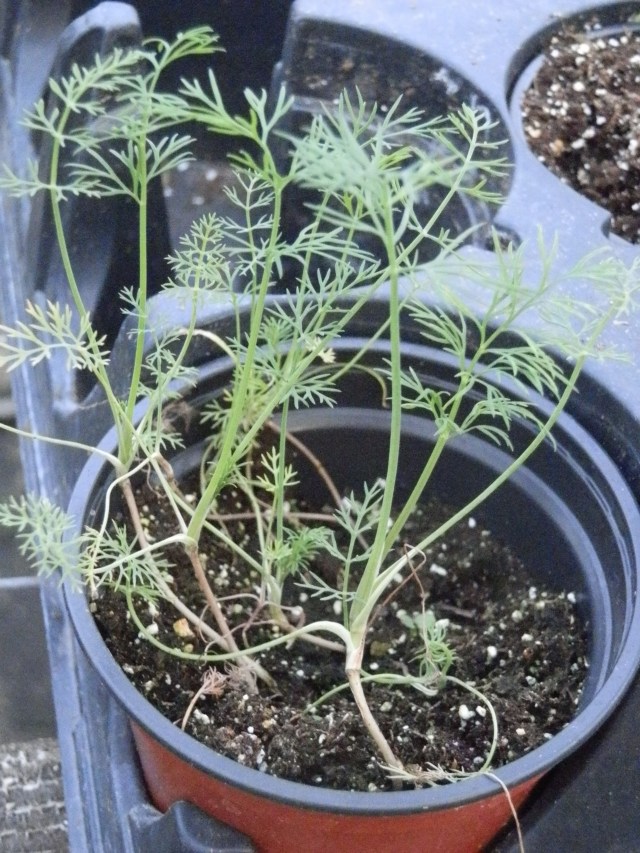
young dill seedlings ready to plant


Ted Manzer teaches agriculture at Northeastern High School.

Posted in Uncategorized | Tagged , , , , , , , , , , , | 5 Comments

Remembering a past Mother’s Day


My father passed away last June, so this is my mom’s first Mother’s Day without him. I know it will be difficult for her. They were married for nearly 64 years.

When I was a kid, Mother’s Day usually signaled the beginning of landlocked salmon and brook trout seasons in northeastern Maine. It was also prime fiddlehead time. We usually foraged enough for an army.

I remember one Mother’s Day weekend we went trolling for salmon and my mother tore them up. I was about ten-years-old. Overloaded, we ventured out onto the lake in serious choppy water. Just when we got comfortable, the spray slapped us in the face. The waves bounced us around like crazy in that little 14-foot boat, but nobody got seasick, just cold.

We had a boatful of fishermen, but she was the only one who caught any keepers. Boy, did she tie into them! I think she caught seven legal-sized fish in less than three hours, which any salmon fisherman will tell you is hitting the jackpot.

The rest of us kept changing flies to duplicate the nine-three streamer fly she was using but to no avail. It didn’t matter. She had everyone’s limit. We came back to the dock cold and wet, but I can’t remember many fishing excursions I enjoyed as much as that one. I had another reason to be satisfied. I tied the fly she caught all the fish with.

Mother’s Day morning we let Mom sleep in. She stayed back at camp and we didn’t catch a thing. Still, we had a great Mother’s Day feast. For the next few days, we ate very well. Fresh baked or grilled salmon is hard to top.

That fishing trip was extra special, because my grandfather (her father) had just bought her a new fishing rod and reel and that Mother’s Day weekend was the first time she ever fished with it.

I think it’s important for families to establish their own traditions and not rely on the status quo. For most folks, Mother’s Day is not about fishing or foraging for greens. It’s for giving that special woman a day off and maybe some flowers too. If that’s the case, we might wonder about the most appropriate flowers for this day.

Carnations are the unofficial Mother’s Day flowers. Pink and red are most traditional if she is still living. If she isn’t, we can adorn her monument with white ones or have some at home in memory of her.

The first official Mother’s Day holiday was in 1917. The second Sunday in May became the chosen date, but Mother’s Day isn’t just an American holiday. It’s celebrated in numerous countries all over the world.

My mother is 86 and will be working at her church and at the local museum on this holiday. Nothing seems to slow her down. I won’t be able to be with my mother this Sunday, but I’ll be sure to call her Sunday evening and see if she received her bouquet of red and pink carnations.

Image may contain: 2 people, including Margaret A. Manzer, people smiling, people sitting, indoor and food

This is a picture of my mom and dad not too long before my dad’s passing.

Image may contain: 3 people

Here’s one of my mom, my sister and me back in 1960 or 61.

Ted Manzer teaches agriculture at Northeastern High School.

Posted in Uncategorized | Tagged , , , , | 1 Comment

All pollen is not created equal


I took a relaxing boat ride on the Perquimans river recently and noticed copious amounts of tree pollen floating on the water. I suspect much of it was from bald cypress trees since most loblolly and longleaf pine pollen has been shed already.

Watching these yellow masses flow down the river made me think. There’s a lot of pollen that never hit the target. It also made me realize why some pollen causes more problems than others.

Pollen is the male gamete of plants, just like sperm cells are in animals. Plants can be pollinated in one of three ways. The most common way is by wind, and this is the method that causes most problems for allergy sufferers. Wind-pollinated plants produce huge amounts of pollen that must stay in the air long enough to find a suitable female gamete for reproduction.

Pine pollen and cypress for that matter are more of a cosmetic problem than they are harmful. They are not major allergy causes because the pollen grains are relatively large. Therefore, they don’t stay suspended in the air as long as pollen grains of oaks and grasses. If they aren’t airborne as long, it is less likely they’ll find their way into nasal passages.

In general, wind-pollinated plants are the worst problems for two reasons. First, they usually produce huge amounts of pollen. This pollen also stays suspended in the air. Corn is wind pollinated and if you plant your garden with just a few long rows of corn, you might be greeted with many half-full ears come harvest time.

Wind is just one mechanism pollen is spread. Some is transferred by insects and other pollinating animals. This type of pollination makes it less likely for allergy sufferers to contact the pollen.

Plants that rely on pollinators usually have pollen that is somewhat sticky. This makes it stick to an insect’s body. Remember, an insect’s goal is not to pollinate flowers. The goal is to collect nectar and maybe some pollen too. Pollinating the flowers is just an added benefit for the plant.

Sticky pollen is not likely to wind up in one’s nose. That’s one reason I always shake my head every time I hear people blaming goldenrod for fall allergies when they should be blaming ragweed. Goldenrod flowers are very visible, but their pollen is sticky. Ragweed has less visible flowers, but the pollen is easily airborne and it’s what causes most people’s problems.

A third way plants are pollinated is by self-pollination. Generally, this method is not problematic to allergy sufferers. There’s no free pollen to wind up bothering anyone.

The method is also good for people who like to save their own seeds. If pollen never leaves the flower, we can be pretty sure what the resulting offspring will be. That’s why many old-timers save their heirloom tomato and bean seeds.

There’s a lot more to pollen than that nasty yellow stuff that accumulates on your car. We listen to many misconceptions and false accusations, but pollen is necessary for life.


Ted Manzer teaches agriculture at Northeastern High School.
Posted in Uncategorized | Tagged , , , , , , , , , , , | 1 Comment

Cilantro is a versatile herb with a long history


Cilantro (Coriandrum sativum) is an annual herb used in numerous recipes from various cultures. It’s also known by different names, including coriander, Mexican parsley and Chinese parsley.

It’s been cultured for at least 5000 years. Many Egyptian tombs contain seeds of this herb. That’s likely because the seeds were considered some type of aphrodisiac.

Interestingly, when discussing its seeds, they are usually referred to as coriander. I don’t know why this is, but I think it has something to do with coriander’s Spanish translation as well as the genus name.

Cilantro’s botanical origin is generally considered to be in the Mediterranean region, but it has been grown and used in China for centuries. It was also one of the first herbs to be brought to the Americas, and it soon became part of Mexican and Central American cuisine.

This herb is one of the most widely distributed and used plants in the world. It is a component of cuisines from all over the world. All parts of the plant are edible. They are eaten both raw and cooked. Sometimes oils are extracted from the seeds.

Cilantro is unique among herbs in that the foliage and the seeds have no similar flavor. I use chopped celery or celery seed interchangeably to acquire the desired flavor, but that doesn’t work with cilantro.

Cilantro or coriander seeds have a citrusy smell and taste, while foliage has a musky smell and only a slight hint of citrus flavor. Some even consider it soapy. That’s a genetic taste trait. I’ve heard many folks claim they like coriander spice but hate cilantro.

Cilantro grows best in near neutral well-drained soils. Plants thrive in full sun, but they tolerate shade. They can even be grown in a sunny window indoors. Plants are annuals, but they self-seed, so replanting the following season is sometimes unnecessary.

Cilantro plants usually grow one to two feet tall and can be cut frequently. They tolerate summer heat but grow best in spring and fall. Blossoms attract bees and other pollinators.

Like many herbs, cilantro is prone to attack from aphids and other soft-bodied insects like thrips and spider mites. Usually washing plants off with mild dish detergent will solve the problem.

Cilantro is a generous source of antioxidant chemicals. Like many other spices, it also can help preserve food. It has anti-fungal and anti-bacterial properties.

Herbalists claim many benefits from consuming cilantro. Among them are reducing swelling and inflammation of arthritis, better bone health, improving digestion, reducing bad cholesterol and blood sugar levels and improving vision and eyestrain. I assume the latter is due to the carotenoid antioxidants.

I guess it all boils down to whether you like the taste of cilantro to determine if you use it in cooking. I consider it indispensable in salsa and guacamole. I’m also not among the folks that consider the flavor soapy.

As far as preserving cilantro, I’m not a fan. It’s fresh or nothing. Dried cilantro has only a fraction of the flavor, so I consider it a waste of time to dry it. Pureeing and freezing it is an option though.

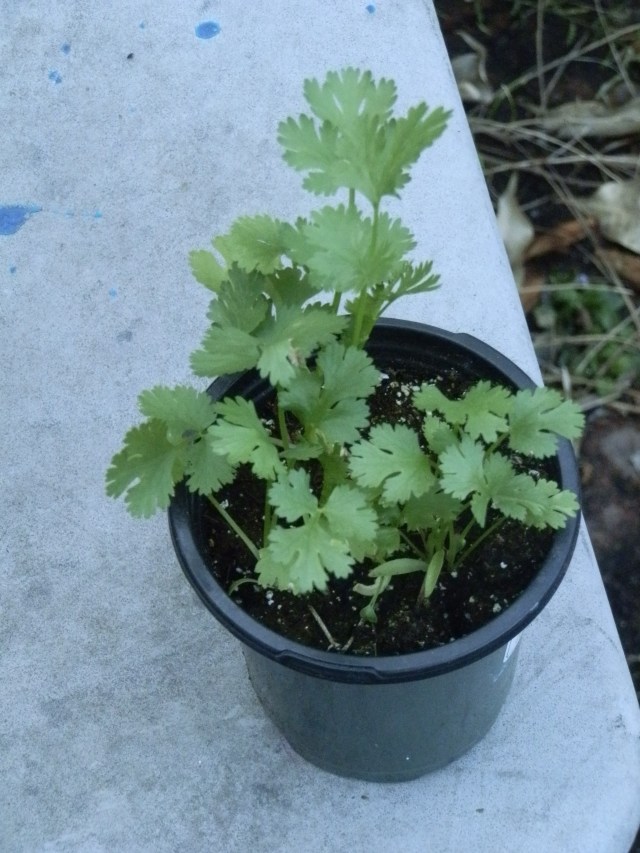
Young cilantro seedlings ready for planting

Ted Manzer teaches agriculture at Northeastern High School.
Posted in foraging | Tagged , , , , , , , , | 1 Comment

Comfrey is a plant of many misconceptions


Pick up any book on poisonous plants and comfrey will be in it. It is an old-time herb that has been used for centuries for various things. Some folks eat it. Some make tea. Some make topical medicines from it. Some feed it to livestock. Some people avoid it like the plague.

Common comfrey (Symphytum officinale) is in the borage family. It is a large perennial herb that has thick stems and usually grows two to three feet high. Plants grow quickly and have a furry texture. They can grow in shady places, but their bloom will be less than it would be in a sunnier location.

Plants have thick long taproots. This makes them quite drought tolerant. They also are well adapted to wet places. In either location, plants yield a huge amount of vegetation capable of producing loads of compost to enrich the soil at the very least.

Comfrey has a narrow carbon to nitrogen ratio. This means that it breaks down very quickly and releases its nutrient to the soil. These properties help it make other compost materials break down faster.

The dominant feature of this herb is its copious quantities of purple flowers. Bees love them. Occasionally, people will plant comfrey simply to add pollinators to fruit trees and small fruit gardens.

One problem with this herb is that once you have it you always will. It’s not overly invasive, but it’s difficult to get rid of, particularly selectively in a garden. Continued pruning can usually keep it in its place.

Years ago, comfrey was a common plant used as a food source and as a medicinal herb. In recent years all comfrey products for internal use have been banned in this country and in many others.

The reason is that plants accumulate pyrrolizidine alkaloids that are very toxic. These chemicals accumulate in the leaves, stems and roots. In general, alkaloids must be broken down by the liver, and that puts massive stress on it. These alkaloids are especially problematic.

Years ago, comfrey was used as livestock feed. Cattle, hogs and poultry all will eat it. They generally performed quite well, too. Some farmers still include comfrey in the rations of their livestock.

However, when we consider the lifespans of livestock and compare that to those of humans, we realize that liver failure and cancer are maladies that usually take years to develop. Many livestock might be in the freezer by then.

Does that mean that comfrey has no human use anymore? Many topical products have been used successfully to treat arthritis and other bone and joint problems. A few clicks on the internet can lead you to creams and herbal oils many folks swear by.

Comfrey roots and leaves contain allantoin. This helps to rejuvenate the skin and reduce inflammation. However, commercial comfrey creams warn not to treat areas of broken skin. Despite lofty claims side-effects are many.

There are many different species of comfrey. Some have more alkaloids than others. However, all species produce pyrrolizidine alkaloids. I’m not planning on consuming any comfrey internally. I like my liver.


Ted Manzer teaches agriculture at Northeastern High School.
Posted in foraging | Tagged , , , , , , , , , , , , | 3 Comments

Wild fennel is an invasive weed, but I still like it.


Actually, it’s not truly wild. It’s escaped and naturalized, and it has been for a long time. Wild fennel is like fennel found in nurseries and stores, and you can find it anywhere.

I ran into a bunch of it the other day. From a distance, I thought it was dill, but when I ventured closer, I could see it was fennel. Fennel has delicate foliage that develops a strong licorice-like aroma and flavor.

That’s one thing that makes it a safe foraging plant. Fennel resembles wild carrot and even poison and water hemlock, but the anise-like aroma is absent in the others and very prevalent in fennel.

Young leaves are edible and useful in salads and cooking. Once leaves become mature, they get tough. That doesn’t mean you can’t use them. They make a great simmering potpourri. They also can be used medicinally.

When plants grow older, they can get quite tall. I’ve seen them achieve heights of over six feet. Mature plants have copious inflorescences of bright yellow flowers. These flowers produce huge quantities of seed.

Horticulturists recommend growing fennel in sunny places on moist well-drained soil. I often find it growing in pavement cracks or on the edges of ditches. It’s an adaptable plant.

There are two types of fennel. The bulb type rarely makes its way into the wild. The type called sweet fennel (Foeniculum vulgare)

is the one I encounter. It can be used to replace its domesticated cousin in thousands of recipes, and food consumers will rarely catch on.

As popular as fennel is as a culinary herb, it might be even more popular as a medicinal one. Fennel seeds are a popular digestive aid. They are used to relieve heartburn, gas, bloating and loss of appetite. The seed oil is also used as a flavoring in some laxatives.

Fennel tea is often prescribed to detoxify the body. It is high in antioxidants. It is also high in anti-inflammatory substances. It even has been recommended to reduce blood pressure.

On the negative side, fennel can slow blood clotting, so people with bleeding issues might want to avoid it. Chemicals in fennel also interfere with estrogen found in birth control pills rendering them less effective. Fennel also interferes with the effectiveness of the antibiotic Cipro.

It’s easy to get confused and even scared by some of the things you read about the toxicity, medicinal value or edibility of plants. If any part of a plant might be a problem at any stage of growth, some book or list will report it as poisonous. It’s important to look further. Sometimes just the seeds are toxic.

Many of the plants we consume regularly are considered poisonous plants. However, there is a difference between the quantity eaten as a spice and the amount that might be needed to produce an extract for medicinal use.

It’s always best to look at many different sources and still consult your medical professional. As far as spices go, unless you’re allergic you should have no complications using fennel in seasoning quantities.

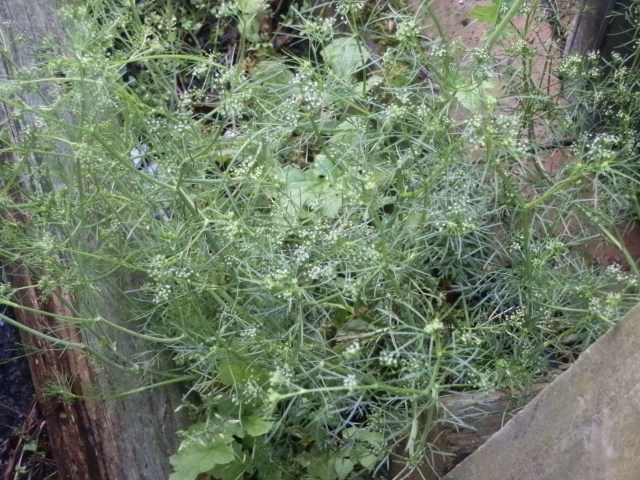
Wild Fennel growing in a drainage ditch near a greenhouse

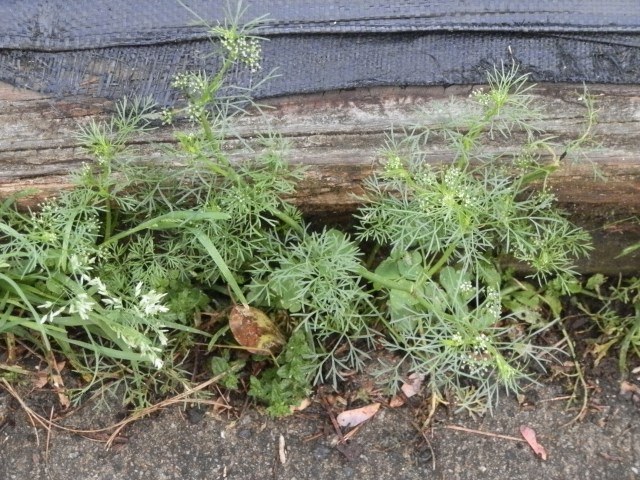
Wild Fennel growing in the cracks at the edge of the walkway

Ted Manzer teaches agriculture at Northeastern High School.
Posted in Uncategorized | Tagged , , , , , , , , | 3 Comments

Lily of the valley is a blast from my past


When I was young, my grandfather had a huge patch of these tiny fragrant white flowers all around his house. I used to pick them and place them in jars to bring some aroma inside. Nobody ever cautioned me about them. My grandmother simply filled a low vase with water for me.

These flowers are lily of the valley (Convallaria majalis). We now live in a paranoid society. Look up this plant and you’ll be inundated with how poisonous it is. I never had any desire to eat them, but they were pretty, and they smelled nice.

Cultivation of this plant goes back to biblical times. They have a huge worldwide range. Despite the name, these delicate flowers are not a lily at all, though some botanists still place them in that family. They are in the asparagus family.

Flowers are white, cuplike and slightly nodding. They have six points on them. Leaves are broad, about six inches long with parallel veins and remind me a little of wild leek. I guess that could be a problem for some, as wild leeks (ramps) are a common foraging plant and lily of the valley is poisonous to eat. All parts of the plant are poisonous if consumed orally.

These perennial flowers bloom in spring and thrive in cool weather. We can grow them in eastern North Carolina, but they must be in protected shady spots. They won’t tolerate hot sunny locations in our climate. They do well in places where they have some shade from deciduous trees in summer but have more sun during the blooming season. Early morning sun is great.

Plants thrive in moist soil. Once established they hold well in dry shady places too. They require little care, and while the blooming season is usually less than a month, their fragrance is worth it. Whenever I see or smell them, I can’t help but think of my youth.

Lily of the valley is easy to propagate. I think division is the easiest method. I usually dig up a clump and split it into sections. This method is most successful when they are dormant, but I’ve had good luck when plants are in active growth, too.

As stated, plants are poisonous, but that can be a good thing. Deer and rabbits won’t touch them. Lily of the valley also has few disease and insect pests.

These versatile perennials also can make great houseplants. Since they don’t require much light, they adapt well to the indoor environment. Indoors, they grow better if placed in an east-facing window.

These versatile perennials are often used in floral work. They make a great wedding flower, but blooming is seasonal. Still, they can be a great choice for spring weddings.

Toxins from this plant affect the heart. Therefore, one might assume herbalists have used it for heart maladies. This would be true. Irregular heartbeat, heart failure, stroke and fluid retention have been treated with this herb. I think I’d rather enjoy its fragrance and think about my grandparents.

I’ll attach a picture as soon as I can find a good one. I looked through my photo library and came up empty.


Ted Manzer teaches agriculture at Northeastern High School.
Posted in Uncategorized | Tagged , , , , , , , , , , , | 3 Comments

Mockingbirds are interesting creatures few people notice


Mockingbirds are cool. We have a few at school, and one likes to play games with me. He’ll fly beside me and stop a short distance in front of me while I talk to him. When I get within four or five feet, he flies a little further. Never does he seem intimidated.

I did some research on mockingbirds and found that behavior to be typical. Mockingbirds are smart and have great memories. Like crows, they remember if someone has been aggressive toward them. I haven’t.

A few weekends ago I was working on the greenhouses and this mockingbird shadowed me. He shifted around a little but basically stayed in my vicinity even though I was using power tools. I soon noticed he didn’t have a constant call. He’d make a robin call and a cardinal call interspersed with others I didn’t recognize.

Mockingbirds get their name from mimicking the sounds of other creatures. They copy the calls of other birds to ward off predators, but I think they imitate mostly for the fun of it. That one stayed with me for a few hours while I talked to it and ran saws and drills the whole time.

I’ve read where people have been attacked by mockingbirds, but I’ve never witnessed anything like that. I’ve had swallows divebomb me before but never mockingbirds.

For those not familiar with them, mockingbirds are small to medium sized somewhat long-legged gray birds with white patches on their wings. The underbelly is lighter colored. Their wingspan is slightly over a foot long, and their beaks are pointed and nearly black.

Mockingbirds prefer to live in an edge type habitat, where there are some open places interspersed with trees and shrubs. They like to have a few high perches to choose from. Normally, they nest only a few feet off the ground, but sometimes they make their homes much higher.

Mockingbirds are monogamous. Often you see them in pairs, and they work hard to find a mate. During the spring mating season, they are especially noisy.

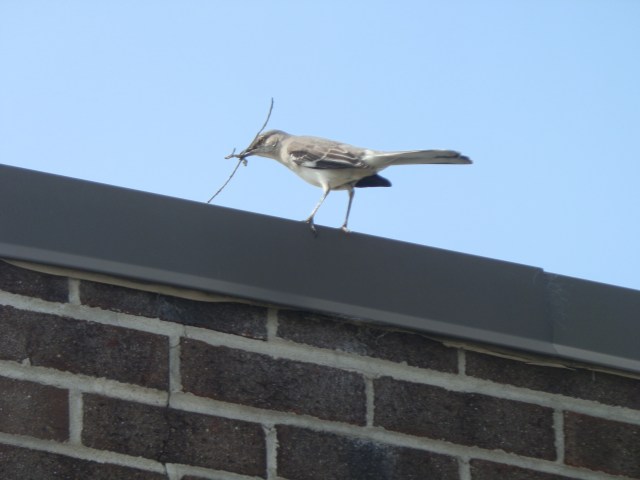
Unlike most birds, it is the male who does most of the nest building work. The outer part is constructed of twigs, but the eggs lay amidst finer delicate materials. Each nest takes a couple days to make.

These noisy birds don’t often reuse nests either. Some couples may raise several clutches each year and use a different nest each time.

Females lay three to five pale bluish-green eggs and they hatch in less than two weeks. Only females incubate eggs, but both parents feed the young for 10-12 days. The whole nest construction to fledging process takes less than four weeks. Then they start all over again.

Mockingbirds are not picky eaters. They eat insects when they are available. Beetles, wasps, ants and caterpillars are their favorite. When insects are scarce, they eat seeds and berries.

There are some mockingbirds that migrate southward for the winter and return to breed in northern climates. Around here, they’re year-round residents. Enjoy them, talk to them and they’ll talk back.

The male is busy with nest building duties.

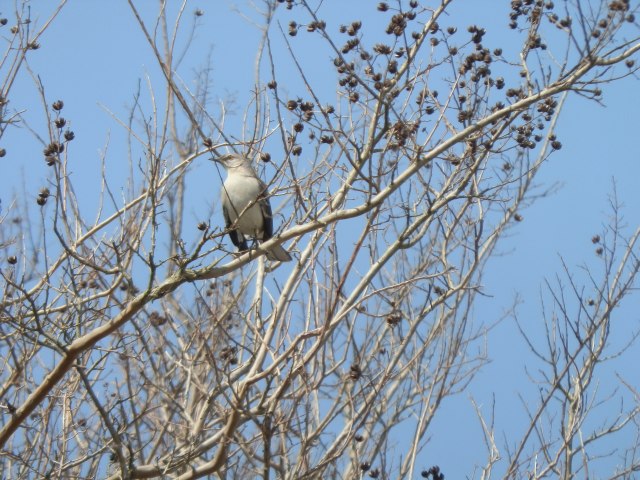
His mate waits patiently in the upper branches of a crape myrtle.

Ted Manzer teaches agriculture at Northeastern High School.

Posted in Uncategorized | Tagged , , , , , , , , | 5 Comments